

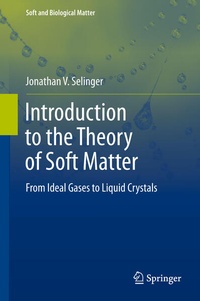
Introduction to the Theory of Soft Matter
Description

Reviews / Votes
"Selinger's book is clearly an excellent, well-written introduction to the phenomenology and concepts of soft matter physics. I enjoyed reading it and can but recommend it to students of theoretical physics with an interest in pursuing this research direction, or to those that would need a good background to the contemporary research literature . . recommended this book to my graduate students with the path to theoretical soft matter physics in mind, as the first that they should read." (Rudolf Podgornik, Liquid Crystals Today, Vol. 26 (2), April, 2017)
"Introduction to the Theory of Soft Matter: From Ideal Gases to Liquid Crystals, presents students with many of the key methods and principles of condensed-matter theory that have been valuable for understanding and engineering soft matter, with a particular focus on the theory of liquid crystals. . It will be a valuable asset for students and junior researchers who are in a growing interdisciplinary field and are looking for an approachable yet rigorous introduction to many of its cornerstone principles." (Greg Grason, Physics Today, scitation.aip.com, November, 2016)
More details
Other editions
Additional editions
Person
Jonathan Selinger is Professor of Chemical Physics and Ohio Eminent Scholar at Kent State's Liquid Crystal Institute. His research focuses on the theory of liquid crystals, nanoparticle suspensions, and related topics in soft materials and seeks to make connections between fundamental statistical mechanics and technological applications.
Selinger studied physics at Harvard University, receiving his A.B. in 1983 and Ph.D. in 1989. He then did postdoctoral research in Los Angeles, with positions at the UCLA Department of Physics and Caltech Department of Chemical Engineering. In 1992 he moved to the Naval Research Laboratory in Washington, DC, where he worked as a Research Physicist in the Center for Bio/Molecular Science and Engineering. In 2005 he came to his current position at Kent State. In addition to these research and teaching positions, he has also served as Associate Editor of Physical Review E, responsible for the liquid-crystal section of the journal.
