

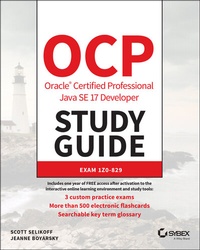
OCP Oracle Certified Professional Java SE 17 Developer Study Guide
Description

In the OCP Oracle Certified Professional Java SE 17 Developer Study Guide: Exam 1Z0-829, you'll find accessible and essential test prep material for the in-demand and practical OCP Java SE 17 Developer certification. Providing comprehensive coverage of all OCP Java SE 17 exam objectives and competencies, the Study Guide offers you access to all the skills and knowledge you'll need to succeed on the test and in the field as a new or experienced Java developer.
This book provides material on records, sealed classes, text blocks, dates, streams, controlling program flow, using the Java object-oriented approach, handling exceptions, working with arrays and collections, and more. You'll also get:
* Intuitively organized information that aligns with the competencies tested on the exam and those required by real-world Java developers
* Opportunities to practice and develop skills that remain in high demand in the IT industry
* Access to the Sybex online learning center, with chapter review questions, full-length practice exams, hundreds of electronic flashcards, and a glossary of key terms
Perfect for anyone prepping for the brand-new OCP Java SE 17 credential, OCP Oracle Certified Professional Java SE 17 Developer Study Guide: Exam 1Z0-829 is also a can't-miss reference for practicing and aspiring Java developers seeking to learn or reinforce their foundational skills in Java programming and improve their performance on the job.
More details
Other editions
Additional editions
Persons
Scott Selikoff has been a professional Java Enterprise architect for over 20 years. He currently works as a Staff Software Engineer at Google, specializing in Architecture and Cloud Services. He is a Leader of the Garden State Java User Group, helping to facilitate discussions and exchange of ideas within the community.
Jeanne Boyarsky is a Java Champion and has worked as a Java developer for a major bank for more than 20 years. She is a senior moderator at CodeRanch, and trains and mentors students of all levels, including the programming department of a FIRST robotics team.
Content
Assessment Test xlv
Chapter 1 Building Blocks 1
Chapter 2 Operators 65
Chapter 3 Making Decisions 101
Chapter 4 Core APIs 155
Chapter 5 Methods 219
Chapter 6 Class Design 275
Chapter 7 Beyond Classes 345
Chapter 8 Lambdas and Functional Interfaces 419
Chapter 9 Collections and Generics 463
Chapter 10 Streams 531
Chapter 11 Exceptions and Localization 591
Chapter 12 Modules 661
Chapter 13 Concurrency 721
Chapter 14 I/o 785
Chapter 15 Jdbc 863
Appendix Answers to the Review Questions 909
Index 963
Introduction
This book is for those looking to obtain an Oracle Certified Professional: Java SE 17 Developer or Java Foundations Certified Junior Associate title. This book is also for those looking to gain a deeper understanding and appreciation of Java. Not only do we want you to pass your exams, but we also want to help you to improve yourself and become a better professional software developer.
The book provides detailed preparation for the following Oracle certification exams:
- 1Z0-829 Exam: Java SE 17 Developer The Developer exam covers a wide variety of core topics in Java 17 including classes, interfaces, streams, collections, concurrency, and modules.
- 1Z0-811 Exam: Java Foundations The Foundations exam is a junior-level certification exam that contains a variety of introductory and basic Java 8 topics.
In this introduction, we start by covering important information about the various exams. We then move on to information about how this book is structured. Finally, we conclude with an assessment test so you can see how much studying lies ahead of you.
Understanding the Exam
At the end of the day, the exam is a list of questions. The more you know about the structure of the exam, the better you are likely to do. For example, knowing how many questions the exam contains allows you to better manage your progress and time remaining. In this section, we discuss the details of the exam, along with some history of previous certification exams.
Choosing Which Exam to Take
Java is now over 25 years old, celebrating being "born" in 1995. As with anything 25 years old, there is a good amount of history and variation between different versions of Java. Over the years, the certification exams have changed to cover different topics. The number of exams and names of certifications have also changed.
For Java 17, Oracle has simplified things. Becoming an Oracle Certified Professional now requires passing only one exam, not two, and there are no Java 17 upgrade exams. Regardless of the previous certifications you hold, everyone takes the same, single Java 17 exam to become an Oracle Certified Professional.
This means your only choice is between the Java 17 OCP exam and the Java Foundations exam. Our advice is to only take the Java Foundations exam if your employer has specifically asked you to. While it is an easier exam, it targets a very old version of Java and is not meant for professionals who work with Java every day.
Considering the Exam Objectives
Oracle provides a list of objectives to guide you on what to study for each exam. Each objective defines a list of subobjectives that provide additional details about the objective. Unfortunately, the objectives don't encompass the full amount of material needed to pass the exam.
So how do you know what to study? By reading this study guide, of course! We've spent years studying the certification exams in all of their forms and have carefully cultivated topics, material, and practice questions that we are confident can lead to successfully passing the exam. More recently, we've worked hand-in-hand with Oracle helping to create and refine the objectives and material for the Java 11 and Java 17 exams.
As a starting point, you should review the list of objectives presented in this introduction and mark down the ones that are unfamiliar to you. This list, along with the Assessment Test at the end of this introduction, will give you a rough idea of how much you are going to need to study for the exam.
Changes to the Exams
Table I.1 shows the information about the exams at the time of publishing.
TABLE I.1 Exam information
Exam Length # of Questions Passing Score 1Z0-829 Java SE 17 Developer 90 minutes 50 68% 1Z0-811 Java Foundations 150 minutes 75 65%Oracle has a tendency to fiddle with the length of the exam and the passing score once it comes out. Oracle also likes to "tweak" the exam objectives over time. It wouldn't be a surprise for Oracle to make minor changes to the exam objectives, the number of questions, or the passing score after this book goes to print.
If there are any changes to the exam after this book is published, we will post them on the book page of our blog:
Scope of Objectives
In previous certification exams, the list of exam objectives tended to include specific topics, classes, and APIs that you needed to know for the exam. For example, take a look at an objective for the OCP 8 exam (1Z0-809):
- Use BufferedReader, BufferedWriter, File, FileReader, FileWriter, FileInputStream, FileOutputStream, ObjectOutputStream, ObjectInputStream, and PrintWriter in the java.io package.
Now compare it with the equivalent objective for the OCP 17 exam (1Z0-829):
- Read and write console and file data using I/O Stream.
Notice the difference? The older version is more detailed and describes specific classes you need to understand. The newer version is a lot vaguer. It also gives the exam writers a lot more freedom to insert a new feature without having to update the list of objectives.
Choosing the Correct Answer(s)
Each exam consists entirely of multiple-choice questions. There are between four and seven possible answers. If a question has more than one answer, the question specifically states exactly how many correct answers there are. This book does not do that. We say Choose all that apply to make the questions harder. This means the questions in this book are generally harder than those on the exam. The idea is to give you more practice so you can spot the correct answer more easily on the real exam.
Reading the Exam Code
Many of the questions on each exam are code snippets rather than full classes. Saving space by not including imports and/or class definitions leaves room for lots of other code. You should only focus on import statements when the question specifically asks about them.
For example, it is common to come across classes on the exam with import statements and portions omitted, like so:
public class Zoo implements Serializable { String name; // Getters/Setters/Constructors omitted } In this case, you can assume that java.io.Serializable is imported and that methods like getName() and setName(), as well as related constructors, exist. For instance, we would expect this code to compile:
var name = new Zoo("Java Zoo").getName(); Encountering Out-of-Scope Material
When you take an exam, you may see some questions that appear to be out of scope. Don't panic! Often, these questions do not require knowing anything about the topic to answer the question. For example, after reading this book, you should be able to spot that the following does not compile, even if you've never heard of the java.util.logging.Logger class.
final Logger myLogger = Logger.getAnonymousLogger(); myLogger = Logger.getLogger(String.class.getName()); The classes and methods used in this question are not in scope for the exam, but the reason it does not compile is. In particular, you should know that you cannot reassign a variable marked final.
See? Not so scary, is it? Expect to see at least a few structures on the exam that you are not familiar with. If they aren't part of your exam preparation material, then you don't need to understand them to answer the question.
Reviewing Question Types
The following list of topics is meant to give you an idea of the types of questions and oddities that you might come across on the exam. Being aware of these categories of questions can help you get a higher score on an exam.
- Questions with Extra Information Provided Imagine the question includes a statement that
XMLParseExceptionis a checked exception. It's fine if you don't know what anXMLParseExceptionis or what XML is, for that matter. (If you are wondering, it is a format for data.) This question is a gift. You know the question is about exception handling. - Questions with Embedded Questions To answer some questions on the exam, you may have to answer two or three subquestions. For example, the question may contain two blank lines and ask you to choose the two answers that fill in each blank. In some cases, the two answer choices are not related, which means you're really answering multiple questions, not just one! These questions are among the most difficult and time-consuming on the exam because they contain multiple, often independent, questions to answer. Unfortunately, the exam does not give partial credit, so take care when answering questions like these.
- Questions with Unfamiliar APIs If you see a class or method that wasn't covered in this book, assume that it works as you would expect. Some of these APIs you might come across, such as...
