

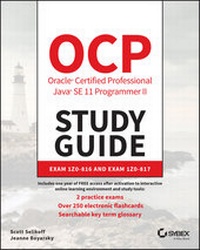
OCP Oracle Certified Professional Java SE 11 Programmer II Study Guide
Description

No matter the changes, rest assured both of the Programmer I and II Study Guides cover everything you need to prepare for and take Exam 1Z0-819. If you've purchased one of the Programmer Study Guides, purchase the other one and you'll be all set.
NOTE: The OCP Java SE 11 Programmer I Exam 1Z0-815 and Programmer II Exam 1Z0-816 have been retired (as of October 1, 2020), and Oracle has released a new Developer Exam 1Z0-819 to replace the previous exams. The Upgrade Exam 1Z0-817 remains the same.
The completely-updated preparation guide for the new OCP Oracle Certified Professional Java SE 11 Programmer II exam--covers Exam 1Z0-816
Java, a platform-independent, object-oriented programming language, is used primarily in mobile and desktop application development. It is a popular language for client-side cloud applications and the principal language used to develop Android applications. Oracle has recently updated its Java Programmer certification tracks for Oracle Certified Professional.
OCP Oracle Certified Professional Java SE 11 Programmer II Study Guide ensures that you are fully prepared for this difficult certification exam. Covering 100% of exam objectives, this in-depth study guide provides comprehensive coverage of the functional-programming knowledge necessary to succeed. Every exam topic is thoroughly and completely covered including exceptions and assertions, class design, generics and collections, threads, concurrency, IO and NIO, and more. Access to Sybex's superior online interactive learning environment and test bank--including self-assessment tests, chapter tests, bonus practice exam questions, electronic flashcards, and a searchable glossary of important terms--provides everything you need to be fully prepared on exam day. This must-have guide:
* Covers all exam objectives such as inheriting abstract classes and interfaces, advanced strings and localization, JDBC, and Object-Oriented design principles and patterns
* Explains complex material and reinforces your comprehension and retention of important topics
* Helps you master more advanced areas of functional programming
* Demonstrates practical methods for building Java solutions
OCP Oracle Certified Professional Java SE 11 Programmer II Study Guide will prove invaluable for anyone seeking achievement of this challenging exam, as well as junior- to senior-level programmers who uses Java as their primary programming language.
More details
Other editions
Additional editions
Persons
Content
Introduction
Congratulations! If you are reading this, you've likely passed the 1Z0-815 Programmer I exam, and you are now ready to start your journey through the 1Z0-816 (Java SE Programmer II) exam. Or perhaps you came here from an older version of the certification and are now taking the IZ0-817 (Upgrade OCP Java 6, 7 & 8 to Java SE 11 Developer) exam. In either case, this book will guide you on your path to becoming a Java 11 Oracle Certified Professional.
The Programmer II exam builds upon the Programmer I exam. You are expected to know all of Programmer I material when taking the second exam. Some objectives on the 1Z0-816 exam are the same as those on the 1Z0-815 exam, such as the final modifier. Most are implied. For example, the 1Z0-816 exam objectives don't mention if statements, loops, and constructors. Clearly, you still need to know these. We will also point out differences in Java 11 to help those of you new to Java 11.
If you didn't score well on the 1Z0-815 exam or if it has been a while since you took it, we recommend reviewing the book you used to study for it. You really need to know the fundamentals well. If you've misplaced your study materials, feel free to check out our 1Z0-815 book, OCP Oracle Certified Professional Java SE 11 Programmer I Study Guide: Exam 1Z0-815 (Sybex, 2019).
In the introduction, we will cover important information about the exam before moving on to information about this book. Finally, this introduction ends with an assessment test so you can see how much studying lays ahead of you.
Understanding the Exam
At the end of the day, the exam is a list of questions. The more you know about the structure of the exam, the better you are likely to do. For example, knowing how many questions the exam contains allows you to manage your progress and time remaining better. In this section, we discuss the details of the exam, along with some history of previous certification exams.
Broader Objectives
In previous certification exams, the list of exam objectives tended to include specific topics, classes, and APIs that you needed to know for the exam. For example, take a look at an objective for the 1Z0-809 (OCP 8) exam:
- Use BufferedReader, BufferedWriter, File, FileReader, FileWriter, FileInputStream, FileOutputStream, ObjectOutputStream, ObjectInputStream, and PrintWriter in the java.io package.
Now compare it with the equivalent objective for the 1Z0-816 (OCP 11) exam:
- Use I/O Streams to read and write files
Notice the difference? The older version is more detailed and describes specific classes you will need to understand. The newer version is a lot vaguer. It also gives the exam writers a lot more freedom to insert a new feature, for example, without having to update the list of objectives.
So how do you know what to study? By reading this study guide of course! We've spent years studying the certification exams, in all of their forms, and have carefully cultivated topics, material, and practice questions that we are confident can lead to successfully passing the exam.
Choosing Which Exam to Take
Java is now 25 years old, celebrating being "born" in 1995. As with anything 25 years old, there is a good amount of history and variation between different versions of Java. Over the years, the certification exams have changed to cover different topics. The names of the exams have even changed. This book covers the Java 11 exam.
Those with more recent certifications might remember that Oracle released two exams each for Java 7 and Java 8. The first exam tended to be easier, and completing it granted you the title of Oracle Certified Associate (OCA). The second exam was a lot more difficult, with much longer questions, and completing it granted you the title of Oracle Certified Professional (OCP).
Oracle did not release an exam for Java 9 or Java 10, probably because neither of these is a Long Term Support (LTS) release. With Java 11, Oracle decided to discontinue both the OCA certification and its associated exam. You still have to take two exams to earn an OCP title. The difference is that now you do not obtain a certification title from completing the first exam.
Figure I.1 shows these past and current Java certifications. This image is helpful if you run into material online that references older exams. It is also helpful if you have an older certification and are trying to determine where it fits in.
FIGURE I.1 Past and current Java certifications
Figure I.2 shows the exams you need to take in order to earn the latest Java certification if you don't have any existing Java certifications. If you haven't taken the 1Z0-815 exam yet, see our OCP Oracle Certified Professional Java SE 11 Programmer I Study Guide: Exam 1Z0-815 (Sybex, 2019).
FIGURE I.2 Latest Java certification exams
If you already hold a Java certification, you need to decide which exam you can take to earn the Java 11 OCP title. Besides the 1Z0-816 Programmer II exam, there is also a 1Z0-817 Upgrade exam. Oracle has defined a number of upgrade paths to achieve the OCP title, shown in Figure I.3.
FIGURE I.3 Exam prerequisites
In a nutshell, you can take the 1Z0-816 exam if you passed the 1Z0-815 exam or hold the OCA 7 or 8 title. Oracle's goal here is to help people get to Java 11 OCP certification if they are halfway through the journey to OCP certification.
If you hold a recent OCP 6, 7, or 8 certification title (or even the older Sun Certified Programmer 6 title), then you can take the 1Z0-817 exam to obtain the Java 11 OCP title with just one exam. Those with a Java certification older than this will have to start over and take the 1Z0-815 exam, followed by the 1Z0-816 exam.
What if you hold both OCA and OCP Java 7 or 8 certifications? Well, in that case you have a decision to make. Passing either the 1Z0-816 or 1Z0-817 exam will grant you the Java 11 OCP title. We recommend reviewing the objectives between the two exams and deciding which one you feel more comfortable with.
There are also two edge cases. Those who passed the OCA 6 exam must still take the 1Z0-815 exam. The OCA 6 exam covered far less material than the OCA 7 or 8.
Additionally, those who passed the OCP 7 or 8 exam but never received the OCP title because they didn't pass the OCA exam, need to take the 1Z0-815 exam. After that, you have a choice of the 1Z0-816 exam or the 1Z0-817 exam.
If you're not sure which exam you should take, you can post questions on CodeRanch.com, and the community will be happy to help. You might even get a response from Scott or Jeanne!
Taking the Upgrade Exam
The chapters of this book are structured for those taking the 1Z0-816 Programmer II exam. As we said earlier, though, you can easily rely on this book to prepare for the 1Z0-817 exam. If, after reading the previous section, you decide to take the 1Z0-817 exam, then you should be aware that the objectives between the two exams are not the same.
To help support those taking the 1Z0-817 exam, we include Appendix A, "The Upgrade Exam," as part of this book. This appendix includes material you would have learned when taking the 1Z0-815 Programmer I exam that you will need to know for the 1Z0-817 exam. Because of this, you should actually read this appendix first. For example, you need to first know how to create a module before you can create a module service in Chapter 6, "Modular Applications."
While we think every chapter is worth reading, here are some chapters you can skip if you are taking the 1Z0-817 exam:
- Chapter 2, "Annotations"
- Chapter 8, "I/O"
- Chapter 10, "JDBC"
- Chapter 11, "Security"
For other chapters, the 1Z0-817 exam may involve understanding the entire chapter or select portions of the chapter. We've included a mapping of all of the upgrade exam objectives and their associated chapters in the "Reviewing Exam Objectives" section of this introduction.
Changes to the Exam
At the time of this book being published, all OCP 11 certification exams contain 80 questions and have a duration of 3 hours. The 1Z0-816 exam requires a passing score of 63 percent, while the 1Z0-817 exam requires a passing score of 61 percent.
Oracle has a tendency to fiddle with the length of the exam and the passing score once it comes out. Oracle also likes to "tweak" the exam topics over time. It wouldn't be a surprise for Oracle to make minor changes to the exam objectives, the number of questions, or the passing score after this book goes to print.
If there are any changes to the exam after this book is published, we will note them on the book page of our blog.
Exam Questions
The exams consist entirely of multiple-choice questions. There are between four and seven possible answers. If a question has more than one answer, the question specifically states exactly how many correct answers there are. This book does not do that. We say "Choose all that apply" to make the questions harder. This means the questions in this book are generally harder than those on the exam. The idea is to give you...
