

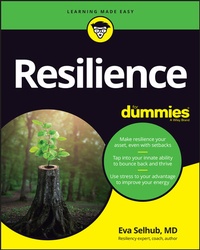
Resilience For Dummies
Description

Stress, anxiety, and exhaustion are all-too-common features of our crazy-paced, curveball-throwing contemporary existence, and it's sometimes hard to see how we can make it from one week to the next intact. But there's a solution to the struggle: resilience! In Resilience For Dummies, Dr. Eva Selhub--former Harvard Medical School instructor and director of the Benson Henry Institute for Mind Body Medicine at the Massachusetts General Hospital for six years--outlines the proven steps we can all take toward optimal resilience to build healthier, more purposeful, and increasingly joyful lives.
The six pillars of resilience are: physical vitality, emotional equilibrium, mental toughness and clarity, spiritual purpose, healthy personal relationships, and being an inspiring leader and part of a wider community or team. Dr. Selhub explains why each of these foundations is crucial to flourishing, how fortifying them gives us a base for attacking stress, hardship, and failure head-on, and how this confrontation then develops the strength we need for transformative change within our personal and professional lives.
* Know how genetics, education, and culture contribute to resilience
* Avoid learned helplessness and the victim mindset
* Harmonize stress and make it work for you
* Clear negative emotions and find your bliss
* Build up your physical, mental, and spiritual muscles
Dr. Selhub's six pillars of resilience show you how to channel your inner strength, face down whatever trouble comes your way, and come out thriving on the other side.
More details
Other editions
Additional editions
Person
Content
Chapter 1
Embarking on the Journey to Resilience
IN THIS CHAPTER
What resilience is
What resilience is not
The six pillars of resilience
Contrary to what many people think, resilience has nothing to do with avoiding stress, hardship, or failure in life. Instead, it's about knowing that life is filled with both joy and adversity and that when hardship happens, you'll be prepared to take it on, learn from it, and become stronger as a result. Resilience confers the ability to bounce back easily and thrive in the face of life's many inevitable challenges. In this chapter, I describe the factors that determine resilience, explain how it's possible to develop resilience even if your genes aren't wired that way, and set the stage for how you can embark on the journey to building your bounce back muscle and becoming stronger, wiser and feeling more fulfilled.
Resilience Is for Everyone
It's true that some people are naturally more resilient than others. These folks see challenges as opportunities, maintain a positive outlook, find meaning in the struggle, and successfully adapt to adversity. The good news is that even if it doesn't come naturally to you, you can build your bounce-back muscle. It comes down to choosing not to let adversity get you down and instead work towards using the situation to become stronger and wiser. Here are your options:
- Stay broken: Succumb to stress, fall apart, and stay that way - you're unable to recover normal functioning and feel helpless.
- Stay weak: Succumb to stress, get injured, and partially recover - you're week and your functioning is still subpar.
- Get back to baseline: Manage the stress and bounce back to baseline, whatever that may be.
- Become stronger: Reckon with the stress and grow stronger, wiser, and fitter as a result.
You can choose to feel victimized by life's hardships or choose to accept them and make the most of every situation. You'll have to make some effort to build your resilience muscle, but it's absolutely possible, especially if your choice is to thrive rather than dive.
When you're ready to choose to thrive and embark on a journey to greater resilience, this book provides you with information, tools, skills, and so much more to help you along the way.
What Determines Resilience?
At some point, most people incur some form of suffering, whether it's the death of a loved one, illness, injury, divorce, job loss, or another difficult life event. Not everyone copes with adversity in the same way, though, because it's influenced by multiple factors. Some of these factors you have no control over, like your genes, the culture you grew up in, or critical life events that may have occurred in your past. Some of these factors are within your control, such as your beliefs, behaviors, attitudes, and chosen networks of support. The question is, which of these determinants carries the most weight when it comes to resilience? Is it up to nature, or is it a result of nurture?
Though genetics does play a role, it appears that people have the ability to develop resilience despite genetics. According to a study conducted by the National Institutes of Health's National Institute of Nursing Research, led by Heather Rusch, two critically important factors associated with resilience are in your control to change:
- Self-mastery: The degree to which you perceive yourself as having control and influence over circumstance.
- Social support: The degree to which you perceive you are cared for and receiving help from other people.
The stronger these two factors, according to the research, the higher the likelihood that an individual will be resilient in the face of trauma or stress.
In the next several sections, I describe the different factors that determine resilience and see how it all works.
Your genes
Though it hasn't been established that a single gene or gene variation confers resilience, it has been found that genetic factors can influence how you respond to stress and deal with adversity. A range of genes has been identified that are associated with resilient phenotypes (how a gene expresses itself physically). Genes or variations of genes, for example, can influence the stress response, nervous system, immune system, and pathways that produce feel-good neurotransmitters like serotonin and dopamine and determine your biological response to stress. The bottom line is that science is showing that although genes play a role in determining resilience, they're only part of the story because it's now widely known that nature and nurture go hand in hand.
Your life experiences - especially early life, culture, and behaviors - influence the expression of genes and the neurobiological systems that enable adaptation to stress and resilience. Meditation, exercise, healthy nutrition, and social support are examples of lifestyle changes that can effect such neurobiological changes and, possibly, genetic expression. In short, you can influence your genes and still achieve better self-mastery and social support.
Childhood development
Early childhood experiences can positively or negatively affect the development of the stress response and how individuals subsequently learn to cope with adversity. Trauma and abuse can lead to changes in central nervous system circuits, a hyperactive stress response, more anxious behavior, and vulnerability to stress from learned helplessness, as people learn to believe that they have no control to change their circumstance or situation.
It has also been shown that when individuals realize that it's possible to change behaviors - even in the face of adversity - and feel better, learned helplessness doesn't happen. Examples might include when a child suffers bullying at school and receives a lot of love and support from family, friends, and counselors and is provided with effective coping tools. Children who gain the ability to adapt to stress develop better self-esteem, prosocial behavior, and more immunity to stress as they age.
As such, neither your genetics nor your past necessarily blocks you from being resilient. Either of these may support a tendency to adapt to stress more effectively or less effectively, but neither seals the deal on your ability to become stronger and more positive and have a better sense of self-mastery.
Culture
Individual behavior and coping styles are influenced by cultural patterns of beliefs, values, commitments, resources, and expected behaviors. Culture, therefore, can predict resilience as it shapes how people might see themselves and how they relate to others. The culture of a family can especially shape how a child develops a sense of self-concept and self-esteem. For example, a culture might value the woman's role as being quiet and docile, and subject to a man's authority, whereas another culture advocates for gender equality. Children growing up in either of these households will likely grow up to have very different self-concepts.
Culture refers not just to your ethnicity or religion but also to the culture of your family or your workplace. Cultures that promote respect, collaboration, reliance, open communication, and strong core values promote resilience within the community as well as individual resilience.
Psychological outlook
Your upbringing and environment can influence your outlook and how you see yourself and the world at large. A positive outlook has been found to be protective in the face of adversity and associated with better coping behaviors, quicker recovery times, improved health and wellbeing, and a better sense of self-mastery. The reverse is true for a negative outlook, as a negative view of oneself and the world increases the perception and magnitude of stress and reduces the sense of self-mastery and belief that challenges are manageable. A negative outlook is associated with limiting beliefs, negative self-talk, narrow thinking, and less effective coping habits.
A myriad of traits are associated with a positive outlook. Those most associated with resilience are believing that success is possible (optimism), viewing difficulties as opportunities for growth and learning, having the willingness to push forward, being able to accept change, and being open to making mistakes and learning from failures. All these traits can be cultivated with practice and also aren't purely dependent on upbringing and genetics.
Coping habits
Coping habits are habits you have developed that have helped you get through challenges or difficulties. In general, there are two types of coping habits, adaptive and maladaptive.
- Adaptive habits are the behaviors that help you cope with stress that are also healthy for the mind and body.
- Maladaptive habits are behaviors that might reduce anxiety and therefore help you cope but are themselves destructive to your health.
Confronting your fears head-on, appraising situations realistically, calming your emotions, and maintaining healthy behaviors - like good sleep hygiene and a balanced exercise-and-nutrition regimen - are examples of adaptive coping habits. Choosing to avoid dealing with fear and drinking alcohol, binge eating, or throwing yourself into work so...
