

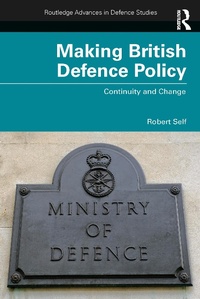
Making British Defence Policy
Continuity and Change
1st Edition
Published on 16. June 2022
302 pages
978-1-000-60017-9 (ISBN)
Description

This book explores the process by which defence policy is made in contemporary Britain and the institutions, actors and conflicting interests which interact in its inception and continuous reformulation.
Rather than dealing with the substance of defence policy, this study focuses upon the institutional actors involved in this process. This is a subject which has commanded far more interest from public, Parliament, government and the armed forces since the protracted, bloody and ultimately unsuccessful British military involvement in Iraq and Afghanistan. The work begins with a discussion of two contextual factors shaping policy. The first relates to the impact of Britain's 'special relationship' with the United States over defence and intelligence matters, while the second considers the impact of Britain's relatively disappointing economic performance upon the funding of British defence since 1945. It then goes on to explore the role and impact of all the key policy actors, from the Prime Minister, Cabinet and core executive, to the Ministry of Defence and its relations with the broader 'Whitehall village', and the Foreign Office and Treasury in particular. The work concludes by examining the increasing influence of external policy actors and forces, such as Parliament, the courts, political parties, pressure groups and public opinion.
This book will be of much interest to students of British defence policy, security studies, and contemporary military history.
Rather than dealing with the substance of defence policy, this study focuses upon the institutional actors involved in this process. This is a subject which has commanded far more interest from public, Parliament, government and the armed forces since the protracted, bloody and ultimately unsuccessful British military involvement in Iraq and Afghanistan. The work begins with a discussion of two contextual factors shaping policy. The first relates to the impact of Britain's 'special relationship' with the United States over defence and intelligence matters, while the second considers the impact of Britain's relatively disappointing economic performance upon the funding of British defence since 1945. It then goes on to explore the role and impact of all the key policy actors, from the Prime Minister, Cabinet and core executive, to the Ministry of Defence and its relations with the broader 'Whitehall village', and the Foreign Office and Treasury in particular. The work concludes by examining the increasing influence of external policy actors and forces, such as Parliament, the courts, political parties, pressure groups and public opinion.
This book will be of much interest to students of British defence policy, security studies, and contemporary military history.
Reviews / Votes
'Robert Self has produced a timely and vitally important book for anyone wanting to understand the myriad problems facing modern British defence policy makers. The outstanding research and analysis into critical linkages between economics, domestic politics and foreign policy issues in that process is unrivalled.'Greg Kennedy, Defence Academy of the United Kingdom
'Making British Defence Policy fills an important gap in the literature on how defence policy is made in contemporary Britain. It does so by moving beyond analysis of the substance of recent British defence policy, focussing instead on the often-neglected issues of how that policy is actually made, who makes it and the interaction of factors that shape it.'
Matthew Uttley, King's College London, UK
'This book is an important wake-up call. Poorly co-ordinated and opaque processes have long bedevilled British defence policymaking. These problems have occasionally been obscured by campaign successes, yet the underlying problems so forensically examined here nonetheless persist.'
Pippa Catterall, University of Westminster, UK
More details
Series
Edition
1. Auflage
Language
English
Place of publication
London
United Kingdom
Publishing group
Taylor & Francis Ltd
Target group
College/higher education
Professional and scholarly
ISBN-13
978-1-000-60017-9 (9781000600179)
Copyright in bibliographic data and cover images is held by Nielsen Book Services Limited or by the publishers or by their respective licensors: all rights reserved.
Schweitzer Classification
Other editions
Additional editions
Book
06/2022
1st Edition
Routledge
€62.00
Shipment within 10-20 days
Book
06/2022
1st Edition
Routledge
€206.80
Shipment within 10-20 days
Person
Robert Self is a specialist in interwar Britain having published several important archival studies including a biography of Neville Chamberlain and a study of the inter-Allied war debt controversy between 1917 and 1941. Since his retirement as Professor of British Politics and Contemporary History, he has turned his attention to the study of recent British foreign and defence policy.
Content
1 Making Defence Policy in Contemporary Britain
2 The diplomatic and economic context for defence policy-making
3 The Ministry of Defence in transition
4 The Prime Minister and the 'central direction of defence'
5 Cabinet government and defence policy
6 The Defence Secretary and their department
7 Departmental politics within the Whitehall village
8 The Treasury and financial control in an age of austerity
9 Civil-military relations in Britain
10 The Armed Forces, judiciary and the fear of legal encirclement
11 The influence of Parliament over defence policy
12 Political parties, pressure groups and public opinion
13 Conclusions
Bibliography
Appendix: Ministers, Permanent Under-Secretaries and Chief of Defence Staff at the Ministry of Defence since 1946
2 The diplomatic and economic context for defence policy-making
3 The Ministry of Defence in transition
4 The Prime Minister and the 'central direction of defence'
5 Cabinet government and defence policy
6 The Defence Secretary and their department
7 Departmental politics within the Whitehall village
8 The Treasury and financial control in an age of austerity
9 Civil-military relations in Britain
10 The Armed Forces, judiciary and the fear of legal encirclement
11 The influence of Parliament over defence policy
12 Political parties, pressure groups and public opinion
13 Conclusions
Bibliography
Appendix: Ministers, Permanent Under-Secretaries and Chief of Defence Staff at the Ministry of Defence since 1946
