

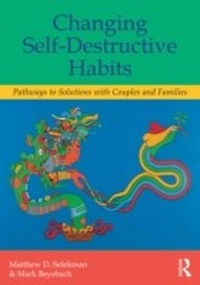
Changing Self-Destructive Habits
Pathways to Solutions with Couples and Families
1st Edition
Published on 25. September 2014
368 pages
978-1-136-73497-7 (ISBN)
Description

For the first time in one volume self-harm, substance abuse, eating-disordered behavior, gambling, and Internet and cyber sex abuse-five crippling, self-destructive behaviors-are given a common conceptual framework to help with therapeutic intervention. Matthew Selekman and Mark Beyebach, two internationally-recognized therapists, know first-hand that therapists see clients who have problems with several of these habits in varying contexts. They maintain an optimistic, positive, solution-focused approach while carefully addressing problems and risks. The difficulties of change, the risk of slips and relapses, and the ups-and-downs of therapeutic processes are widely acknowledged and addressed.
Readers will find useful, hands-on therapeutic strategies and techniques that they can use in both individual and conjoint sessions during couple, family, and one-on-one therapy. Detailed case examples provide windows to therapeutic processes and the complexities in these cases. Clinical interventions are put in a wider research context, while research is reviewed and used to extract key implications of empirical findings. This allows for a flexible and open therapeutic approach that therapists can use to integrate techniques and procedures from a variety of approaches and intervention programs.
Readers will find useful, hands-on therapeutic strategies and techniques that they can use in both individual and conjoint sessions during couple, family, and one-on-one therapy. Detailed case examples provide windows to therapeutic processes and the complexities in these cases. Clinical interventions are put in a wider research context, while research is reviewed and used to extract key implications of empirical findings. This allows for a flexible and open therapeutic approach that therapists can use to integrate techniques and procedures from a variety of approaches and intervention programs.
Reviews / Votes
"Selekman and Beyebach have brought considerable ingenuity, verve, and clinical artistry to a set of concerns that has rarely seen such approaches and for whatever reason has been denied them. Reading this book should refresh any veteran of such concerns and renew their enthusiasm for exploring their own creativity." - David Epston, co-author of Narrative Means to Therapeutic Ends and Biting the Hand that Starves You: Inspiring Resistance to Anorexia/Bulimia"If you feel stymied about how to help clients transform self-destructive habits into virtuous ones, this is just the book for you. Selekman and Beyebach demonstrate the similarities inherent in many self-destructive habits and offer an effective skeleton key for helping clients make life-altering changes. This is a must-read book!" - Michele Weiner-Davis, LCSW, Author of Divorce Busting and The Sex-Starved Marriage
"Whatever your discipline or approach, Changing Self-Destructive Habits will prove invaluable in helping your clients overcome the many compulsive behaviors endemic to this 'age of dysregulation.'" - Scott D. Miller, PhD, International Center for Clinical Excellence, www.centerforclinicalexcellence.com
"Selekman and Beyebach's wealth of clinical experience and scholarly expertise are evident throughout this useful and informative book. Numerous case examples illustrate creative psychotherapeutic methodology for transforming self-destructive habits while maintaining safety and building lasting resources." - Yvonne Dolan, Director of the Institute for Solution-Focused Therapy, Chicago and Sturgeon Bay, USA
"Selekman and Beyebach's treatment manual couples clinical experience and grounding with an enduring optimism about human capacity for change and transformation. However, what most sets this book apart from so many other treatment manuals is the paradigm of growth, opportunity, strength, collaboration, and self-transformation that infuses each and every page. It is a beacon of light and hope in an era of increasingly inventive self-harming opportunities; a must-read for clinicians and youth, family service providers, and families of self-harming youth." - Janis Whitlock, MPH, PhD, Research Scientist, Bronfenbrenner Center for Translational Research, Cornell University, New York, USA
More details
Language
English
Place of publication
London
United Kingdom
Publishing group
Taylor & Francis Ltd
Target group
Professional and scholarly
Illustrations
1 s/w Photographie bzw. Rasterbild, 8 s/w Zeichnungen
8 Line drawings, black and white; 1 Halftones, black and white
File size
5,99 MB
ISBN-13
978-1-136-73497-7 (9781136734977)
Copyright in bibliographic data and cover images is held by Nielsen Book Services Limited or by the publishers or by their respective licensors: all rights reserved.
Schweitzer Classification
Other editions
Additional editions
Matthew D. Selekman | Mark Beyebach
Changing Self-Destructive Habits
Pathways to Solutions with Couples and Families
Book
03/2013
1st Edition
Routledge
€269.90
Shipment within 15-20 days
Matthew D. Selekman | Mark Beyebach
Changing Self-Destructive Habits
Pathways to Solutions with Couples and Families
Book
03/2013
1st Edition
Routledge
€58.50
Shipment within 15-20 days
Persons
Matthew D. Selekman, MSW, is a family therapist and a licensed addictions counselor in private practice, and the co-director of Partners for Collaborative Solutions, an international family therapy training and consulting firm in Evanston, Illinois, USA. He is an approved supervisor with the American Association for Marriage and Family Therapy, and also received the Walter S. Rosenberry Award in 2006, 2000, and 1999 from the Children's Hospital in Denver, Colorado, for having made significant contributions to the fields of psychiatry and the behavioral sciences.
Mark Beyebach, PhD, is a clinical psychologist, and a licensed family therapist and family therapy supervisor in Spain. For the past 18 years, he has served as the director of the Master's Degree Program in Systemic Therapy in the Department of Psychology at the Universidad Pontificia de Salamanca, Spain. He also serves as a clinical research consultant and trainer for Partners for Collaborative Solutions in Evanston, Illinois, USA. He is currently a board member for the European Brief Therapy Association, and has been on the executive board of the Spanish Federation of Family Therapy Associations.
Mark Beyebach, PhD, is a clinical psychologist, and a licensed family therapist and family therapy supervisor in Spain. For the past 18 years, he has served as the director of the Master's Degree Program in Systemic Therapy in the Department of Psychology at the Universidad Pontificia de Salamanca, Spain. He also serves as a clinical research consultant and trainer for Partners for Collaborative Solutions in Evanston, Illinois, USA. He is currently a board member for the European Brief Therapy Association, and has been on the executive board of the Spanish Federation of Family Therapy Associations.
Content
1. Self-Destructive Habits: A Collaborative Strengths-Based Brief Family Therapy Approach 2. Key Elements for Co-Creating a Therapeutic Climate Ripe for Change 3. Major Therapeutic Experiments and Rituals 4. Self-Harming Habits 5. Eating-Distressed Habits 6. Substance-Abusing Habits 7. Problematic Gambling Habits 8. Internet and Cyber-Sex Dependency Habits 9. Working with Reluctant and Complicated Multi-Habit Dependent Clients and Couple and Family Systems 10. Couple and Family Relapse Prevention Tools and Strategies 11. Self-Destructive Habits: Future Directions with Treatment, Training, and Research
