

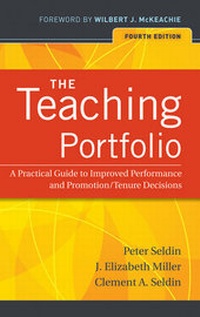
The Teaching Portfolio
Description

More details
Other editions
Additional editions
Persons
Peter Seldin is Distinguished Professor of Management Emeritus at Pace University in Pleasantville, New York. He has been a consultant on higher education issues to more than 350 colleges and universities throughout the United States and in 45 countries around the world. He was named by the World Bank as a Visiting Scholar to Indonesia, and he was elected a fellow of the College of Preceptors in London, England. For his contributions to the scholarship of teaching, he has received honorary degrees from Keystone College and Columbia College (South Carolina).
J. Elizabeth Miller is Associate Professor of Family and Child Studies at Northern Illinois?University. Previously, she was the university director of the teaching assistant and training development office, where she established and ran the training program for more than 800 teaching assistants. She is the recipient of several teaching and service awards, and her research focuses on the interplay between feminist teaching and learner-centered teaching.
Clement A. Seldin is Professor of Education at the?University of Massachusetts, Amherst. He has worked with Peter Seldin and Elizabeth Miller countless times as a mentor of faculty preparing their portfolios, a presenter at national conferences, and coauthor of books and journal articles. He has many years of portfolio experience and a?solid national reputation as practitioner.
Content
WHY A NEW EDITION?
Since 2004, when the third edition of The Teaching Portfolio was published, we have collectively visited more than one hundred colleges and universities and talked with countless faculty and administrators about the portfolio and its place in the evaluation and development of teaching. We have also had the distinct pleasure of working one-on-one as mentors to hundreds of faculty members as they prepared their personal teaching portfolios. During that period, we picked up new ideas, gained new perspectives, and refined and modified what was already known about portfolios. This new edition of The Teaching Portfolio puts many of these into print. Like the first, second, and third editions, this one keeps the focus on self-reflection and documenting teaching performance. But in this edition, considerable substance has been added: A new detailed table of contents for portfolios prepared for personnel decisions and for portfolios prepared for improvement purposes A new section of nearly one hundred prompt questions to guide the preparation of each part of the portfolio An expanded section on the key factors to consider in choosing portfolio items A new section on the important items to be sure to include in the portfolio appendix An expanded section on the specific topics of conversation needed between the professor and department chair on portfolio expectations A more detailed section on how to gain institutional acceptance of the portfolio concept An expanded section on electronic portfolios and a new section on clinical educator portfolios An expanded section on how to prepare a portfolio without a mentor A new section on how to evaluate portfolios for tenure/promotion decisions, including a field-tested form for doing so
HOW THIS BOOK IS ORGANIZED
The Teaching Portfolio, Fourth Edition has three parts. Part One presents the what, why, and how to develop teaching portfolios. It outlines an extensively tested step-by-step approach to create a portfolio, discusses how to prepare it for tenure decisions or for improvement in performance, and offers an array of field-tested suggestions for improving portfolios. Chapter One discusses the teaching portfolio concept: what it is, how it includes the scope and quality of a professor's teaching performance, how it is based on structured reflection and thoughtfully selected information on teaching activities and provides solid evidence of their effectiveness, and how it differs from other approaches to evaluate and improve teaching. It also provides a detailed table of contents. Chapter Two describes the many possibilities from which faculty members can select portfolio items relevant to their academic situation, discusses the factors to consider in choosing items, outlines the three main categories of the narrative, provides suggestions as to the length of each category, and sets out more than one hundred prompt questions to guide the preparation of each part of the portfolio. Chapter Three outlines the necessary topics of conversation between the department chair and professor on portfolio expectations and specifics of what and how teaching performance is to be reported, provides helpful guidelines for getting started with portfolios, and spells out ten field-tested ways to gain institutional acceptance of the teaching portfolio concept. It offers practical advice and takes a hard look at what works and what does not. Chapter Four examines in important detail the key sequence of steps in creating a teaching portfolio. It then discusses the need to begin the process by deciding the purpose in preparing it and the audience that will read it, outlines how to describe an approach to teaching and select portfolio items that illustrate teaching style and offer evidence of effectiveness, and offers helpful suggestions on how to present the entire portfolio in a unified container. Chapter Five examines the key role of the mentor, describes the collaborative approach to developing a polished portfolio, recognizes that sometimes no able mentors are available, and provides important self-assessment questions that can serve as a helpful checklist for those who are preparing a portfolio without a mentor's advice. Chapter Six presents a list of specific, field-tested suggestions to faculty as they prepare their portfolios (with or without a mentor). Among others, the detailed recommendations include housing the portfolio in a binder with tabs; cross-referencing the narrative to the appendix; explaining the evidence; bringing the teaching philosophy statement to life; limiting the number of student or colleague comments; and using graphs, charts, italics, and boldface to enhance reader interest. Chapter Seven discusses how to evaluate teaching portfolios for personnel decisions, what should be evaluated, and how it should be done. It discusses the key requirements of practicality, relevance, and acceptability; outlines common pitfalls in the evaluation of portfolios; provides practical advice in the form of a twenty-point general checklist of items to consider; and includes specific criteria and suggested evidence that can be used to evaluate teaching from portfolios. Chapter Eight offers pragmatic answers to questions commonly raised about developing and using teaching portfolios. It discusses how a portfolio differs from the usual end-of-year faculty report to administrators, how much time it takes to produce a portfolio, who "owns" it, why no two portfolios look alike, why models and mentors are so important, and why an elegant portfolio cannot disguise weak performance in teaching. Chapter Nine discusses electronic teaching portfolios; describes how technology allows portfolio developers to collect and organize the contents in many formats, including audio, video, graphical, and text; examines the use of hypertext links to organize the material; and outlines the strengths and weaknesses of electronic portfolios. Chapter Ten examines the clinical educator portfolio and describes how it differs from the traditional teaching portfolio. It discusses individual instruction, direct patient care, board certification, how working with adult learners affects teaching methods, and the need for clinical educators to document different types of teaching-for example, bedside, didactic, and simulation. Part Two, new to this edition, contains profiles of campus use of the teaching portfolio. It describes how four very different colleges and universities have implemented portfolios, what worked and what did not, purposes, tough decisions, and key strategies. It also includes a personal report by a university provost on what he looks for in reviewing portfolios submitted for tenure and promotion purposes. Chapters Eleven to Fourteen contain profiles of campus practice and provide detailed yet concise accounts of what four campuses are doing with teaching portfolios: Loyola University Maryland, University of Massachusetts Amherst, Elgin Community College (Illinois), and Florida Gulf Coast University. The settings and practices are diverse by design, reflecting the broad individual differences in institutions. The intent is not to present the best of current practice (though many positive examples can be seen in the profiles) but rather to demonstrate how teaching portfolio use depends on context and purpose, as well as the mission and culture of an institution. Chapter Twelve presents a personal report by the provost at Florida Gulf Coast University on what he looks for in reviewing portfolios submitted for tenure and promotion, what separates strong from weak portfolios, and the kinds of evidence that are most persuasive. It includes the practical but surprising recommendations that he, an "end user," makes to faculty who are preparing their portfolios for personnel decisions. Part Three is also new to this edition and contains the actual teaching portfolios of twenty-one faculty...
