

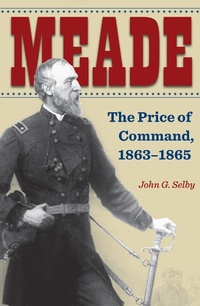
Meade
Description

George Gordon Meade has not been treated kindly by history. Victorious at Gettysburg, the biggest battle of the American Civil War, Meade was the longest-serving commander of the Army of the Potomac, leading his army through the brutal Overland Campaign and on to the surrender of Robert E. Lee and the Army of Northern Virginia at Appomattox. Serving alongside his new superior, Ulysses S. Grant, in the last year of the war, his role has been overshadowed by the popular Grant. This first full-length study of Meade's two-year tenure as commander of the Army of the Potomac brings him out of Grant's shadow and into focus as one of the top three Union generals of the war.
John G. Selby portrays a general bestride a large army he could manage well and a treacherous political environment he neither fully understood nor cared to engage. Meade's time as commander began on a high note with the victory at Gettysburg, but when he failed to fight Lee's retreating army that July and into the fall of 1863, the political knives came out. Meade spent the winter of 1863-64 struggling to retain his job while the Joint Committee on the Conduct of the War sought to have him dismissed. Meade offered to resign, but Grant told him to keep his job. Together, they managed the Overland Campaign and the initial attacks on Petersburg and Richmond in 1864.
By basing his study on the Official Records of the War of the Rebellion, original Meade letters, and the letters, diaries, journals, and reminiscences of contemporaries, Selby demonstrates that Meade was a much more active, thoughtful, and enterprising commander than has been assumed. This sensitive and reflective man accepted a position that was as political as it was military, despite knowing that the political dimensions of the job might ultimately destroy what he valued the most, his reputation.
More details
Other editions
Additional editions
Person
Content
- Cover
- Copyright
- Dedication
- Contents
- Acknowledgments
- Introduction
- One: From Cadiz to Gettysburg: Meade's Life and Career up to the Battle of Gettysburg
- Two: Gettysburg: Test of Command
- Three: The Pursuit of Lee: July 5-14, 1863
- Four: Fall Frustration: Meade and Lee Spar in Virginia, July-November 1863
- Five: Winter's Worries: Meade Fights for His Job, December 1863-April 1864
- Six: New Commander, Same Foe: The Battle of the Wilderness, May 1864
- Seven: Grant Takes Command: The Battles for Spotsylvania Court House, May 1864
- Eight: The "Hammering" Continues: From Spotsylvania to Cold Harbor
- Nine: South to Petersburg: The Army Moves South and Begins the Siege of Petersburg-Richmond
- Ten: Extending the Line: Richmond-Petersburg Operations, August 1864-March 1865
- Eleven: The Defeat of Lee and the End of the Army of the Potomac
- Twelve: A Major-General in Peacetime, 1865-1872
- Conclusion
- Notes
- Bibliography
- Index
