

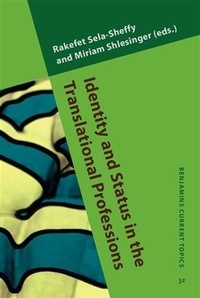
Identity and Status in the Translational Professions
1st Edition
Published on 13. October 2011
XIII, 282 pages
978-90-272-8501-0 (ISBN)
Description

This volume contributes to the emerging research on the social formation of translators and interpreters as specific occupational groups. Despite the rising academic interest in sociological perspectives in Translation Studies, relatively little research has so far been devoted to translators' social background, status struggles and sense of self. The articles assembled here zoom in on the "groups of individuals" who perform the complex translating and/or interpreting tasks, thereby creating their own space of cultural production. Cutting across varied translatorial and geographical arenas, they reflect a view of the interrelatedness between the macro-level question of professional status and micro-level aspects of practitioners' identity. Addressing central theoretical issues relating to translators' habitus and role perception, as well as methodological challenges of using qualitative and quantitative measures, this endeavor also contributes to the critical discourse on translators' agency and ethics and to questions of reformulating their social role.The contributions to this volume were originally published in Translation and Interpreting Studies 4:2 (2009) and 5:1 (2010).
More details
Other editions
Additional editions
Rakefet Sela-Sheffy | Miriam Shlesinger
Identity and Status in the Translational Professions
Book
10/2011
John Benjamins Publishing Co
€100.70
Shipment within 10-15 days
Persons
Content
- Identity and Status in the Translational Professions
- Editorial page
- Title page
- LCC data
- Table of contents
- Preface
- 1. Questions of Status and Field
- 2. Questions of Role and Identity
- References
- Introduction
- References
- Legal and translational occupations in Spain
- Introduction
- Theoretical framework
- Cultural capital and distinction
- Cultural capital, specialization, and division of labor
- Social capital and legitimation
- Legitimation through jurisdictional regulation
- Occupational struggles in the Spanish context
- Distinction and legitimation in the case of certified TIs
- Certified TIs versus court TIs
- Certified TIs versus notaries public
- Some conclusions
- References
- Effectiveness of translator certification as a signaling device
- Introduction
- Theoretical Framework
- Research Design
- Research findings
- Conclusion
- Notes
- References
- Conference interpreting
- Introduction
- Methodology
- Corpus Analysis
- Surveys on Role
- Conclusion
- Note
- References
- Occupation or profession
- Introduction
- The Survey Methodology
- Results
- University theory and training
- Conclusion
- Notes
- References
- Attitudes to role, status and professional identity in interpreters and translators with Chinese in Shanghai and Taipei
- Introduction
- Hypotheses
- Methods
- Results
- Summary and Conclusion
- Acknowledgments
- Notes
- References
- Conference interpreters and their self-representation
- Introduction
- Early self-representations
- Collective self-representation by a professional body (AIIC)
- Methods
- Results
- Discussion
- Conclusion
- Notes
- References
- Habitus and self-image of native literary author-translators in diglossic societies
- Introduction
- Literary translators in Belgium
- Camille Melloy, a Fleming translating into French
- Conclusion
- Notes
- References
- The people behind the words
- Historical background
- Ethnic affiliation
- Education
- Occupations
- Ideological attitudes
- Translator work patterns
- Conclusions and suggestions for further research
- References
- Appendix. Questionnaire for translators of Arabic literature into Hebrew
- Revised translations, revised identities
- "Who am I" and "what do I do"
- Yuasa Yoshiko and Chekov's letters to his wife: The beginning
- Translating cultural context
- Translating marriage
- Conclusion
- Acknowledgement
- Notes
- References
- Conference interpreters and their perception of culture
- Introduction
- Oral history
- Interpreters' reaction to culture
- What is culture?
- Narratives of the interpreters
- Cultural awareness and role perception
- Conclusion
- Endnotes
- References
- Images of the court interpreter
- Attitudes toward interpreters at a 1682 murder trial
- Modern trial courts' views on the status of court interpreters
- The interpreter speaks up
- Conclusion
- Epilogue
- Endnotes
- Cases Cited
- References
- A professional ideology in the making
- Introduction
- Bilingualism, translation and interpreting
- Circumstantial or elective bilinguals: Does it matter?
- Bilingual youngsters as linguistic advocates: The beginning of a professional ideology
- Linguistic diversity and the interpreter's notion of (no) choice
- Language minorities accessing services in California
- The making of an interpreter
- Implications and conclusion
- Notes
- References
- "Boundary work" as a concept for studying professionalization processes in the interpreting field
- Introduction
- Classifications and classification systems
- Boundaries and boundary work
- Professions and professionalization
- Method and research questions
- Notes
- References
- The task of the interpreter in the struggle of the other for empowerment
- The task
- The third person
- The paradox
- The voice
- The promise, the profession
- Endnotes
- References
- Index
