

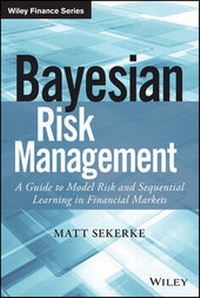
Bayesian Risk Management
Description

Most financial risk models assume the future will look like the past, but effective risk management depends on identifying fundamental changes in the marketplace as they occur. Bayesian Risk Management details a more flexible approach to risk management, and provides tools to measure financial risk in a dynamic market environment. This book opens discussion about uncertainty in model parameters, model specifications, and model-driven forecasts in a way that standard statistical risk measurement does not. And unlike current machine learning-based methods, the framework presented here allows you to measure risk in a fully-Bayesian setting without losing the structure afforded by parametric risk and asset-pricing models.
* Recognize the assumptions embodied in classical statistics
* Quantify model risk along multiple dimensions without backtesting
* Model time series without assuming stationarity
* Estimate state-space time series models online with simulation methods
* Uncover uncertainty in workhorse risk and asset-pricing models
* Embed Bayesian thinking about risk within a complex organization
Ignoring uncertainty in risk modeling creates an illusion of mastery and fosters erroneous decision-making. Firms who ignore the many dimensions of model risk measure too little risk, and end up taking on too much. Bayesian Risk Management provides a roadmap to better risk management through more circumspect measurement, with comprehensive treatment of model uncertainty.
All prices
More details
Other editions
Additional editions
Person
Content
Acknowledgments
Chapter 1: Models for Discontinuous Markets
Risk Models and Model Risk
Time-Invariant Models and Crisis
Bayesian Probability as a Means of Handling Discontinuity
Time-Invariance and 'Objectivity'
Part One: Capturing Uncertainty in Statistical Models
Chapter 2: Prior Knowledge, Parameter Uncertainty, and Estimation
Estimation with Prior Knowledge: The Beta-Bernoulli Model
Prior Parameter Distributions as Hypotheses: The Normal Linear Regression Model
Decisions after Observing the Data: The Choice of Estimators
Chapter 3: Model Uncertainty
Bayesian Model Comparison
Models as Nuisance Parameters
Uncertainty in Pricing Models
A Note on Backtesting
Part Two: Sequential Learning with Adaptive Statistical Models
Chapter 4: Introduction to Sequential Modeling
Sequential Bayesian Inference
Achieving Adaptivity via Discounting
Accounting for Uncertainty in Sequential Models
State Space Models of Time Series
Dynamic Linear Models
Recursive Relationships in the DLM
Variance Estimation
Sequential Model Comparison
Chapter 5: Sequential Monte Carlo Inference
Non-Linear and Non-Normal Models
State Learning with Particle Filters
Joint Learning of Parameters and States
Sequential Model Comparison
Part Three: Sequential Models of Financial Risk
Chapter 6: Volatility Modeling
Single-Asset Volatility
Volatility for Multiple Assets
Chapter 7: Asset Pricing Models and Hedging
Derivative Pricing in the Schwartz Model
Online State-Space Model Estimates of Derivative Prices
Models for Portfolios of Assets
Part Four: Bayesian Risk Management
Chapter 8: From Risk Measurement to Risk Management
Results
Prior Information as an Instrument of Corporate Governance
References
Index
Preface
Most financial risk models assume that the future will look like the past. They don't have to. This book sketches a more flexible risk-modeling approach that more fully recognizes our uncertainty about the future.
Uncertainty about the future stems from our limited ability to specify risk models, estimate their parameters from data, and be assured of the continuity between today's markets and tomorrow's markets. Ignoring any of these dimensions of model risk creates an illusion of mastery and fosters erroneous decision making. It is typical for financial firms to ignore all of these sources of uncertainty. Because they measure too little risk, they take on too much risk.
The core concern of this book is to present and justify alternative tools to measure financial risk without assuming that time-invariant stochastic processes drive financial phenomena. Discarding time-invariance as a modeling assumption makes uncertainty about parameters, models, and forecasts accessible and irreducible in a way that standard statistical risk measurements do not. The constructive alternative offered here under the slogan Bayesian Risk Management is an online sequential Bayesian modeling framework that acknowledges all of these sources of uncertainty, without giving up the structure afforded by parametric risk models and asset-pricing models.
Following an introductory chapter on the far-reaching consequences of the time-invariance assumption, Part One of the book shows where Bayesian analysis opens up uncertainty about parameters and models in a static setting. Bayesian results are compared to standard statistical results to make plain the strong assumptions embodied in classical, "objective" statistics. Chapter 2 begins by discussing prior information and parameter uncertainty in the context of the binomial and normal linear regression models. I compare Bayesian results to classical results to show how the Bayesian approach nests classical statistical results as a special case, and relate prior distributions under the Bayesian framework to hypothesis tests in classical statistics as competing methods of introducing nondata information. Chapter 3 addresses uncertainty about models and shows how candidate models may be compared to one another. Particular focus is given to the relationship between prior information and model complexity, and the manner in which model uncertainty applies to asset-pricing models.
Part Two extends the Bayesian framework to sequential time series analysis. Chapter 4 introduces the practice of discounting as a means of creating adaptive models. Discounting reflects uncertainty about the degree of continuity between the past and the future, and prevents the accumulation of data from destroying model flexibility. Expanding the set of available models to entertain multiple candidate discount rates incorporates varying degrees of memory into the modeling enterprise, avoiding the need for an a priori view about the rate at which market information decays. Chapters 5 and 6 then develop the fundamental tools of sequential Bayesian time series analysis: dynamic linear models and sequential Monte Carlo (SMC) models. Each of these tools incorporates parameter uncertainty, model uncertainty, and information decay into an online filtering framework, enabling real-time learning about financial market conditions.
Part Three then applies the methods developed in the first two parts to the estimation of volatility in Chapter 7 and the estimation of a commodity forward curve under the risk-neutral measure subject to arbitrage restrictions in Chapter 8. My goal here is to show the applicability of the methods developed to two problems which represent two extremes in our level of modeling knowledge. Additional applications are also possible. In Chapter 8 especially, I discuss how other common models may be reformulated and estimated using the same sequential Bayesian toolkit.
Chapter 9, the sole chapter of Part Four, synthesizes the results of the first three parts and begins the transition from a risk measurement framework based on Bayesian principles to a properly Bayesian risk management. I argue that the sequential Bayesian framework offers a coherent mechanism for organizational learning in environments characterized by incomplete information. Bayesian models allow senior management to make clear statements of risk policy and test elements of strategy against market outcomes in a direct and rigorous way. One may wish to begin reading at the final chapter: A glimpse of the endgame could provide useful orientation while reading the rest of the text.
The genesis of this book is multifold. As an undergraduate student in economics, I was impressed by the divide between the information-processing capacity assumed for individuals and firms in economic theory and the manner in which empirical individuals and firms actually learn. While economics provided many powerful results for the ultimate market outcomes, the field had less to say about the process by which equilibria were reached, or the dynamic stability of equilibrium given large perturbations from fixed points. Given a disruption to the economy, it seemed as though economic agents would have to find their way back to equilibrium over time, and on the basis of incomplete and uncertain information. With the notable exception of Fisher (1983) and some works by the Austrian economists, I quickly discovered that the field furnished few ready answers.
As I began my career consulting in economic litigations, I had two further experiences that find their theme in this book. The first involved litigation over a long-term purchase contract, which included a clause for renegotiation in the event that a "structural change" in the subject market had occurred. In working to find econometric evidence for such a structural change, I was struck, on the one hand, by the dearth of methods for identifying structural change in a market as it happened; identification seemed to be possible mainly as a forensic exercise, though there were obvious reasons why a firm would want to identify structural change in real time. On the other hand, after applying the available methods to the data, it seemed that it was more likely than not to find structural change wherever one looked, particularly in financial time series data at daily frequency. If structural change could occur at any time, without the knowledge of those who have vested interests in knowing, the usual methods of constructing forecasts with classical time series models seemed disastrously prone to missing the most important events in a market. Worse, their inadequacy would not become evident until it was probably too late.
The second experience was my involvement in the early stages of litigation related to the credit crisis. In these lawsuits, a few questions were on everyone's mind. Could the actors in question have seen significant changes in the market coming? If so, at what point could they have known that a collapse was imminent? If not, what would have led them to believe that the future was either benign or unknowable? The opportunity to review confidential information obtained in the discovery phase of these litigations provided innumerable insights into the inner workings of the key actors with respect to risk measurement, risk management, and financial instrument valuation. I saw two main things. First, there was an overwhelming dependence on front-office information-bid sheets, a few consummated secondary-market trades, and an overwhelming amount of "market color," the industry term for the best rumor and innuendo on offer-and almost no dependence on middle-office modeling. Whereas certain middle-office modeling efforts could have reacted to changes in market conditions, the traders on the front lines would not act until they saw changes in traded prices. Second, there were interminable discussions about how to weigh new data on early-stage delinquencies, default rates, and home prices against historical data. Instead of asking whether the new data falsified earlier premises on which expectations were built, discussions took place within the bounds of the worst-known outcomes from history, with the unstated assurance that housing market phenomena were stable and mean-reverting overall. Whatever these observations might imply about the capacity of the actors involved, it seemed that a better balance could be struck between middle-office risk managers and front-office traders, and that gains could be had by making the expectations of all involved explicit in the context of models grounded in the relevant fundamentals.
However, it was not until I began my studies at the University of Chicago that these themes converged around the technical means necessary to make them concrete. Nick Polson's course in probability theory was a revelation, introducing the Bayesian approach to probability within the context of financial markets. Two quarters of independent study with him followed immediately in which he introduced me to the vanguard of Bayesian thinking about time series. A capstone elective on Bayesian econometrics with Hedibert Lopes provided further perspective and rigor. His teaching was a worthy continuation of a tradition at the University of Chicago going back to Arnold Zellner.
The essay offered here brings these themes together by offering sequential Bayesian inference as the technical integument, which allows an organization to learn in real time about "structural change." It is my provisional and constructive answer to how a...
