

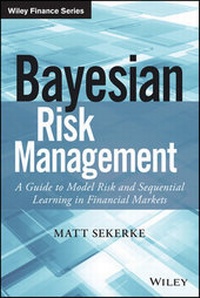
Bayesian Risk Management
A Guide to Model Risk and Sequential Learning in Financial Markets
Published on 19. August 2015
240 pages
978-1-118-74745-2 (ISBN)
Description

A risk measurement and management framework that takes model risk seriously
Most financial risk models assume the future will look like the past, but effective risk management depends on identifying fundamental changes in the marketplace as they occur. Bayesian Risk Management details a more flexible approach to risk management, and provides tools to measure financial risk in a dynamic market environment. This book opens discussion about uncertainty in model parameters, model specifications, and model-driven forecasts in a way that standard statistical risk measurement does not. And unlike current machine learning-based methods, the framework presented here allows you to measure risk in a fully-Bayesian setting without losing the structure afforded by parametric risk and asset-pricing models.
* Recognize the assumptions embodied in classical statistics
* Quantify model risk along multiple dimensions without backtesting
* Model time series without assuming stationarity
* Estimate state-space time series models online with simulation methods
* Uncover uncertainty in workhorse risk and asset-pricing models
* Embed Bayesian thinking about risk within a complex organization
Ignoring uncertainty in risk modeling creates an illusion of mastery and fosters erroneous decision-making. Firms who ignore the many dimensions of model risk measure too little risk, and end up taking on too much. Bayesian Risk Management provides a roadmap to better risk management through more circumspect measurement, with comprehensive treatment of model uncertainty.
Most financial risk models assume the future will look like the past, but effective risk management depends on identifying fundamental changes in the marketplace as they occur. Bayesian Risk Management details a more flexible approach to risk management, and provides tools to measure financial risk in a dynamic market environment. This book opens discussion about uncertainty in model parameters, model specifications, and model-driven forecasts in a way that standard statistical risk measurement does not. And unlike current machine learning-based methods, the framework presented here allows you to measure risk in a fully-Bayesian setting without losing the structure afforded by parametric risk and asset-pricing models.
* Recognize the assumptions embodied in classical statistics
* Quantify model risk along multiple dimensions without backtesting
* Model time series without assuming stationarity
* Estimate state-space time series models online with simulation methods
* Uncover uncertainty in workhorse risk and asset-pricing models
* Embed Bayesian thinking about risk within a complex organization
Ignoring uncertainty in risk modeling creates an illusion of mastery and fosters erroneous decision-making. Firms who ignore the many dimensions of model risk measure too little risk, and end up taking on too much. Bayesian Risk Management provides a roadmap to better risk management through more circumspect measurement, with comprehensive treatment of model uncertainty.
All prices
More details
Other editions
Additional editions
Matt Sekerke
Bayesian Risk Management
A Guide to Model Risk and Sequential Learning in Financial Markets
Book
10/2015
Wiley
€88.00
Shipment within 15-20 days
Matt Sekerke
Bayesian Risk Management - A Guide to Model Risk and Sequential Learning in Financial Markets
Software
08/2015
Wiley
€109.49
No shipping information available
Person
MATT SEKERKE is an economic consultant based in New York whose work focuses on the financial services industry and the application of advanced quantitative modeling techniques o financial data. He holds a BA in economics and mathematics from The Johns Hopkins University, an MA in history from The Johns Hopkins University, and an MBA in econometrics and statistics, analytic finance, and entrepreneurship from The University of Chicago Booth School of Business. He is also a CFA charterholder, a certified Financial Risk Manager, and a certified Energy Risk Professional.
Content
Preface
Acknowledgments
Chapter 1: Models for Discontinuous Markets
Risk Models and Model Risk
Time-Invariant Models and Crisis
Bayesian Probability as a Means of Handling Discontinuity
Time-Invariance and 'Objectivity'
Part One: Capturing Uncertainty in Statistical Models
Chapter 2: Prior Knowledge, Parameter Uncertainty, and Estimation
Estimation with Prior Knowledge: The Beta-Bernoulli Model
Prior Parameter Distributions as Hypotheses: The Normal Linear Regression Model
Decisions after Observing the Data: The Choice of Estimators
Chapter 3: Model Uncertainty
Bayesian Model Comparison
Models as Nuisance Parameters
Uncertainty in Pricing Models
A Note on Backtesting
Part Two: Sequential Learning with Adaptive Statistical Models
Chapter 4: Introduction to Sequential Modeling
Sequential Bayesian Inference
Achieving Adaptivity via Discounting
Accounting for Uncertainty in Sequential Models
State Space Models of Time Series
Dynamic Linear Models
Recursive Relationships in the DLM
Variance Estimation
Sequential Model Comparison
Chapter 5: Sequential Monte Carlo Inference
Non-Linear and Non-Normal Models
State Learning with Particle Filters
Joint Learning of Parameters and States
Sequential Model Comparison
Part Three: Sequential Models of Financial Risk
Chapter 6: Volatility Modeling
Single-Asset Volatility
Volatility for Multiple Assets
Chapter 7: Asset Pricing Models and Hedging
Derivative Pricing in the Schwartz Model
Online State-Space Model Estimates of Derivative Prices
Models for Portfolios of Assets
Part Four: Bayesian Risk Management
Chapter 8: From Risk Measurement to Risk Management
Results
Prior Information as an Instrument of Corporate Governance
References
Index
Acknowledgments
Chapter 1: Models for Discontinuous Markets
Risk Models and Model Risk
Time-Invariant Models and Crisis
Bayesian Probability as a Means of Handling Discontinuity
Time-Invariance and 'Objectivity'
Part One: Capturing Uncertainty in Statistical Models
Chapter 2: Prior Knowledge, Parameter Uncertainty, and Estimation
Estimation with Prior Knowledge: The Beta-Bernoulli Model
Prior Parameter Distributions as Hypotheses: The Normal Linear Regression Model
Decisions after Observing the Data: The Choice of Estimators
Chapter 3: Model Uncertainty
Bayesian Model Comparison
Models as Nuisance Parameters
Uncertainty in Pricing Models
A Note on Backtesting
Part Two: Sequential Learning with Adaptive Statistical Models
Chapter 4: Introduction to Sequential Modeling
Sequential Bayesian Inference
Achieving Adaptivity via Discounting
Accounting for Uncertainty in Sequential Models
State Space Models of Time Series
Dynamic Linear Models
Recursive Relationships in the DLM
Variance Estimation
Sequential Model Comparison
Chapter 5: Sequential Monte Carlo Inference
Non-Linear and Non-Normal Models
State Learning with Particle Filters
Joint Learning of Parameters and States
Sequential Model Comparison
Part Three: Sequential Models of Financial Risk
Chapter 6: Volatility Modeling
Single-Asset Volatility
Volatility for Multiple Assets
Chapter 7: Asset Pricing Models and Hedging
Derivative Pricing in the Schwartz Model
Online State-Space Model Estimates of Derivative Prices
Models for Portfolios of Assets
Part Four: Bayesian Risk Management
Chapter 8: From Risk Measurement to Risk Management
Results
Prior Information as an Instrument of Corporate Governance
References
Index
