

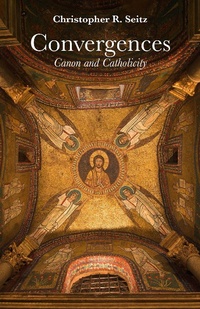
Convergences
Description

In an essay on Biblical Theology published in 1982, Paul Beauchamp points out a "striking convergence" between a prominent Roman Catholic scholar of the period, Roland de Vaux, and the leading Protestant Old Testament theologian of the day, Gerhard von Rad. Both saw looming on the horizon the need for a Biblical Theology in which both Testaments were taken seriously as part of a single, comprehensive theological reflection. There was genuine excitement at the prospect of the methods of tradition-historical reading, already harnessed by von Rad toward a specifically theological goal, turning now to a Biblical Theology proper. Where did that project and the excitement go?
With Convergences, Christopher Seitz returns to the period in question. In the later work of von Rad and Martin Noth, Seitz identifies the clear foreshadowing of what would become "canonical interpretation" reflected especially in the work of Brevard Childs. Seitz further reveals that the work of Beauchamp, largely unknown in the Anglophone world, would ultimately line up with Childs in a great many areas (typology, concern with the final form, appreciation for the history of biblical interpretation before the modern era). These scholars reached common shores by distinctive routes and via different interlocutors.
Convergences displays such lines of connection and how they spill over from the academy into the interests of the church, including Roman Catholic understandings of the place of Scripture since the mid-twentieth century. Seitz studies the emergence of the lectionary conception, the ressourcement movement, and non-Catholic interest in the prior history of interpretation and figural reading. Convergences maintains that much of what was accomplished in a hopeful coalescence around the canonical form of Scripture remains relevant for biblical interpretation in our present period. Here, we find a form of "catholicity" that offers hope and promise for our day in spite of cultural, ecclesial, and academic distinctives.
More details
Other editions
Additional editions
Person
Content
Introduction1 Diachronic Legacy and Complementary Reading2 Intent and Inspiration3 Typology and Figuration4 Biblical Theology5 Wisdom, Creation, Ontology6 Roman Catholic Hermeneutics and Canon7 Common Text ConvergenceConclusion
