

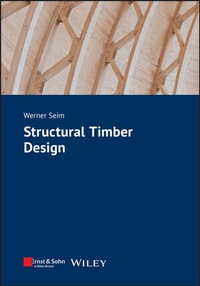
Structural Timber Design
1st Edition
Published on 19. March 2024
XXII, 394 pages
978-3-433-61158-6 (ISBN)
Description

Timber construction has been one of the most innovative areas of the building industry for several years. The speed with which new products are introduced into practical application is almost breathtaking compared to the other construction materials in the building industry. As a result, timber construction is continuously increasing its market share in commercial buildings and hall structures, and even in multi-storey construction for residential and office buildings.
This book provides essential knowledge and skills required for the design, detailing, and construction of timber structures for typical building structures. Special emphasis is placed on the specific features of timber and wood-based materials compared to other construction materials. This concerns the numerous advantages, as e.g. the comparatively low weight, the good workability of the high-performance material and the large variety of assembling technologies, but also the challenges resulting from the material anisotropy and from the susceptibility to natural pests.
In each chapter the essential phenomena are explained first and then brought into connection with code regulations. This aims to support the basic understanding of the interrelations and dependencies in timber engineering, which is the fundamental basis of creative engineering.
This book provides essential knowledge and skills required for the design, detailing, and construction of timber structures for typical building structures. Special emphasis is placed on the specific features of timber and wood-based materials compared to other construction materials. This concerns the numerous advantages, as e.g. the comparatively low weight, the good workability of the high-performance material and the large variety of assembling technologies, but also the challenges resulting from the material anisotropy and from the susceptibility to natural pests.
In each chapter the essential phenomena are explained first and then brought into connection with code regulations. This aims to support the basic understanding of the interrelations and dependencies in timber engineering, which is the fundamental basis of creative engineering.
More details
Other editions
Additional editions
Complete work / Part of the work
Book
06/2024
1st Edition
Ernst & Sohn
€129.00
Shipment within 5-7 days
Person
Werner Seim is a professor for Timber Engineering and Building Preservation at the University of Kassel, Germany, and also an engineer with more than 35 years of experience in design and assessment of timber structures. He holds a Civil Engineering Degree from the University of Stuttgart, received his PhD in 1994 at the KIT (Karlsruhe Institute for Technology) and conducted postdoctoral studies 1998 at the UCSD (University of California, San Diego). His research is focussed on bracing systems for high-rise buildings, timber-concrete-composites and assessment and re-use of structures. He is member of several national and international scientific committees. He was invited as a Visiting Professor to UBC Vancouver, EPF Lausanne and FCBA Bordeaux. His commitment to teaching was rewarded in 2020 with the Hessian State Prize. As an engineer he received in 2006 a timber construction prize awarded by the state of Baden-Württemberg.
Content
PREFACE
LIST OF ABBREVIATIONS
1 TIMBER AS A STRUCTURAL MATERIAL
1.1 Building with timber - advantages and challenges
1.2 Mechanical properties of solid timber
1.2.1 Influence of the fibre direction
1.2.2 Strength values of solid timber
1.2.3 Deformation properties of solid timber
1.2.4 Influence of load duration and humidity
1.3 Wood based products
1.3.1 Solid structural timber and glued solid timber
1.3.2 Glued laminated timber
1.3.3 Cross laminated timber
1.4 Wood based materials
1.4.1 Laminated veneer lumber
1.4.2 Plywood
1.4.3 OSB
1.4.4 Particle boards
1.4.5 Fibreboards
2 STRUCTURAL DESIGN OF BEAM-TYPE MEMBERS
2.1 Basics of structural design
2.1.1 Action combinations
2.1.2 Modification factors and deformations factors
2.2 Bending
2.3 Shear
2.4 Torsion and rolling shear
2.5 Buckling
2.5.1 Lateral bending buckling - kc method
2.5.2 Lateral torsional buckling - km method
2.5.3 Torsional flexural buckling
2.5.4 Calculation according to Second Order Theory
2.6 Tension and bending
2.7 Serviceability limit state
2.7.1 Deformations
2.7.2 Vibrations
3 STRESSES PERPENDICULAR TO THE GRAIN
3.1 Introduction
3.2 Compression
3.2.1 Compression perpendicular to the grain
3.2.2 Compression stresses at an angle to the grain
3.3 Tension perpendicular to grain
3.3.1 General
3.3.2 Notches
3.3.3 Tension loaded connections perpendicular to grain
3.3.4 Holes in glulam beams
4 DOWEL-TYPE CONNECTIONS
4.1 General
4.2 Connections with dowel-type fasteners
4.2.1 Overview
4.2.2 Deformation behaviour
4.2.3 Basics of the calculation of shear loaded connections
4.2.4 Shear loaded timber-timber connections
4.2.5 Shear loaded timber-timber connections - simplified calculation
4.2.6 Shear loaded steel-timber connections
4.2.7 Shear loaded steel-timber connections - simplified calculation
4.3 Dowels and Bolts
4.4 Nails and staples
4.4.1 Definitions
4.4.2 Construction rules for connections with nails
4.4.3 Construction rules for staples
4.4.4 Load bearing capacity
4.5 Connections with screws
4.5.1 General
4.5.2 Conceptual design of screwed connections
4.5.3 Load bearing capacity
4.5.4 Application examples and execution
4.6 Block shear
4.7 Reinforcement of doweled connections
4.8 Connections with Cross-laminated timber (CLT)
5 OTHER TYPES OF CONNECTIONS
5.1 Shear connectors
5.1.1 Mechanism
5.1.2 Connector types and construction rules
5.1.3 Load bearing capacity
5.2 Carpentry joints
5.2.1 Introduction
5.2.2 Halving joints
5.2.3 Step joints
5.2.4 Mortise and tenon
5.2.5 Wooden nails
5.2.6 Deformations - slip moduli
5.3 Hinged and moment resistant connections
5.3.1 Structural detailing and calculation modelling
5.3.2 Principle of intersection
5.3.3 Rules for detailing
5.4 Adhesive bonded connections
5.4.1 Introduction
5.4.2 Adhesive bonding of structural elements
5.4.3 Connections, local reinforcement and repair
5.5 Reinforcement against tension forces perpendicular to the grain
5.5.1 Notches
5.5.2 Connections perpendicular to grain
5.5.3 Openings
6 STRUCTURAL ELEMENTS - BEAM TYPE MEMBERS
6.1 Glulam beams
6.1.1 Bending stresses
6.1.2 Tension stresses perpendicular to the grain
6.2 Trusses
6.3 Composite elements
6.3.1 Beams, slab and roof elements
6.3.2 Timber-concrete composites (TCC)
6.3.3 Columns
6.4 Bracing - Design and detailing
6.4.1 Introduction
6.4.2 Roof structures
6.4.3 Beams and columns
6.5 Modelling of beam type elements
7 STRUCTURAL ELEMENTS - PLANE
7.1 Light frame elements
7.1.1 Introduction
7.1.2 Wall elements
7.1.3 Slab elements - diaphragms
7.1.4 Connections and anchoring
7.2 Cross laminated timber (CLT)
7.2.1 Production, load bearing characteristics, and strength
7.2.2 Plates
7.2.3 Wall panels
7.2.4 Detailing and load transfer
7.3 Modelling of plane elements
7.3.1 CLT plates
7.3.2 Shear walls
7.4 Interaction of diaphragms and bracing walls
8 DYNAMIC BEHAVIOUR OF TIMBER STRUCTURES
8.1 Dynamics and vibration
8.1.1 Structures under dynamic impact
8.1.2 Natural frequencies of simple systems
8.2 Vibration of slabs
8.3 Structures under earthquake impact
LIST OF ABBREVIATIONS
1 TIMBER AS A STRUCTURAL MATERIAL
1.1 Building with timber - advantages and challenges
1.2 Mechanical properties of solid timber
1.2.1 Influence of the fibre direction
1.2.2 Strength values of solid timber
1.2.3 Deformation properties of solid timber
1.2.4 Influence of load duration and humidity
1.3 Wood based products
1.3.1 Solid structural timber and glued solid timber
1.3.2 Glued laminated timber
1.3.3 Cross laminated timber
1.4 Wood based materials
1.4.1 Laminated veneer lumber
1.4.2 Plywood
1.4.3 OSB
1.4.4 Particle boards
1.4.5 Fibreboards
2 STRUCTURAL DESIGN OF BEAM-TYPE MEMBERS
2.1 Basics of structural design
2.1.1 Action combinations
2.1.2 Modification factors and deformations factors
2.2 Bending
2.3 Shear
2.4 Torsion and rolling shear
2.5 Buckling
2.5.1 Lateral bending buckling - kc method
2.5.2 Lateral torsional buckling - km method
2.5.3 Torsional flexural buckling
2.5.4 Calculation according to Second Order Theory
2.6 Tension and bending
2.7 Serviceability limit state
2.7.1 Deformations
2.7.2 Vibrations
3 STRESSES PERPENDICULAR TO THE GRAIN
3.1 Introduction
3.2 Compression
3.2.1 Compression perpendicular to the grain
3.2.2 Compression stresses at an angle to the grain
3.3 Tension perpendicular to grain
3.3.1 General
3.3.2 Notches
3.3.3 Tension loaded connections perpendicular to grain
3.3.4 Holes in glulam beams
4 DOWEL-TYPE CONNECTIONS
4.1 General
4.2 Connections with dowel-type fasteners
4.2.1 Overview
4.2.2 Deformation behaviour
4.2.3 Basics of the calculation of shear loaded connections
4.2.4 Shear loaded timber-timber connections
4.2.5 Shear loaded timber-timber connections - simplified calculation
4.2.6 Shear loaded steel-timber connections
4.2.7 Shear loaded steel-timber connections - simplified calculation
4.3 Dowels and Bolts
4.4 Nails and staples
4.4.1 Definitions
4.4.2 Construction rules for connections with nails
4.4.3 Construction rules for staples
4.4.4 Load bearing capacity
4.5 Connections with screws
4.5.1 General
4.5.2 Conceptual design of screwed connections
4.5.3 Load bearing capacity
4.5.4 Application examples and execution
4.6 Block shear
4.7 Reinforcement of doweled connections
4.8 Connections with Cross-laminated timber (CLT)
5 OTHER TYPES OF CONNECTIONS
5.1 Shear connectors
5.1.1 Mechanism
5.1.2 Connector types and construction rules
5.1.3 Load bearing capacity
5.2 Carpentry joints
5.2.1 Introduction
5.2.2 Halving joints
5.2.3 Step joints
5.2.4 Mortise and tenon
5.2.5 Wooden nails
5.2.6 Deformations - slip moduli
5.3 Hinged and moment resistant connections
5.3.1 Structural detailing and calculation modelling
5.3.2 Principle of intersection
5.3.3 Rules for detailing
5.4 Adhesive bonded connections
5.4.1 Introduction
5.4.2 Adhesive bonding of structural elements
5.4.3 Connections, local reinforcement and repair
5.5 Reinforcement against tension forces perpendicular to the grain
5.5.1 Notches
5.5.2 Connections perpendicular to grain
5.5.3 Openings
6 STRUCTURAL ELEMENTS - BEAM TYPE MEMBERS
6.1 Glulam beams
6.1.1 Bending stresses
6.1.2 Tension stresses perpendicular to the grain
6.2 Trusses
6.3 Composite elements
6.3.1 Beams, slab and roof elements
6.3.2 Timber-concrete composites (TCC)
6.3.3 Columns
6.4 Bracing - Design and detailing
6.4.1 Introduction
6.4.2 Roof structures
6.4.3 Beams and columns
6.5 Modelling of beam type elements
7 STRUCTURAL ELEMENTS - PLANE
7.1 Light frame elements
7.1.1 Introduction
7.1.2 Wall elements
7.1.3 Slab elements - diaphragms
7.1.4 Connections and anchoring
7.2 Cross laminated timber (CLT)
7.2.1 Production, load bearing characteristics, and strength
7.2.2 Plates
7.2.3 Wall panels
7.2.4 Detailing and load transfer
7.3 Modelling of plane elements
7.3.1 CLT plates
7.3.2 Shear walls
7.4 Interaction of diaphragms and bracing walls
8 DYNAMIC BEHAVIOUR OF TIMBER STRUCTURES
8.1 Dynamics and vibration
8.1.1 Structures under dynamic impact
8.1.2 Natural frequencies of simple systems
8.2 Vibration of slabs
8.3 Structures under earthquake impact
