

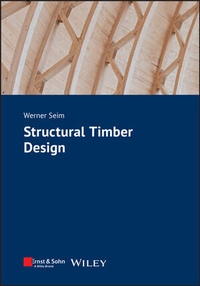
Structural Timber Design
1st Edition
Published on 5. April 2024
XXII, 394 pages
978-3-433-61157-9 (ISBN)
Description

Timber construction has been one of the most innovative areas of the building industry for several years. The speed with which new products are introduced into practical application is almost breathtaking compared to the other construction materials in the building industry. As a result, timber construction is continuously increasing its market share in commercial buildings and hall structures, and even in multi-storey construction for residential and office buildings.
This book provides essential knowledge and skills required for the design, detailing, and construction of timber structures for typical building structures. Special emphasis is placed on the specific features of timber and wood-based materials compared to other construction materials. This concerns the numerous advantages, as e.g. the comparatively low weight, the good workability of the high-performance material and the large variety of assembling technologies, but also the challenges resulting from the material anisotropy and from the susceptibility to natural pests.
In each chapter the essential phenomena are explained first and then brought into connection with code regulations. This aims to support the basic understanding of the interrelations and dependencies in timber engineering, which is the fundamental basis of creative engineering.
This book provides essential knowledge and skills required for the design, detailing, and construction of timber structures for typical building structures. Special emphasis is placed on the specific features of timber and wood-based materials compared to other construction materials. This concerns the numerous advantages, as e.g. the comparatively low weight, the good workability of the high-performance material and the large variety of assembling technologies, but also the challenges resulting from the material anisotropy and from the susceptibility to natural pests.
In each chapter the essential phenomena are explained first and then brought into connection with code regulations. This aims to support the basic understanding of the interrelations and dependencies in timber engineering, which is the fundamental basis of creative engineering.
More details
Other editions
Additional editions
Person
Werner Seim is a professor for Timber Engineering and Building Preservation at the University of Kassel, Germany, and also an engineer with more than 35 years of experience in design and assessment of timber structures. He holds a Civil Engineering Degree from the University of Stuttgart, received his PhD in 1994 at the KIT (Karlsruhe Institute for Technology) and conducted postdoctoral studies 1998 at the UCSD (University of California, San Diego). His research is focussed on bracing systems for high-rise buildings, timber-concrete-composites and assessment and re-use of structures. He is member of several national and international scientific committees. He was invited as a Visiting Professor to UBC Vancouver, EPF Lausanne and FCBA Bordeaux. His commitment to teaching was rewarded in 2020 with the Hessian State Prize. As an engineer he received in 2006 a timber construction prize awarded by the state of Baden-Württemberg.
Content
PREFACE
LIST OF ABBREVIATIONS
1 TIMBER AS A STRUCTURAL MATERIAL
1.1 Building with timber - advantages and challenges
1.2 Mechanical properties of solid timber
1.2.1 Influence of the fibre direction
1.2.2 Strength values of solid timber
1.2.3 Deformation properties of solid timber
1.2.4 Influence of load duration and humidity
1.3 Wood based products
1.3.1 Solid structural timber and glued solid timber
1.3.2 Glued laminated timber
1.3.3 Cross laminated timber
1.4 Wood based materials
1.4.1 Laminated veneer lumber
1.4.2 Plywood
1.4.3 OSB
1.4.4 Particle boards
1.4.5 Fibreboards
2 STRUCTURAL DESIGN OF BEAM-TYPE MEMBERS
2.1 Basics of structural design
2.1.1 Action combinations
2.1.2 Modification factors and deformations factors
2.2 Bending
2.3 Shear
2.4 Torsion and rolling shear
2.5 Buckling
2.5.1 Lateral bending buckling - kc method
2.5.2 Lateral torsional buckling - km method
2.5.3 Torsional flexural buckling
2.5.4 Calculation according to Second Order Theory
2.6 Tension and bending
2.7 Serviceability limit state
2.7.1 Deformations
2.7.2 Vibrations
3 STRESSES PERPENDICULAR TO THE GRAIN
3.1 Introduction
3.2 Compression
3.2.1 Compression perpendicular to the grain
3.2.2 Compression stresses at an angle to the grain
3.3 Tension perpendicular to grain
3.3.1 General
3.3.2 Notches
3.3.3 Tension loaded connections perpendicular to grain
3.3.4 Holes in glulam beams
4 DOWEL-TYPE CONNECTIONS
4.1 General
4.2 Connections with dowel-type fasteners
4.2.1 Overview
4.2.2 Deformation behaviour
4.2.3 Basics of the calculation of shear loaded connections
4.2.4 Shear loaded timber-timber connections
4.2.5 Shear loaded timber-timber connections - simplified calculation
4.2.6 Shear loaded steel-timber connections
4.2.7 Shear loaded steel-timber connections - simplified calculation
4.3 Dowels and Bolts
4.4 Nails and staples
4.4.1 Definitions
4.4.2 Construction rules for connections with nails
4.4.3 Construction rules for staples
4.4.4 Load bearing capacity
4.5 Connections with screws
4.5.1 General
4.5.2 Conceptual design of screwed connections
4.5.3 Load bearing capacity
4.5.4 Application examples and execution
4.6 Block shear
4.7 Reinforcement of doweled connections
4.8 Connections with Cross-laminated timber (CLT)
5 OTHER TYPES OF CONNECTIONS
5.1 Shear connectors
5.1.1 Mechanism
5.1.2 Connector types and construction rules
5.1.3 Load bearing capacity
5.2 Carpentry joints
5.2.1 Introduction
5.2.2 Halving joints
5.2.3 Step joints
5.2.4 Mortise and tenon
5.2.5 Wooden nails
5.2.6 Deformations - slip moduli
5.3 Hinged and moment resistant connections
5.3.1 Structural detailing and calculation modelling
5.3.2 Principle of intersection
5.3.3 Rules for detailing
5.4 Adhesive bonded connections
5.4.1 Introduction
5.4.2 Adhesive bonding of structural elements
5.4.3 Connections, local reinforcement and repair
5.5 Reinforcement against tension forces perpendicular to the grain
5.5.1 Notches
5.5.2 Connections perpendicular to grain
5.5.3 Openings
6 STRUCTURAL ELEMENTS - BEAM TYPE MEMBERS
6.1 Glulam beams
6.1.1 Bending stresses
6.1.2 Tension stresses perpendicular to the grain
6.2 Trusses
6.3 Composite elements
6.3.1 Beams, slab and roof elements
6.3.2 Timber-concrete composites (TCC)
6.3.3 Columns
6.4 Bracing - Design and detailing
6.4.1 Introduction
6.4.2 Roof structures
6.4.3 Beams and columns
6.5 Modelling of beam type elements
7 STRUCTURAL ELEMENTS - PLANE
7.1 Light frame elements
7.1.1 Introduction
7.1.2 Wall elements
7.1.3 Slab elements - diaphragms
7.1.4 Connections and anchoring
7.2 Cross laminated timber (CLT)
7.2.1 Production, load bearing characteristics, and strength
7.2.2 Plates
7.2.3 Wall panels
7.2.4 Detailing and load transfer
7.3 Modelling of plane elements
7.3.1 CLT plates
7.3.2 Shear walls
7.4 Interaction of diaphragms and bracing walls
8 DYNAMIC BEHAVIOUR OF TIMBER STRUCTURES
8.1 Dynamics and vibration
8.1.1 Structures under dynamic impact
8.1.2 Natural frequencies of simple systems
8.2 Vibration of slabs
8.3 Structures under earthquake impact
A Section area, knottiness AC Action combination Aef Effective contact area, effective cross section (steel rod or rebar) Ak Characteristic exceptional action Anet,t, Anet,v Net area against tension and shear failure B Bending stiffness, B = E·I C Minimum stiffness of bracing elements Ecm Mean modulus of elasticity for concrete Emean, E05 Mean modulus of elasticity, 5% fractile of modulus of elasticity Ed Effects of action, design value Ed,fi Effects of action, design values in case of fire Ek Effects of action, characteristic value (EI)ef Effective stiffness of a composite beam F Force F90,Rd Capacity against tension perpendicular to the grain Fax,Rk Characteristic axial tensile resistance of a single fastener Fbs,Rk Characteristic capacity against block shear Fv,w,Rd Design resistance of light frame wall element against horizontal loading Fc,0,d Design compression force parallel to the grain Ftens,k Characteristic tension capacity of a screw Ft,90,d Design tensile force at the crack plane Fv,Ed Design force applied to the connection; design horizontal force applied to the head of a wall Fv,Rk Characteristic lateral resistance per shear plane of a single fastener ?Fv,Rk Characteristic rope effect contribution to the lateral resistance per shear plane of a single fastener Fv,a,Rd Design resistance for shear connector units Fv,a,Rdb Design resistance of the bolt in a connection with shear plates Fv,a,Rdc Design resistance of the shear plate Gmean, G05 Mean shear modulus, 5% fractile of shear modulus Gk Characteristic self-weight Gmean Mean shear modulus GR,mean Mean rolling shear modulus (GA)ef,xz Effective shear stiffness for out-of-plane-loaded CLT panels (GA)ef,xy Effective shear stiffness for in-plane-loaded CLT panels H Altitude above sea level I Torsional moment of inertia Ip Polar moment of inertia Iy, Iz Moment of inertia related to bending around y-axis and z-axis Ief,x, Ief,y Effective moment of inertia for CLT sections related to stresses in the direction of x-axis and y-axis Kser, Ku Slip modulus, stiffness of translational spring K? Stiffness of a rotational spring LDC Load duration class LVL Laminated veneer lumber M Bending moment, shear centre Map,d Design bending moment at the apex of a double-tapered beam Md Design bending moment MD Torsional moment Ms Bending moment at the centre of a group of connectors Mtor Torsional moment My,Rk Characteristic yield moment of a fastener Nd Design normal force Ns Normal force at the centre of a group of connectors OSB Oriented strand board PGA Peak ground acceleration Qk Characteristic transient action Qk,L Characteristic action, life load Qk,S Characteristic action, snow Qk,W Characteristic action, wind Rd Resistance, design value Rk Resistance, characteristic value S Centroid, soil amplification factor Sap,R Maximum spectral acceleration Se, Sd Spectral acceleration, elastic and design value Sy Static moment related to bending around the y-axis T Torsional stiffness, period ULS Ultimate limit state V Volume Vd Design shear force Vle, Vre Shear force at the left and right side resp. of the support Vred Reduced shear force at the support area Vs Shear force at the centre of a group of connectors Vz Shear force in the z-direction Wy, Wz Section modulus related to bending around y-axis and z-axis Wap,netto Section modulus at the apex of a double-tapered beam, if necessary, considering a weakened cross section Wnet Section modulus of weakened cross section Wres Section modulus of residual cross section above or below an opening
a Length of rectangular opening or diameter of round opening, acceleration a1, a2 Spacing parallel and perpendicular to the grain, coefficients for the calculation of the buckling length, protrusion at the contact area a3,c, a3,t Unloaded and loaded end distance parallel to the grain a4,c, a4,t Unloaded and loaded end distance perpendicular to the grain afi Additional dimensions to reach a certain fire resistance for connections ar Distance of ribs, width of a group of connectors b Section width of a member, width of the contact area, length of a wall element bfi Section width after fire exposure bnet Net distance between studs of light frame element bw Width of the web of a beam c Reduction factor for slender walls, damping constant d Diameter of a fastener dc Diameter of a shear connector def Charring depth dh Diameter of the head or the washer di Diameter of knot i dn Diameter of a nail's head dr Diameter of a glued-in rod d0 Zero strength layer for members under fire exposure f Natural frequency fax,k Characteristic withdrawal strength parameter fc,0,d Design compression strength parallel to the...
LIST OF ABBREVIATIONS
1 TIMBER AS A STRUCTURAL MATERIAL
1.1 Building with timber - advantages and challenges
1.2 Mechanical properties of solid timber
1.2.1 Influence of the fibre direction
1.2.2 Strength values of solid timber
1.2.3 Deformation properties of solid timber
1.2.4 Influence of load duration and humidity
1.3 Wood based products
1.3.1 Solid structural timber and glued solid timber
1.3.2 Glued laminated timber
1.3.3 Cross laminated timber
1.4 Wood based materials
1.4.1 Laminated veneer lumber
1.4.2 Plywood
1.4.3 OSB
1.4.4 Particle boards
1.4.5 Fibreboards
2 STRUCTURAL DESIGN OF BEAM-TYPE MEMBERS
2.1 Basics of structural design
2.1.1 Action combinations
2.1.2 Modification factors and deformations factors
2.2 Bending
2.3 Shear
2.4 Torsion and rolling shear
2.5 Buckling
2.5.1 Lateral bending buckling - kc method
2.5.2 Lateral torsional buckling - km method
2.5.3 Torsional flexural buckling
2.5.4 Calculation according to Second Order Theory
2.6 Tension and bending
2.7 Serviceability limit state
2.7.1 Deformations
2.7.2 Vibrations
3 STRESSES PERPENDICULAR TO THE GRAIN
3.1 Introduction
3.2 Compression
3.2.1 Compression perpendicular to the grain
3.2.2 Compression stresses at an angle to the grain
3.3 Tension perpendicular to grain
3.3.1 General
3.3.2 Notches
3.3.3 Tension loaded connections perpendicular to grain
3.3.4 Holes in glulam beams
4 DOWEL-TYPE CONNECTIONS
4.1 General
4.2 Connections with dowel-type fasteners
4.2.1 Overview
4.2.2 Deformation behaviour
4.2.3 Basics of the calculation of shear loaded connections
4.2.4 Shear loaded timber-timber connections
4.2.5 Shear loaded timber-timber connections - simplified calculation
4.2.6 Shear loaded steel-timber connections
4.2.7 Shear loaded steel-timber connections - simplified calculation
4.3 Dowels and Bolts
4.4 Nails and staples
4.4.1 Definitions
4.4.2 Construction rules for connections with nails
4.4.3 Construction rules for staples
4.4.4 Load bearing capacity
4.5 Connections with screws
4.5.1 General
4.5.2 Conceptual design of screwed connections
4.5.3 Load bearing capacity
4.5.4 Application examples and execution
4.6 Block shear
4.7 Reinforcement of doweled connections
4.8 Connections with Cross-laminated timber (CLT)
5 OTHER TYPES OF CONNECTIONS
5.1 Shear connectors
5.1.1 Mechanism
5.1.2 Connector types and construction rules
5.1.3 Load bearing capacity
5.2 Carpentry joints
5.2.1 Introduction
5.2.2 Halving joints
5.2.3 Step joints
5.2.4 Mortise and tenon
5.2.5 Wooden nails
5.2.6 Deformations - slip moduli
5.3 Hinged and moment resistant connections
5.3.1 Structural detailing and calculation modelling
5.3.2 Principle of intersection
5.3.3 Rules for detailing
5.4 Adhesive bonded connections
5.4.1 Introduction
5.4.2 Adhesive bonding of structural elements
5.4.3 Connections, local reinforcement and repair
5.5 Reinforcement against tension forces perpendicular to the grain
5.5.1 Notches
5.5.2 Connections perpendicular to grain
5.5.3 Openings
6 STRUCTURAL ELEMENTS - BEAM TYPE MEMBERS
6.1 Glulam beams
6.1.1 Bending stresses
6.1.2 Tension stresses perpendicular to the grain
6.2 Trusses
6.3 Composite elements
6.3.1 Beams, slab and roof elements
6.3.2 Timber-concrete composites (TCC)
6.3.3 Columns
6.4 Bracing - Design and detailing
6.4.1 Introduction
6.4.2 Roof structures
6.4.3 Beams and columns
6.5 Modelling of beam type elements
7 STRUCTURAL ELEMENTS - PLANE
7.1 Light frame elements
7.1.1 Introduction
7.1.2 Wall elements
7.1.3 Slab elements - diaphragms
7.1.4 Connections and anchoring
7.2 Cross laminated timber (CLT)
7.2.1 Production, load bearing characteristics, and strength
7.2.2 Plates
7.2.3 Wall panels
7.2.4 Detailing and load transfer
7.3 Modelling of plane elements
7.3.1 CLT plates
7.3.2 Shear walls
7.4 Interaction of diaphragms and bracing walls
8 DYNAMIC BEHAVIOUR OF TIMBER STRUCTURES
8.1 Dynamics and vibration
8.1.1 Structures under dynamic impact
8.1.2 Natural frequencies of simple systems
8.2 Vibration of slabs
8.3 Structures under earthquake impact
Symbols and Abbreviations
Latin Upper-case Letters
A Section area, knottiness AC Action combination Aef Effective contact area, effective cross section (steel rod or rebar) Ak Characteristic exceptional action Anet,t, Anet,v Net area against tension and shear failure B Bending stiffness, B = E·I C Minimum stiffness of bracing elements Ecm Mean modulus of elasticity for concrete Emean, E05 Mean modulus of elasticity, 5% fractile of modulus of elasticity Ed Effects of action, design value Ed,fi Effects of action, design values in case of fire Ek Effects of action, characteristic value (EI)ef Effective stiffness of a composite beam F Force F90,Rd Capacity against tension perpendicular to the grain Fax,Rk Characteristic axial tensile resistance of a single fastener Fbs,Rk Characteristic capacity against block shear Fv,w,Rd Design resistance of light frame wall element against horizontal loading Fc,0,d Design compression force parallel to the grain Ftens,k Characteristic tension capacity of a screw Ft,90,d Design tensile force at the crack plane Fv,Ed Design force applied to the connection; design horizontal force applied to the head of a wall Fv,Rk Characteristic lateral resistance per shear plane of a single fastener ?Fv,Rk Characteristic rope effect contribution to the lateral resistance per shear plane of a single fastener Fv,a,Rd Design resistance for shear connector units Fv,a,Rdb Design resistance of the bolt in a connection with shear plates Fv,a,Rdc Design resistance of the shear plate Gmean, G05 Mean shear modulus, 5% fractile of shear modulus Gk Characteristic self-weight Gmean Mean shear modulus GR,mean Mean rolling shear modulus (GA)ef,xz Effective shear stiffness for out-of-plane-loaded CLT panels (GA)ef,xy Effective shear stiffness for in-plane-loaded CLT panels H Altitude above sea level I Torsional moment of inertia Ip Polar moment of inertia Iy, Iz Moment of inertia related to bending around y-axis and z-axis Ief,x, Ief,y Effective moment of inertia for CLT sections related to stresses in the direction of x-axis and y-axis Kser, Ku Slip modulus, stiffness of translational spring K? Stiffness of a rotational spring LDC Load duration class LVL Laminated veneer lumber M Bending moment, shear centre Map,d Design bending moment at the apex of a double-tapered beam Md Design bending moment MD Torsional moment Ms Bending moment at the centre of a group of connectors Mtor Torsional moment My,Rk Characteristic yield moment of a fastener Nd Design normal force Ns Normal force at the centre of a group of connectors OSB Oriented strand board PGA Peak ground acceleration Qk Characteristic transient action Qk,L Characteristic action, life load Qk,S Characteristic action, snow Qk,W Characteristic action, wind Rd Resistance, design value Rk Resistance, characteristic value S Centroid, soil amplification factor Sap,R Maximum spectral acceleration Se, Sd Spectral acceleration, elastic and design value Sy Static moment related to bending around the y-axis T Torsional stiffness, period ULS Ultimate limit state V Volume Vd Design shear force Vle, Vre Shear force at the left and right side resp. of the support Vred Reduced shear force at the support area Vs Shear force at the centre of a group of connectors Vz Shear force in the z-direction Wy, Wz Section modulus related to bending around y-axis and z-axis Wap,netto Section modulus at the apex of a double-tapered beam, if necessary, considering a weakened cross section Wnet Section modulus of weakened cross section Wres Section modulus of residual cross section above or below an opening
Latin Lower-case Letters
a Length of rectangular opening or diameter of round opening, acceleration a1, a2 Spacing parallel and perpendicular to the grain, coefficients for the calculation of the buckling length, protrusion at the contact area a3,c, a3,t Unloaded and loaded end distance parallel to the grain a4,c, a4,t Unloaded and loaded end distance perpendicular to the grain afi Additional dimensions to reach a certain fire resistance for connections ar Distance of ribs, width of a group of connectors b Section width of a member, width of the contact area, length of a wall element bfi Section width after fire exposure bnet Net distance between studs of light frame element bw Width of the web of a beam c Reduction factor for slender walls, damping constant d Diameter of a fastener dc Diameter of a shear connector def Charring depth dh Diameter of the head or the washer di Diameter of knot i dn Diameter of a nail's head dr Diameter of a glued-in rod d0 Zero strength layer for members under fire exposure f Natural frequency fax,k Characteristic withdrawal strength parameter fc,0,d Design compression strength parallel to the...
