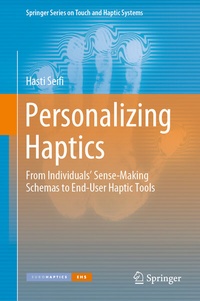
Personalizing Haptics
Description

This monograph presents a vision for haptic personalization tools and lays the foundations for achieving it. Effective haptic personalization requires a suite of tools unified by one underlying conceptual model that can easily be incorporated into users' workflows with various applications. Toward this vision, the book introduces three mechanisms for haptic personalization and details development of two of them into: 1) an efficient interface for choosing from a large haptic library, and 2) three emotion controls for adjusting haptic signals. A series of quantitative experiments identifies five schemas (engineering, sensation, emotion, metaphor, and usage examples) for how end-users think and talk about haptic sensations and characterizes them as the underlying model for the personalization tools.
Personalizing Haptics highlights the need for scalable haptic evaluation methodologies and presents two methodologies for large-scale in-lab evaluation and online crowdsourcing of haptics. While the work focuses on vibrotactile signals as the most mature and accessible type of haptic feedback for end-users, the concepts and findings extend to other categories of haptics.
Taking haptics to the crowds will require haptic design practices to go beyond the current one-size-fits-all approach to satisfy users' diverse perceptual, functional, and hedonic needs reported in the literature. This book provides a starting point for students, researchers, and practitioners in academia or industry who aim to adapt their haptic and multisensory designs to the needs and preferences of a wide audience.
More details
Other editions
Additional editions