

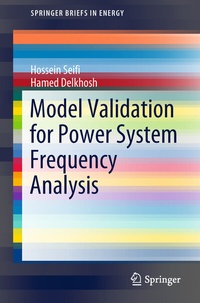
Model Validation for Power System Frequency Analysis
Description

This book examines the role of model validation of power system planning and operation to optimize its performance in terms of frequency control. It presents the detailed model validation for the Iranian Power Grid system, where the frequency performance was analysed and improved using existing and new standard models to identify the influencing parameters. Although the model validation was employed for a specific, practical large-scale system, the framework (concepts, methods, and formulations) can be used for by any type of power system. As such, this book describing a generalized framework for model validation with a real case study is useful for both power industry experts and academia.
More details
Other editions
Additional editions
Persons
Hossein Seifi was born in Shiraz, Iran (1957. He received his B.Sc. from Shiraz University in 1980, and his M.Sc. and Ph.D. from UMIST (U.K.) in 1987 and 1989, respectively. Since 1989, he has been with the TMU (Tarbiat Modares University) in Tehran where he is currently a Full Professor. He has had major contribution in developing the first postgraduate studies in Iran and supervising M.Sc. and Ph.D. students, while also holding positions such as Head of Faculty of Engineering and Vice-chancellor in Research Affairs at the University. He is the founder and also the Head of the Iran Power System Engineering Research Center (IPSERC), which is actively involved in strategic studies for the Iranian power grid, and has completed over 80 such studies over the last 15 years. He is the main author of the book "Electric Power System Planning, Issues, Algorithms and Solutions", published by Springer in 2011 and used worldwide as a textbook for postgraduate students,as well as for experts in electric utilities. His research interests include electricity planning, and the operation and dynamics of power systems.
Hamed Delkhosh was born in Rasht, Iran, in 1991. He ranked highly in the Iranian nation-wide Ph.D. (2015), M.Sc. (2013), and B.Sc. (2009) university entrance exams, and completed his B.Sc. in Electrical Engineering, specializing in power systems (ranked in the top 20%) at Amirkabir University of Technology (AUT), Tehran, in 2013. He received his M.Sc. degree from Sharif University of Technology, Tehran, in September 2015 (ranked in the top 10%). Currently, he is a Ph.D. student in the Faculty of Electrical and Computer Engineering at Tarbiat Modares University (TMU), Tehran, in the field of power systems under the supervision of Professor H. Seifi. At the same time, he is also a researcher and project manager at the Iran Power System Engineering Research Center (IPSERC), which is affiliated to Tarbiat Modares Universityand is highly active in strategic studies for the Iranian power grid. His research interests are power system operation and dynamics and also renewable energies.
