

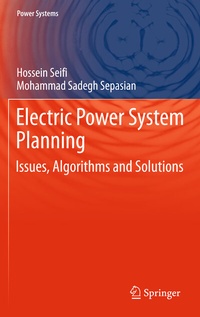
Electric Power System Planning
Description

More details
Other editions
Additional editions
Persons
The present book addresses various power system planning issues for professionals as well as senior level and postgraduate students. Its emphasis is on long-term issues, although much of the ideas may be used for short and mid-term cases, with some modifications. Back-up materials are provided in twelve appendices of the book. The readers can use the numerous examples presented within the chapters and problems at the end of the chapters, to make sure that the materials are adequately followed up.
Based on what Matlab provides as a powerful package for students and professional, some of the examples and the problems are solved in using M-files especially developed and attached for this purpose. This adds a unique feature to the book for in-depth understanding of the materials, sometimes, difficult to apprehend mathematically.
Chapter 1 provides an introduction to Power System Planning (PSP) issues and basic principles. As most of PSP problems aremodeled as optimization problems, optimization techniques are covered in some details in Chapter 2. Moreover, PSP decision makings are based on both technical and economic considerations, so economic principles are briefly reviewed in Chapter 3. As a basic requirement of PSP studies, the load has to be known. Therefore, load forecasting is presented in Chapter 4.
Single bus Generation Expansion Planning (GEP) problem is described in Chapter 5. This study is performed using WASP-IV, developed by International Atomic Energy Agency. The study ignores the grid structure. A Multi-bus GEP problem is discussed in Chapter 6 in which the transmission effects are, somehow, accounted for. The results of single bus GEP is used as an input to this problem.
SEP problem is fully presented in Chapter 7. Chapter 8 devotes to Network Expansion Planning (NEP) problem, in which the network is planned. The results of NEP, somehow, fixes the network structure. Some practical considerations and improvements such as multi-voltage cases are discussed in Chapter 9. As NEP study is typically based on some simplifying assumptions and Direct Current Load Flow (DCLF) analysis, detailed Reactive Power Planning (RPP) study is finally presented in Chapter 10, to guarantee acceptable ACLF performance during normal as well as contingency conditions. This, somehow, concludes the basic PSP problem.
The changing environments due to power system restructuring dictate some uncertainties on PSP issues. It is shown in Chapter 11 that how these uncertainties can be accounted for. Although is intended to be a text book, PSP is a research oriented topic, too. That is why Chapter 12 is devoted to research trends in PSP. The chapters conclude with a comprehensive example in Chapter 13, showing the step-by-step solution of a practical case.
Content
Power System Planning, Basic Principles.- Optimization Techniques.- Some Economic Principles.- Load Forecasting.- Single Bus Generation Expansion Planning.- Multi-bus Generation Expansion Planning.- Substation Expansion Planning.- Network Expansion Planning, a Basic Approach.- Network Expansion Planning, an Advanced Approach.- Reactive Power Planning.- Research Trends in Power System Planning.- Comprehensive Example.- Appendices.- Index
