

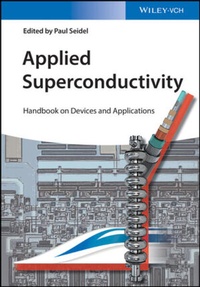
Applied Superconductivity
Handbook on Devices and Applications
1st Edition
Published on 22. January 2015
1336 pages
978-3-527-67066-6 (ISBN)
Description

This wide-ranging presentation of applied superconductivity, from fundamentals and materials right up to the latest applications, is an essential reference for physicists and engineers in academic research as well as in the field.
Readers looking for a systematic overview on superconducting materials will expand their knowledge and understanding of both low and high Tc superconductors, including organic and magnetic materials. Technology, preparation and characterization are covered for several geometries, but the main benefit of this work lies in its broad coverage of significant applications in power engineering or passive devices, such as filter and antenna or magnetic shields. The reader will also find information on superconducting magnets for diverse applications in mechanical engineering, particle physics, fusion research, medicine and biomagnetism, as well as materials processing. SQUIDS and their usage in medicine or geophysics are thoroughly covered as are applications in quantum metrology, and, last but not least, superconductor digital electronics is addressed, leading readers from fundamentals to quantum computing and new devices.
Readers looking for a systematic overview on superconducting materials will expand their knowledge and understanding of both low and high Tc superconductors, including organic and magnetic materials. Technology, preparation and characterization are covered for several geometries, but the main benefit of this work lies in its broad coverage of significant applications in power engineering or passive devices, such as filter and antenna or magnetic shields. The reader will also find information on superconducting magnets for diverse applications in mechanical engineering, particle physics, fusion research, medicine and biomagnetism, as well as materials processing. SQUIDS and their usage in medicine or geophysics are thoroughly covered as are applications in quantum metrology, and, last but not least, superconductor digital electronics is addressed, leading readers from fundamentals to quantum computing and new devices.
More details
Other editions
Additional editions
Book
02/2015
1st Edition
Wiley-VCH
€540.00
Article exhausted; check different version
Person
Edited by Paul Seidel, Professor of Applied Physics at the University of Jena and head of the department of Low Temperature Physics. His main fields of research are thin film deposition and growth, patterning, multilayers, tunneling, Josephson effects, and cryoelectronics. His strong engagement with the community is documented by serving as scientific board member of many international conferences and symposia. Paul Seidel has published more than 200 articles in international journals and contributed to more than 80 books. He is teaching both experimental and theoretical physics and offers special lectures in solid state and low temperature physics.
Content
1. Fundamentals
1.1 Superconductivity
1.1.1 Basic Properties and Parameters of Superconductors (Reinhold Kleiner)
1.1.2 Review on Superconducting Materials (Roland Hott, Reinhold Kleiner, Thomas Wolf, Gertrud Zwicknagel)
1.2 Main Related Effects
1.2.1 Proximity Effect (Mikhail Belogolovskii)
1.2.2 Tunneling and Superconductivity (Steven Ruggiero)
1.2.3 Flux Pinning (Stuart Wimbush)
1.2.4 AC Losses and Numerical Modeling of Superconductors (Francesco Grilli, Frederic Sirois)
2. Superconducting Materials
2.1 Low Temperature Superconductors
2.1.1 Metals and Alloys (Helmut Krauth, Klaus Schlenga)
2.1.2 Magnesiumdiborid (Davide Nardelli, Ilaria Pallecchi, Matteo Tropeano)
2.2 High Temperature Superconductors
2.2.1 Cuprate High Temperature Superconductors (Roland Hott, Thomas Wolf)
2.2.2 Iron-based Superconductors (Ilaria Pallecchi, Marina Putti)
3. Technology, Preparation and Characterization
3.1 Bulk Materials
3.1.1 Preparation of bulk and textured Superconductors (Frank N. Werfel)
3.1.2 Preparation of Single Crystals (Andreas Erb)
3.1.3 Properties of Bulk Materials (Günter Fuchs, Gernot Krabbes,Wolf-Rüdiger Canders)
3.2 Thin Films and Multilayers
3.2.1 Thin Film Deposition (Roger Wördenweber)
3.3 Josephson Junctions and Circuits
3.3.1 LTS Josephson Junctions (Hans-Georg Meyer, Ludwig Fritzsch, Solveig Anders, Matthias Schmelz, Jürgen Kunert, Gregor Oelsner)
3.3.2 HTS Josephson Junctions (Keiichi Tanabe)
3.4 Wires and Tapes
3.4.1 Powder-in tube Superconducting Wires (Tengming Shen, Jianyi Jiang, Eric Hellstrom)
3.4.2 YBCO Coated Conductors (Mariappan Parans Paranthaman, Tolga Aytug, Liliana Stan, Quanxi Jia, Claudia Cantoni)
3.5 Cooling
3.5.1 Fluid Cooling (Luca Bottura, Cesar Luongo)
3.5.2 Cryocoolers (Gunter Kaiser, Gunar Schröder)
3.5.3 Cryogen-free Cooling Systems (Gunter Kaiser, Andreas Kade)
4. Superconducting Magnets
4.1 Bulk Superconducting Magnets for Bearings and Levitation (John R. Hull)
4.1.1 Introduction
4.1.2 Understanding levitation with bulk superconductors
4.1.3 Rotational loss
4.1.4 A rotator dynamic issue
4.1.5 Practical bearing consideration
4.1.6 Applications
4.2 Fundamentals of Superconducting Electromagnets (Martin N. Wilson)
4.2.1 Windings to produce different field shapes
4.2.2 Current supply
4.2.3 Load lines, degradation and training
4.2.4 Cryogenic stabilization
4.2.5 Mechanical disturbances and minimum quench energy
4.2.6 Screening currents and the critical state model
4.2.7 Magnetization and flux jumping
4.2.8 Filamentary wires and cables
4.2.9 AC losses
4.2.10 Quenching and protection
4.3 Magnets for Particle Accelerators and Storage Rings (Lucio Rossi, Luca Bottura)
4.3.1 Introduction
4.3.2 Accelerator, colliders and role of superconducting magnets
4.3.3 Magnetic design
4.3.4 Mechanical design
4.3.5 Margins, stability, training and protection
4.3.6 Field quality
4.3.7 Fast-cycled synchrotrons
4.4 Superconducting Detector Magnets for particle physics (Michael Green)
4.4.1 The development of detector solenoids
4.4.2 LHC detector magnets for the ATLAS, CMC and ALICE experiments
4.4.3 The future of detector magnets for particle physics
4.4.4 The defining parameters for thin solenoids
4.4.5 Thin detector solenoids design criteria
4.4.6 Magnet power supply and coil quench protection
4.4.7 Design criteria for the ends of a detector solenoid
4.4.8 Cryogenic cooling of a detector magnet
4.5 Magnets for NMR and MRI (Yukikazu Iwasa, Seungyong Hahn)
4.5.1 Introduction to NMR and MRI Magnets
4.5.2 Specific Design Issues for NMR & MRI Magnets
4.5.3 Status (2013) of NMR and MRI Magnets
4.5.4 HTS Applications to NMR and MRI Magnets
4.5.5 Conclusions
4.6 Superconducting Magnets for Fusion (Jean-Luc Duchateau)
4.6.1 Introduction to fusion and superconductivity
4.6.2 ITER
4.6.3 Cable in Conduit conductors (CICC)
4.6.4 Quench protection in fusion magnets
4.6.5 Prospective about future fusion reactors Demo
4.6.6. Conclusion
4.7 Magnets for Separation, Crystal Growth and Inductive Melting (Swarn Kalsi)
4.7.1 Introduct
1.1 Superconductivity
1.1.1 Basic Properties and Parameters of Superconductors (Reinhold Kleiner)
1.1.2 Review on Superconducting Materials (Roland Hott, Reinhold Kleiner, Thomas Wolf, Gertrud Zwicknagel)
1.2 Main Related Effects
1.2.1 Proximity Effect (Mikhail Belogolovskii)
1.2.2 Tunneling and Superconductivity (Steven Ruggiero)
1.2.3 Flux Pinning (Stuart Wimbush)
1.2.4 AC Losses and Numerical Modeling of Superconductors (Francesco Grilli, Frederic Sirois)
2. Superconducting Materials
2.1 Low Temperature Superconductors
2.1.1 Metals and Alloys (Helmut Krauth, Klaus Schlenga)
2.1.2 Magnesiumdiborid (Davide Nardelli, Ilaria Pallecchi, Matteo Tropeano)
2.2 High Temperature Superconductors
2.2.1 Cuprate High Temperature Superconductors (Roland Hott, Thomas Wolf)
2.2.2 Iron-based Superconductors (Ilaria Pallecchi, Marina Putti)
3. Technology, Preparation and Characterization
3.1 Bulk Materials
3.1.1 Preparation of bulk and textured Superconductors (Frank N. Werfel)
3.1.2 Preparation of Single Crystals (Andreas Erb)
3.1.3 Properties of Bulk Materials (Günter Fuchs, Gernot Krabbes,Wolf-Rüdiger Canders)
3.2 Thin Films and Multilayers
3.2.1 Thin Film Deposition (Roger Wördenweber)
3.3 Josephson Junctions and Circuits
3.3.1 LTS Josephson Junctions (Hans-Georg Meyer, Ludwig Fritzsch, Solveig Anders, Matthias Schmelz, Jürgen Kunert, Gregor Oelsner)
3.3.2 HTS Josephson Junctions (Keiichi Tanabe)
3.4 Wires and Tapes
3.4.1 Powder-in tube Superconducting Wires (Tengming Shen, Jianyi Jiang, Eric Hellstrom)
3.4.2 YBCO Coated Conductors (Mariappan Parans Paranthaman, Tolga Aytug, Liliana Stan, Quanxi Jia, Claudia Cantoni)
3.5 Cooling
3.5.1 Fluid Cooling (Luca Bottura, Cesar Luongo)
3.5.2 Cryocoolers (Gunter Kaiser, Gunar Schröder)
3.5.3 Cryogen-free Cooling Systems (Gunter Kaiser, Andreas Kade)
4. Superconducting Magnets
4.1 Bulk Superconducting Magnets for Bearings and Levitation (John R. Hull)
4.1.1 Introduction
4.1.2 Understanding levitation with bulk superconductors
4.1.3 Rotational loss
4.1.4 A rotator dynamic issue
4.1.5 Practical bearing consideration
4.1.6 Applications
4.2 Fundamentals of Superconducting Electromagnets (Martin N. Wilson)
4.2.1 Windings to produce different field shapes
4.2.2 Current supply
4.2.3 Load lines, degradation and training
4.2.4 Cryogenic stabilization
4.2.5 Mechanical disturbances and minimum quench energy
4.2.6 Screening currents and the critical state model
4.2.7 Magnetization and flux jumping
4.2.8 Filamentary wires and cables
4.2.9 AC losses
4.2.10 Quenching and protection
4.3 Magnets for Particle Accelerators and Storage Rings (Lucio Rossi, Luca Bottura)
4.3.1 Introduction
4.3.2 Accelerator, colliders and role of superconducting magnets
4.3.3 Magnetic design
4.3.4 Mechanical design
4.3.5 Margins, stability, training and protection
4.3.6 Field quality
4.3.7 Fast-cycled synchrotrons
4.4 Superconducting Detector Magnets for particle physics (Michael Green)
4.4.1 The development of detector solenoids
4.4.2 LHC detector magnets for the ATLAS, CMC and ALICE experiments
4.4.3 The future of detector magnets for particle physics
4.4.4 The defining parameters for thin solenoids
4.4.5 Thin detector solenoids design criteria
4.4.6 Magnet power supply and coil quench protection
4.4.7 Design criteria for the ends of a detector solenoid
4.4.8 Cryogenic cooling of a detector magnet
4.5 Magnets for NMR and MRI (Yukikazu Iwasa, Seungyong Hahn)
4.5.1 Introduction to NMR and MRI Magnets
4.5.2 Specific Design Issues for NMR & MRI Magnets
4.5.3 Status (2013) of NMR and MRI Magnets
4.5.4 HTS Applications to NMR and MRI Magnets
4.5.5 Conclusions
4.6 Superconducting Magnets for Fusion (Jean-Luc Duchateau)
4.6.1 Introduction to fusion and superconductivity
4.6.2 ITER
4.6.3 Cable in Conduit conductors (CICC)
4.6.4 Quench protection in fusion magnets
4.6.5 Prospective about future fusion reactors Demo
4.6.6. Conclusion
4.7 Magnets for Separation, Crystal Growth and Inductive Melting (Swarn Kalsi)
4.7.1 Introduct
