
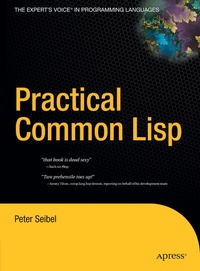
Practical Common Lisp
Description
Alles über E-Books | Antworten auf Fragen rund um E-Books, Kopierschutz und Dateiformate finden Sie in unserem Info- & Hilfebereich.
Lisp is often thought of as an academic language, but it need not be. This is the first book that introduces Lisp as a language for the real world.
Practical Common Lisp presents a thorough introduction to Common Lisp, providing you with an overall understanding of the language features and how they work. Over a third of the book is devoted to practical examples, such as the core of a spam filter and a web application for browsing MP3s and streaming them via the Shoutcast protocol to any standard MP3 client software (e.g., iTunes, XMMS, or WinAmp). In other "practical" chapters, author Peter Seibel demonstrates how to build a simple but flexible in-memory database, how to parse binary files, and how to build a unit test framework in 26 lines of code.
More details
Other editions
Additional editions

Person
Content
System requirements
File format: PDF
Copy protection: Watermark-DRM (Digital Rights Management)
System requirements:
- Computer (Windows; MacOS X; Linux): Use the free software Adobe Reader, Adobe Digital Editions, or any other PDF viewer of your choice (see eBook Help).
- Tablet/Smartphone (Android; iOS): Install the free app Adobe Digital Editions or another reading app for eBooks, e.g., PocketBook (see eBook Help).
- E-reader: Bookeen, Kobo, Pocketbook, Sony, Tolino and many more (only limited: Kindle).
The file format PDF always displays a book page identically on any hardware. This makes PDF suitable for complex layouts such as those used in textbooks and reference books (images, tables, columns, footnotes). Unfortunately, on the small screens of e-readers or smartphones, PDFs are rather annoying, requiring too much scrolling.
This eBook uses Watermark-DRM, a „soft” copy protection. This means that there are no technical restrictions to prevent illegal distribution. However, there is a personalised watermark embedded in the eBook that can be used to identify the purchaser of the eBook in the event of misuse and to provide evidence for legal purposes.
For more information, see our eBook Help page.