

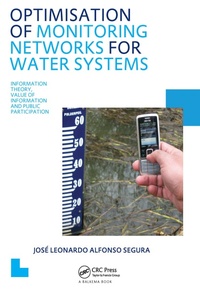
Optimisation of Monitoring Networks for Water Systems
UNESCO-IHE PhD Thesis
Published on 2. February 2026
198 pages
978-1-040-89491-0 (ISBN)
Description

Monitoring networks provide data that is analysed to help managers make informed decisions about their water systems. Their design and evaluation have a number of challenges that must be resolved, among others, the restriction on having a limited number of monitoring devices.
This book presents innovative methods to design and evaluate monitoring networks. The main idea is to maximise the performance of water systems by optimising the information content that can be obtained from monitoring networks. This is done through the combination of models and two theoretical concepts: Information Theory, initially developed in the field of communications, and Value of Information, initially developed in the field of economics. Additionally, the possibility of using public participation to gather information with mobile phones to improve models is also explored in the research. Two very different case studies are used to test the developed methods and theories: Pijnacker, a typical low-lying regional polder in the Netherlands, which is highly controlled and the Magdalena River, the major river system in Colombia.
The results of this research demonstrate that monitoring networks can be evaluated and designed by considering new variables, such as the information content, the user of the information and the potential of current mobile phones for data collection.
This book presents innovative methods to design and evaluate monitoring networks. The main idea is to maximise the performance of water systems by optimising the information content that can be obtained from monitoring networks. This is done through the combination of models and two theoretical concepts: Information Theory, initially developed in the field of communications, and Value of Information, initially developed in the field of economics. Additionally, the possibility of using public participation to gather information with mobile phones to improve models is also explored in the research. Two very different case studies are used to test the developed methods and theories: Pijnacker, a typical low-lying regional polder in the Netherlands, which is highly controlled and the Magdalena River, the major river system in Colombia.
The results of this research demonstrate that monitoring networks can be evaluated and designed by considering new variables, such as the information content, the user of the information and the potential of current mobile phones for data collection.
More details
Series
Language
English
Place of publication
London
United Kingdom
Publishing group
Taylor & Francis Ltd
Product notice
Reflowable
File size
14,24 MB
ISBN-13
978-1-040-89491-0 (9781040894910)
Copyright in bibliographic data and cover images is held by Nielsen Book Services Limited or by the publishers or by their respective licensors: all rights reserved.
Schweitzer Classification
Other editions
Additional editions
Book
09/2018
1st Edition
CRC Press
€207.98
Shipment within 10-20 days
Book
12/2010
1st Edition
CRC Press
€93.03
Shipment within 15-20 days
Person
Jose Leonardo Alfonso Segura was born in 1974 in Bogota, Colombia. In 1999 he graduated as Civil Engineer from the Faculty of Engineering of the National University of Colombia. After his graduation, he entered as Junior Engineer in the LEH Laboratory, in the same University, where he worked on projects on the Magdalena River. In 2004 he started his MSc studies in Hydroinformatics at UNESCO-IHE. He started his PhD studies in 2006, now working on the challenging task of developing approaches for designing and evaluating monitoring networks.
Content
Contents; Summary;
1. Introduction;
2. Literature Review;
3. Case Study 1: Polders of Pijnacker;
4. Case Study 2: Magdalene River;
5. Information Theory for Monitor Location;
6. Value of Information for Monitor Location;
7. Public Data Collection and Assessment of Model Reliability;
8. Conclusions and Recommendations;
9. References;
List of Figures; List of Tables; Notations; Abbrevations, Acknowledgements; About the Author.
1. Introduction;
2. Literature Review;
3. Case Study 1: Polders of Pijnacker;
4. Case Study 2: Magdalene River;
5. Information Theory for Monitor Location;
6. Value of Information for Monitor Location;
7. Public Data Collection and Assessment of Model Reliability;
8. Conclusions and Recommendations;
9. References;
List of Figures; List of Tables; Notations; Abbrevations, Acknowledgements; About the Author.
