

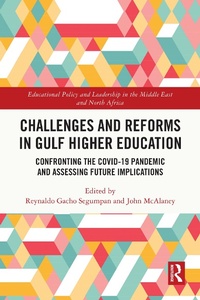
Challenges and Reforms in Gulf Higher Education
Confronting the COVID-19 Pandemic and Assessing Future Implications
1st Edition
Published on 22. December 2023
244 pages
978-1-003-82474-9 (ISBN)
Description

This edited volume explores the educational reforms and challenges in higher education in the Gulf countries during the COVID-19 pandemic.
Featuring a truly global spread of contributors and perspectives from countries such as Bahrain, India, Georgia, Malaysia, Oman, Pakistan, and Saudi Arabia, the book navigates experience-based and practice-linked research spectrum of the ramifications of the COVID-19 pandemic on higher education. It targets key challenges such as the move to online and distance learning, the impact of job-related stress, and the preparedness of institutional risk management. Using qualitative research, autoethnographic accounts, and case study findings, the book makes recommendations for reform implementation within higher education as well as discusses the wider socio-cultural and political landscape left by the pandemic in the Gulf region.
Highlighting current trends and challenges based on empirical works of the authors, the book will be of interest to scholars, researchers, and academics in the field of higher education, international and comparative education, and leadership strategy more specifically. Those involved with educational technology, education policy, and middle-eastern studies will also find the book of value.
Featuring a truly global spread of contributors and perspectives from countries such as Bahrain, India, Georgia, Malaysia, Oman, Pakistan, and Saudi Arabia, the book navigates experience-based and practice-linked research spectrum of the ramifications of the COVID-19 pandemic on higher education. It targets key challenges such as the move to online and distance learning, the impact of job-related stress, and the preparedness of institutional risk management. Using qualitative research, autoethnographic accounts, and case study findings, the book makes recommendations for reform implementation within higher education as well as discusses the wider socio-cultural and political landscape left by the pandemic in the Gulf region.
Highlighting current trends and challenges based on empirical works of the authors, the book will be of interest to scholars, researchers, and academics in the field of higher education, international and comparative education, and leadership strategy more specifically. Those involved with educational technology, education policy, and middle-eastern studies will also find the book of value.
More details
Series
Edition
1. Auflage
Language
English
Place of publication
London
United Kingdom
Publishing group
Taylor & Francis Ebooks
Target group
College/higher education
Professional and scholarly
Illustrations
42 Tables, black and white; 38 Line drawings, black and white; 4 Halftones, black and white; 42 Illustrations, black and white
ISBN-13
978-1-003-82474-9 (9781003824749)
Copyright in bibliographic data and cover images is held by Nielsen Book Services Limited or by the publishers or by their respective licensors: all rights reserved.
Schweitzer Classification
Other editions
Additional editions
Reynaldo Gacho Segumpan | John McAlaney
Challenges and Reforms in Gulf Higher Education
Confronting the COVID-19 Pandemic and Assessing Future Implications
Book
04/2025
1st Edition
Routledge
€65.30
Shipment within 10-20 days
Reynaldo Gacho Segumpan | John McAlaney
Challenges and Reforms in Gulf Higher Education
Confronting the COVID-19 Pandemic and Assessing Future Implications
Book
12/2023
1st Edition
Routledge
€205.60
Shipment within 10-20 days
Persons
Reynaldo Gacho Segumpan is Professor and Dean, City Graduate School, City University Malaysia and Fellow, Higher Education Academy, UK.
John McAlaney is Chartered Psychologist and Professor in Psychology, Bournemouth University, UK.
John McAlaney is Chartered Psychologist and Professor in Psychology, Bournemouth University, UK.
Content
Introduction
Part 1 - Understanding Regional Higher Education Reforms in a COVID-19 Context
Chapter 1
Potential Reforms in the GCC Higher Education Post COVID-19
Chapter 2
Pandemic Upsurge: Insights from Higher Education Reforms in the Gulf
Chapter 3
Toward a Self-Sustainable Higher Education Quality Assurance System: NFCFFE Model for Higher Education Quality Improvement and Assurance
Chapter 4
Pandemic Challenges of Higher Education: Reconsidering Core Values
Chapter 5
Higher Education in the COVID-19 Environment: ICT-based Perspective for GCC Countries
Chapter 6
Application of Risk Management on COVID-19 by Universities in the Gulf Cooperation Council (GCC)
Chapter 7
Directions in Gulf Higher Education: Conclusion
Part 2 - Reframing Higher Education Reforms
Chapter 8
An Empirical Analysis of Oman's Public and Private HEI Students' Behavioural Intention (BI) in Using E-learning during COVID-19
Chapter 9
Transforming Online Teaching of a First-Year Business Course: An Autoethnographic Reflection of Managing Teaching and Learning amidst the Pandemic in the Gulf Region
Chapter 10
University of Buraimi in Oman: Pandemic Lessons and Initiatives for Education Reform from Instructors' Perspectives
Chapter 11
The Role of Internal Crisis Communication on Faculty Members' Implementation of Blended Learning Practices in the Gulf
Chapter 12
Impact of Job-related Stress on Professional and Personal Life during Coronavirus Pandemic
Chapter 13
COVID-19 and the New Normal: Re-Imagining the Future of Higher Education
Chapter 14
Gulf Higher Education Reforms vis-a-vis the Pandemic: Conclusion
Part 1 - Understanding Regional Higher Education Reforms in a COVID-19 Context
Chapter 1
Potential Reforms in the GCC Higher Education Post COVID-19
Chapter 2
Pandemic Upsurge: Insights from Higher Education Reforms in the Gulf
Chapter 3
Toward a Self-Sustainable Higher Education Quality Assurance System: NFCFFE Model for Higher Education Quality Improvement and Assurance
Chapter 4
Pandemic Challenges of Higher Education: Reconsidering Core Values
Chapter 5
Higher Education in the COVID-19 Environment: ICT-based Perspective for GCC Countries
Chapter 6
Application of Risk Management on COVID-19 by Universities in the Gulf Cooperation Council (GCC)
Chapter 7
Directions in Gulf Higher Education: Conclusion
Part 2 - Reframing Higher Education Reforms
Chapter 8
An Empirical Analysis of Oman's Public and Private HEI Students' Behavioural Intention (BI) in Using E-learning during COVID-19
Chapter 9
Transforming Online Teaching of a First-Year Business Course: An Autoethnographic Reflection of Managing Teaching and Learning amidst the Pandemic in the Gulf Region
Chapter 10
University of Buraimi in Oman: Pandemic Lessons and Initiatives for Education Reform from Instructors' Perspectives
Chapter 11
The Role of Internal Crisis Communication on Faculty Members' Implementation of Blended Learning Practices in the Gulf
Chapter 12
Impact of Job-related Stress on Professional and Personal Life during Coronavirus Pandemic
Chapter 13
COVID-19 and the New Normal: Re-Imagining the Future of Higher Education
Chapter 14
Gulf Higher Education Reforms vis-a-vis the Pandemic: Conclusion
