

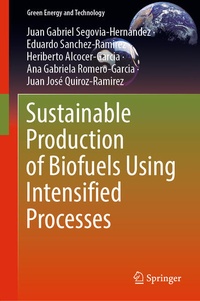
Sustainable Production of Biofuels Using Intensified Processes
Description

This book describes for first time the synthesis and intensified process design in the production of top biofuels. The production of biofuels is not new. In 2019, global biofuel production levels reached 1,841 thousand barrels of oil equivalent per day, in stark comparison to the 187 thousand barrels of oil equivalent per day that was produced in 2000. Growth has largely been driven by policies that encourage the use and production of biofuels due to the perception that it could provide energy security and reduce greenhouse gas emissions in relevant sectors. From a technical point of view, almost all fuels from fossil resources could be substituted by their bio-based counterparts. However, the cost of bio-based production in many cases exceeds the cost of petrochemical production. Also, biofuels must be proven to perform at least as good as the petrochemical equivalent they are substituting and to have a lower environmental impact. The low price of crude oil acted as a barrier to biofuels production and producers focussed on the specific attributes of biofuels such as their complex structure to justify production costs.
Also, the consumer demand for environmentally friendly products, population growth and limited supplies of non-renewable resources has now opened new windows of opportunity for biofuels. The industry is increasingly viewing chemical production from renewable resources as an attractive area for investment. This book uniquely introduces the application of new process intensification techniques that will allow the generation of clean, efficient and economical processes for biofuels in a competitive way in the market.
More details
Other editions
Additional editions
Persons
Prof. Dr. Juan Gabriel Segovia-Hernández, Professor at Department of Chemical, Engineering of University of Guanajuato (México) has strong expertise in synthesis, design and optimization of (bio) processes. He has contributed to defining systematic methodologies to found, in a complete way, optimum sustainable and green processes for the production of several commodities. He also applied his methodologies to the production of biofuels and bio-based building blocks. Products of his research are more than 140 papers published in high impact factor-indexed journals, 3 books with prestigious international publishers and four patent registers. In addition, he acts as Reviewer for over 25 top journals in chemical engineering, energy and applied chemistry. For the pioneering work and remarkable achievements in his area of scientific research, he was National President of Mexican Academy of Chemical Engineering (2013-2015) and Member of "Mexican Academy of Science" (since 2012). Also, he is"Associate Editor" of "Chemical Engineering and Processing: Process Intensification Journal" (Elsevier).
