

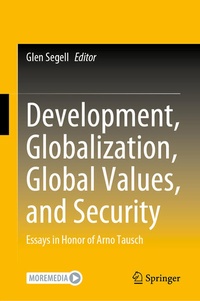
Development, Globalization, Global Values, and Security
Essays in Honor of Arno Tausch
1st Edition
Published on 12. April 2023
XV, 223 pages
978-3-031-24513-8 (ISBN)
Description

This book, written in honor of Arno Tausch, presents cutting-edge research on globalization, development, and global values. Internationally renowned authors cover topics such as global economic and political cycles, global values, and support for terrorism.
Over the last five decades, the Austrian political scientist Arno Tausch was a pioneer in studies on globalization, development and global values. This collection of essays takes up the issues dealt with by Tausch and presents perspectives for the 21st Century. Throughout his work, Tausch applied quantitative methods to study the fundamental issues of the global political economy and the global political system, like dependency, economic and political cycles, and global values, based on a rigorous study of available social scientific data, like the World Values Survey and the Arab Barometer.
Over the last five decades, the Austrian political scientist Arno Tausch was a pioneer in studies on globalization, development and global values. This collection of essays takes up the issues dealt with by Tausch and presents perspectives for the 21st Century. Throughout his work, Tausch applied quantitative methods to study the fundamental issues of the global political economy and the global political system, like dependency, economic and political cycles, and global values, based on a rigorous study of available social scientific data, like the World Values Survey and the Arab Barometer.
Reviews / Votes
"The thematic catholicity of this volume offers a fine reflection of the width and breadth of Arno TAUSCH's scholarship. The collected essays address crucially important topics of our age all of which comprised TAUSCH's many publications. Kudos to the editors and contributors for assembling such a fine anthology celebrating a fine scholar." (Andrei S. Markovits. Karl W. Deutsch Collegiate Professor of Comparative Politics and German Studies, University of Michigan, Ann Arbor)"To shape all levels of the world so that peace will prevail - this has been the scientific and political impulse of Arno TAUSCH all lifelong." (Dieter Senghaas, Professor of Peace, Conflict and Development Research (FR Germany), Author of Perpetual Peace. A Timely Assessment (2oo7))
"This book with contributions from experts in the filed represents well Professor Arno TAUSCH's major contributions to the literature on development, welfare, institutions, globalization, global values, and security using large datasets and advanced composite index methodology in large cross-country comparative studies." (Almas Heshmati, Professor of Economics, Jönköping International Business School (JIBS), Sweden)
"I first got in touch with Arno when I was Editor of the International Journal of Health Planning and Management, and he was contributing material on how globalisation was adversely affecting public health. As I came to explore his work, I realised that his recent work on health was but a small nugget in an immense quarry. This festschrift illustrates the trajectory of his work, from world systems and dependency to his studies on religions today. Early on, Arno rejected Hayek (and I wish that some of the clowns running the UK today could understand why.) His primary concern is with the marginalised and the underdog, but in the context of a morally inspired social-liberal vision for mankind. He is unusual in being a world theorist with a practical orientation to his theory at the very least in the sense that policymaking would be better-off if it heeded the results of his research. In an age of intellectual dead-ends and self-doubt, Arno is a giant." (Calum Paton, Emeritus Professor of Public Policy, Keele University, UK)
"As an academic in political science, reading the essays compiled in this book gave me new and interesting insights into TAUCH's approach to research during his career. It is also a valuable contribution by fellow academics in these fields which builds on the work TAUCH has done with the necessary mindfulness and critical analysis that gives this book valued credibility. In his introduction, the editor confidently hoped that "this work will provide a contribution, however minimal, so that the values chosen consistently show direction to our duties towards one another, our shared humanity." I believe this book does indeed adhere to these aspirations in a way TAUCH surely approves of and readers will, importantly, understand. I confidentlyrecommend this book for anyone who appreciated TAUCH's commitment to these values. For some it will be a timeously reminder of our duties to one another, and for others a necessary wake up call." (Dr Ina Gouws, Political Studies and Governance, University of the Free State, South Africa)
More details
Series
Language
English
Place of publication
Cham
Switzerland
Publishing group
Springer International Publishing
Target group
Professional and scholarly
Product notice
Reflowable
Illustrations
XV, 223 p. 13 illus., 5 illus. in color.
File size
5,24 MB
ISBN-13
978-3-031-24513-8 (9783031245138)
DOI
10.1007/978-3-031-24513-8
Schweitzer Classification
Other editions
Additional editions
Book
04/2023
Springer
€149.79
Shipment within 15-20 days
Person
Glen Segell
is a Visiting Professor and Research Fellow in the Department of Political Studies and Governance at the University of the Free State, South Africa, and Research Fellow at the Ezri Center for Iran & Gulf Studies, University of Haifa, Israel. He holds the rank of Brigadier-General (Reserves) and is an expert for NATO STO.
Content
Chapter 1. Introduction.- Part I. Development.- Chapter 2. Development Theory: The Social-Liberal Approach.- Chapter 3. Analysing Inequality, Dependence, and Poverty in the World System.- Chapter 4. Politics Means Shaping the Shape.- Chapter 5. Multinational Firms and the Pattern and Structure of Foreign Direct Investment.- Part II. Globalization.- Chapter 6. Global Studies Meets World-Systems Theory.- Chapter 7. World-scale Problems and the Policy Response of Multilateral Institutions.- Chapter 8. On the Hidden Pattern in the History of Wars.- Chapter 9. Russia and Germany in the System of Powers.- Part III. Global values.- Chapter 10. Globalization, Islamism and the Persistence of Religion.- Chapter 11. Studies on Global Catholicism.- Chapter 12. Tausch and Political Controversies in Austrian Media: 'Political Islam' in the Austrian Debate.- Part IV. Security.- Chapter 13. States of Emergency: In Whose Interest Are They Invoked?.- Chapter 14. Rabin and the Intelligence Services on the Eve of the Oslo Accords.- Chapter 15. Tausch on Terrorism.- Chapter 16. Terror in the 21st Century The Modus Operandi of the Islamic State - What we know and what we can learn from it!.
