

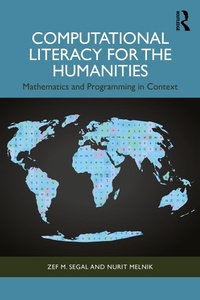
Computational Literacy for the Humanities
Mathematics and Programming in Context
1st Edition
Published on 23. June 2025
298 pages
978-1-040-34994-6 (ISBN)
Description

Computational Literacy for the Humanities provides an introduction to mathematics and programming that is specifically designed for use by those engaged in the humanities. Linking mathematical concepts and computational skills, the chapters in this book explore humanistic questions from diverse fields, such as art, history and literature.
The book helps to advance computational and digital literacy by showing that each mathematical concept has a history, and each technique has a meaning. Rather than viewing mathematics and computer programming as purely instrumental, they are integrated into the process of achieving greater understanding of humanistic phenomena. Algorithms, data, statistics and networks are taught critically within the book, whilst the authors also make a concerted effort to expose the internal biases of these tools. They also demonstrate the applicability of quantification and computation for the promotion of diversification and inclusivity within the humanities. All exercises are designed as an opportunity to gain hands-on mathematical and computational experience, whilst critically exploring and interpreting humanistic phenomena.
Computational Literacy for the Humanities shows readers how to engage with data in a way that is challenging, yet meaningful and empowering. It will be of interest to scholars and students working across the humanities and should be of particular interest to those working in digital humanities.
The book helps to advance computational and digital literacy by showing that each mathematical concept has a history, and each technique has a meaning. Rather than viewing mathematics and computer programming as purely instrumental, they are integrated into the process of achieving greater understanding of humanistic phenomena. Algorithms, data, statistics and networks are taught critically within the book, whilst the authors also make a concerted effort to expose the internal biases of these tools. They also demonstrate the applicability of quantification and computation for the promotion of diversification and inclusivity within the humanities. All exercises are designed as an opportunity to gain hands-on mathematical and computational experience, whilst critically exploring and interpreting humanistic phenomena.
Computational Literacy for the Humanities shows readers how to engage with data in a way that is challenging, yet meaningful and empowering. It will be of interest to scholars and students working across the humanities and should be of particular interest to those working in digital humanities.
Reviews / Votes
"Through its stunning clarity and intellectual richness, this book makes a major contribution to digital humanities. The author combines historical and practical material to introduce the principles of computational thinking. Vivid examples and step-by-step instruction provide excellent demonstrations of these principles. The discussion of mathematics, logic, and statistics is succinct and informative and the demonstration of applications is easy to follow. The organization and language of the book support independent learning for those interested in acquiring the fundamentals of computational literacy for humanities research. But even for those who may not pursue future applications of its principles, this book should be read for the insights it provides into the computational functions that underpin many aspects of contemporary life. I wish I had had this book while I was still teaching, but I would recommend it without reservation to anyone interested in or involved with computation in the humanities."Johanna Drucker, Distinguished Professor and Breslauer Professor Emerita, Department of Information Studies, University of California, Los Angeles, USA
More details
Edition
1. Auflage
Language
English
Place of publication
London
United Kingdom
Publishing group
Taylor & Francis Ltd
Target group
College/higher education
Professional and scholarly
Illustrations
19 Tables, black and white; 15 Line drawings, black and white; 57 Halftones, black and white; 72 Illustrations, black and white
File size
9,81 MB
ISBN-13
978-1-040-34994-6 (9781040349946)
Copyright in bibliographic data and cover images is held by Nielsen Book Services Limited or by the publishers or by their respective licensors: all rights reserved.
Schweitzer Classification
Other editions
Additional editions
Zef Segal | Nurit Melnik
Computational Literacy for the Humanities
Mathematics and Programming in Context
Book
06/2025
1st Edition
Routledge
€63.40
Shipment within 10-20 days
Zef Segal | Nurit Melnik
Computational Literacy for the Humanities
Mathematics and Programming in Context
Book
06/2025
1st Edition
Routledge
€208.10
Shipment within 10-20 days

Book
04/2025
Routledge
Unfortunately, price unknown
Available (delivery time upon request)
Persons
Zef M. Segal is senior lecturer at the School of Media Studies at the College of Management Academic Studies. His research centers on 19th-century mobility, space, and communication, with a particular focus on the historical analysis of journals and maps. A strong advocate for the digital humanities and social sciences in Israel, he spearheaded the development of the Digital Humanities track at the Open University and was among the founding faculty members of the first Israeli bachelor's degree in Digital Humanities at the University of Haifa. His most recent publications include Motion in Maps, Maps in Motion (2020), and The Political Fragmentation of Germany (2019). His forthcoming book, Culture in the Age of the Enlightenment: Reshaping the Private Sphere, will be published in Hebrew by the Open University of Israel.
Nurit Melnik is a senior lecturer in linguistics at the Open University of Israel. Her studies focus on diverse topics: constructions and the relationship between form and meaning, agreement variations in Modern Hebrew, lexical and syntactic flexibility and "frozen" expressions, grammar engineering and the cognitive aspects behind language change. Her work is situated at the intersection of theoretical linguistics, computational linguistics and corpus linguistics.
Nurit Melnik is a senior lecturer in linguistics at the Open University of Israel. Her studies focus on diverse topics: constructions and the relationship between form and meaning, agreement variations in Modern Hebrew, lexical and syntactic flexibility and "frozen" expressions, grammar engineering and the cognitive aspects behind language change. Her work is situated at the intersection of theoretical linguistics, computational linguistics and corpus linguistics.
Content
List of figures; Preface; Introduction; 1 Sets, numbers and functions; 2 Algorithmics; 3 Introduction to the Python Programming Language; 4 Reading charts; 5 Creating Charts; 6 Introduction to Descriptive Statistics; 7 Exploring Relationships Between Variables; 8 Network Theory and Applications in Humanities; 9 Center and Periphery in Network Theory; Index.
