

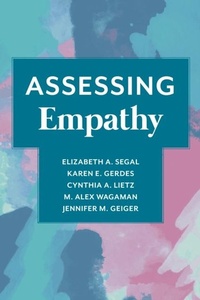
Assessing Empathy
1st Edition
Published on 10. April 2017
192 pages
978-0-231-54388-0 (ISBN)
Description

Empathy is a widely used term, but it is also difficult to define. In recent years, the field of cognitive neuroscience has made impressive strides in identifying neural networks in the brain related to or triggered by empathy. Still, what exactly do we mean when we say that someone has-or lacks-empathy? How is empathy distinguished from sympathy or pity? And is society truly suffering from an "empathy deficit," as some experts have charged??
In Assessing Empathy, Elizabeth A. Segal and colleagues marshal years of research to present a comprehensive definition of empathy, one that links neuroscientific evidence to human service practice. The book begins with a discussion of our current understanding of empathy in neurological, biological, and behavioral terms. The authors explain why empathy is important on both the individual and societal levels. They then introduce the concepts of interpersonal empathy and social empathy, and how these processes can interrelate or operate separately. Finally, they examine the weaknesses of extant empathy assessments before introducing three new, validated measures: the Empathy Assessment Index, the Social Empathy Index, and the Interpersonal and Social Empathy Index.
In Assessing Empathy, Elizabeth A. Segal and colleagues marshal years of research to present a comprehensive definition of empathy, one that links neuroscientific evidence to human service practice. The book begins with a discussion of our current understanding of empathy in neurological, biological, and behavioral terms. The authors explain why empathy is important on both the individual and societal levels. They then introduce the concepts of interpersonal empathy and social empathy, and how these processes can interrelate or operate separately. Finally, they examine the weaknesses of extant empathy assessments before introducing three new, validated measures: the Empathy Assessment Index, the Social Empathy Index, and the Interpersonal and Social Empathy Index.
All prices
More details
Other editions
Additional editions
Elizabeth Segal | Karen Gerdes | Cynthia Lietz
Assessing Empathy
Book
02/2017
Columbia University Press
€109.12
Article not available at the moment
Elizabeth Segal | Karen Gerdes | Cynthia Lietz
Assessing Empathy
Book
02/2017
Columbia University Press
€31.00
Shipment within 10-20 days
Persons
Elizabeth A. Segal is a professor in the School of Social Work at Arizona State University. She is the author of Social Welfare Policy and Social Programs: A Values Perspective, fourth edition (2016) and a co-author of An Introduction to the Profession of Social Work: Becoming a Change Agent, fifth edition (2016).
Karen E. Gerdes is professor emerita in the School of Social Work at Arizona State University. She is also a co-author of An Introduction to the Profession of Social Work: Becoming a Change Agent, fifth edition (2016).
Cynthia A. Lietz is senior associate dean of the College of Public Service and Community Solutions and professor at the School of Social Work at Arizona State University. She is the co-author of Applying Theory to Generalist Social Work Practice (2015).
M. Alex Wagaman is assistant professor at the Virginia Commonwealth University School of Social Work and co-author of Practice Behaviors Workbook for Social Welfare Policy and Social Programs: A Values Perspective, third edition (2012).
Jennifer M. Geiger is an assistant professor at the Jane Addams College of Social Work, University of Illinois at Chicago.
Karen E. Gerdes is professor emerita in the School of Social Work at Arizona State University. She is also a co-author of An Introduction to the Profession of Social Work: Becoming a Change Agent, fifth edition (2016).
Cynthia A. Lietz is senior associate dean of the College of Public Service and Community Solutions and professor at the School of Social Work at Arizona State University. She is the co-author of Applying Theory to Generalist Social Work Practice (2015).
M. Alex Wagaman is assistant professor at the Virginia Commonwealth University School of Social Work and co-author of Practice Behaviors Workbook for Social Welfare Policy and Social Programs: A Values Perspective, third edition (2012).
Jennifer M. Geiger is an assistant professor at the Jane Addams College of Social Work, University of Illinois at Chicago.
Content
1. What Is Empathy?
2. The Building Blocks of Empathy
3. Why Is Empathy Important?
4. Why Is Empathy So Difficult to Achieve?
5. Linking Interpersonal and Social Empathy
6. Tools for Measuring and Assessing Empathy
Appendix A. Research and Statistical Analysis of the Relationship Between Interpersonal Empathy and Social Empathy
Appendix B. Empathy Assessment Index
Appendix C. Social Empathy Index
Appendix D. Interpersonal and Social Empathy Index
Appendix E. Spanish Translation of the Empathy Assessment Index, the Social Empathy Index, and the Interpersonal and Social Empathy Index, by David Becerra and María del Rosario Silva Arciniega
References
Index

