

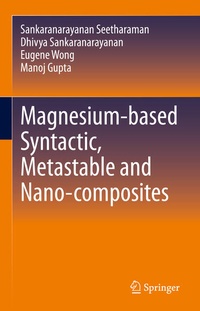
Magnesium-based Syntactic, Metastable and Nano-composites
Description

The book provides a detailed study and review on magnesium composites and includes recent studies on nanoparticulate reinforced magnesium composites, metastable composites and syntactic composites highlighting the improvement in properties compared with conventional micron-size ceramic-reinforced magnesium composites. It provides a comprehensive review on magnesium composites focusing on the addition of nanoreinforcements, which can substantially improve the properties of magnesium without the negative effect of reduced ductility and increased weight that are typically associated with the addition of micron size reinforcements. Magnesium is the lightest structural metal and has tremendous potential to replace aluminum leading to improved weight savings and machinability. Compared to polymer composites, magnesium composites can be repaired using existing metal repair techniques whereas polymer composites require sophisticated non-destructive testing techniques to detect underlying cracknetwork and extensive removal of materials to repair the damaged component.
Due to increasing emphasis on light weighting to reduce carbon emissions and with the recent approval of magnesium usage for aircraft seats in 2015 the amount of work with magnesium metals and alloys and thereby this research area expanded significantly.More details
Other editions
Additional editions
Persons
Prof. Manoj Gupta is currently serving as Provost Chair Professor in the Mechanical Engineering Department of National University of Singapore. He completed his Ph.D. (Materials Science) from the University of California at Irvine in 1992 and postdoctoral research at University of Alberta, Canada in the same year. Previously, he served as Director designate of Materials Science and Engineering Initiative at NUS and as Head of Materials Division of Department of Mechanical Engineering. His current research interests include processing, microstructure and properties evaluation of advanced light weight structural materials.
Dr. Eugene Won g is currently Director of Operations with the School of Mechanical & System Engineering, Newcastle University International Singapore. He is involved in the Mechanical Design and Manufacturing Engineering degree program which is offered in collaboration with Singapore Institute of Technology. Dr Wong received his BEng and PhD degrees from National University of Singapore and was a recipient of NUS President's Graduate Fellowship and NUS Graduate Research Scholarship. His research interests include the development of lightweight metal matrix composites, repair of polymer composite materials, energy efficient microwave processing of materials and additive manufacturing technologies.Content
Introduction to Magnesium.- Metal Matrix Composites.- Synthesis Techniques for Magnesium Based Composites.- Magnesium Based Composites.- Review of Characteristics of Magnesium Nanocomposites.- Machinability of Magnesium Composites.- Weldability of Magnesium Composites.- Coatings for Magnesium and Composites.
