

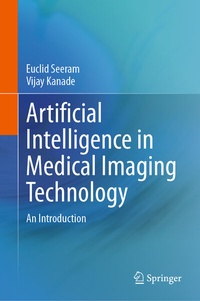
Artificial Intelligence in Medical Imaging Technology
Description

This book covers the principles, concepts, and applications of artificial intelligence in medical imaging technologies, specifically in the context of diagnostic imaging, such as radiography and radiological technology. First, artificial intelligence and its subsets machine learning and deep learning are described followed by a discussion of applications of these AI principles in medical imaging technologies. Finally, ethical questions, regulatory aspects, and future trends and challenges are also reviewed in this textbook.
This book is intended for both students and practitioners in radiological technology, radiography, radiation therapy, nuclear medicine technology, diagnostic medical sonography, and biomedical engineering technology. Furthermore, residents in radiology, and medical physics students and related healthcare personnel (administrators and managers for example) may find this book useful.
More details
Other editions
Additional editions
Persons
Euclid Seeram was formerly the Program Head of the Medical Imaging Degree and Magnetic Resonance Imaging Post Diploma Programs at the British Columbia Institute of Technology, where he worked for 38 years serving the Medical Imaging Education and Clinical Practice Communities.
Currently he serves as adjunct associate professor at Monash University; adjunct research professor at Charles Sturt University; and Adjunct Associate Professor, University of Canberra; in Australia. Furthermore, Euclid is a regular guest lecturer in Radiographic Sciences; Computed Tomography Physics and Instrumentation; for VCA Education Solutions for Health Professionals; Toronto, Ontario, Canada. Additionally, Euclid presents lectures (by invitation) on topics related to x-ray imaging systems to biomedical engineering technology program students at the British Columbia Institute of Technology, in British Columbia, Canada.
Euclid has published more than 60 papers in peer-reviewed radiologic technology journals and has had 27 textbooks published on computed tomography, computers in radiology, radiographic instrumentation, digital radiography, and radiation protection. He is a founding member of the Journal of Medical Imaging and Radiation Sciences and is now on editorial boards for Radiography; Biomedical Imaging and Intervention Journal; International Journal of Radiology and Medical Imaging; Open Journal of Radiology; Journal of Allied Health; Journal of Social Science & Allied Health Professions. Euclid also serves on the international advisory panel for the Journal of Medical Radiation Sciences based in Australia. Euclid's current research interests are related to radiation dose optimization in computed tomography and digital radiography imaging systems, as well as in radiation protection related to diagnostic imaging.
Vijay Kanade embarked on his research journey at Raman Research Institute, Bangalore, where he involuntarily assumed the role of a 'research scholar' for a concise duration of 6 months. During his tenure, he actively engaged in projects centered around 'Brain Computer Interface (BCI).' Subsequently, he transitioned into the corporate sector, delving into the realm of 'Intellectual Property (IP),' wherein he served various IP firms for a span of eight years.
During his tenure as an IP professional, Vijay conducted independent research endeavors, garnering international recognition from universities worldwide, who extended invitations for him to present his work. To date, he has authored over 50 research papers, disseminated through esteemed international conferences and peer-reviewed journals such as Springer, ACM, IEEE, and other reputable Scopus indexed publications.
Presently, Vijay serves as an autonomous researcher, dedicating part of his time to freelance as an "AI researcher" for an online publishing firm. Additionally, he remains engaged in addressing IP-related matters whenever required
Content
Chapter 1-Artificial Intelligence in Medical Imaging: A Brief Glance.- Chapter 2-AI Fundamentals.- Chapter 3-Principles of Machine Learning.- Chapter 4-Principles of Deep Learning.- Chapter 5-Image Processing and Analysis.- Chapter 6-AI in CT Image Reconstruction.- Chapter 7-AI Applications in Medical Imaging.- Chapter 8-Ethical and Regulatory Considerations.- Chapter 9-Future Trends and Challenges.
