

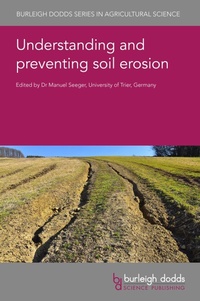
Understanding and Preventing Soil Erosion
Published on 20. August 2024
262 pages
978-1-80146-380-5 (ISBN)
Description

It's been suggested that around 12 million hectares of agricultural land are affected by soil erosion each year. If the degradation of the world's soil reservoir continues, many have estimated that this could lead to a 30% reduction in global food production by 2040.
Understanding and preventing soil erosion provides a comprehensive overview of recent research on understanding the mechanisms of soil erosion, as well as the best practices for measuring and modelling soil erosion risk in agricultural soils. The book also considers the range of agronomic practices and techniques available to mitigate future soil erosion, including the use of buffer strips, zero/no-tillage and soil stabilisers.
In its detailed assessment of soil erosion, the book succeeds in highlighting the potential future impact of degraded soils on the quality, security and longevity of our global food system if the problem of soil erosion isn't effectively managed.
Understanding and preventing soil erosion provides a comprehensive overview of recent research on understanding the mechanisms of soil erosion, as well as the best practices for measuring and modelling soil erosion risk in agricultural soils. The book also considers the range of agronomic practices and techniques available to mitigate future soil erosion, including the use of buffer strips, zero/no-tillage and soil stabilisers.
In its detailed assessment of soil erosion, the book succeeds in highlighting the potential future impact of degraded soils on the quality, security and longevity of our global food system if the problem of soil erosion isn't effectively managed.
More details
Series
Language
English
Place of publication
Cambridge
United Kingdom
Target group
College/higher education
Professional and scholarly
Researchers in soil and crop science, agricultural engineers, farmers, as well as government and other agencies monitoring the health of agricultural soils
Illustrations
Color tables, photos and figures
File size
5,24 MB
ISBN-13
978-1-80146-380-5 (9781801463805)
DOI
10.19103/AS.2023.0131
Copyright in bibliographic data and cover images is held by Nielsen Book Services Limited or by the publishers or by their respective licensors: all rights reserved.
Schweitzer Classification
Other editions
Additional editions
Manuel Seeger
Understanding and Preventing Soil Erosion
Book
08/2024
Burleigh Dodds Science Publishing Limited
€222.90
Shipment within 3-4 weeks
Persons
Dr Manuel Seeger is Senior Lecturer in the Department of Physical Geography in the School of Regional and Environmental Sciences at the University of Trier, Germany. He was formerly Associate Professor at the University of Zaragoza, Spain, and Assistant Professor at Wageningen University, The Netherlands. Dr Seeger is internationally known for his research on measuring, understanding and mitigating soil erosion, particularly for European soils. He has chaired sessions related to soil erosion, its measurement and modelling at a number of conferences, including those organised by the European Geosciences Union. Dr Seeger is also on the editorial boards of a number of journals and has participated in a number of EU research projects such as DiverFarming and FireLinks.
Dennis C. Flanagan is a Research Agricultural Engineer and Lead Scientist with the USDA-Agricultural Research Service (ARS) National Soil Erosion Research Laboratory (NSERL) in West Lafayette, Indiana. He is also an adjunct full Professor with the Purdue University Department of Agricultural & Biological Engineering. His research deals with soil erosion by water mechanics, erosion control, and erosion prediction technology development. He is the leader of the Water Erosion Prediction Project (WEPP) modeling efforts by the USDA-ARS (since 1999), and works extensively with user agencies (Forest Service, Natural Resources Conservation Service, etc.) and others on implementation and use of this process-based technology. He has authored or co-authored over 300 publications including 143 refereed journal articles and 15 book chapters, and has edited 4 books. Dr. Flanagan has made frequent presentations at the American Society of Agricultural & Biological Engineers (ASABE) international meetings, was Chair of the 10th International Symposium on Agriculture and the Environment (AgroEnviron 2016), and was Chair of the 2023 ASABE Soil Erosion Research under a Changing Climate international symposium. He is a life member and Fellow of ASABE, and also a member of the Soil and Water Conservation Society (SWCS) and the American Geophysical Union (AGU).
Michael retired from USDA-NRCS in January 2023 after a forty-two-year career. At retirement Michael served as the National Erosion Database Steward and Agronomist at National Soil Survey Center in Lincoln, Nebraska. Some select awards Michael received included the Hugh Hammond Bennett award for international work in soil and water management from the Soil and Water Conservation Society, Nebraska Agribusiness Assocation Partnership and Researcher/Educator of the Year awards, Nebraska FFA Assocation Honorary State FFA Degree and many more.
Dennis C. Flanagan is a Research Agricultural Engineer and Lead Scientist with the USDA-Agricultural Research Service (ARS) National Soil Erosion Research Laboratory (NSERL) in West Lafayette, Indiana. He is also an adjunct full Professor with the Purdue University Department of Agricultural & Biological Engineering. His research deals with soil erosion by water mechanics, erosion control, and erosion prediction technology development. He is the leader of the Water Erosion Prediction Project (WEPP) modeling efforts by the USDA-ARS (since 1999), and works extensively with user agencies (Forest Service, Natural Resources Conservation Service, etc.) and others on implementation and use of this process-based technology. He has authored or co-authored over 300 publications including 143 refereed journal articles and 15 book chapters, and has edited 4 books. Dr. Flanagan has made frequent presentations at the American Society of Agricultural & Biological Engineers (ASABE) international meetings, was Chair of the 10th International Symposium on Agriculture and the Environment (AgroEnviron 2016), and was Chair of the 2023 ASABE Soil Erosion Research under a Changing Climate international symposium. He is a life member and Fellow of ASABE, and also a member of the Soil and Water Conservation Society (SWCS) and the American Geophysical Union (AGU).
Michael retired from USDA-NRCS in January 2023 after a forty-two-year career. At retirement Michael served as the National Erosion Database Steward and Agronomist at National Soil Survey Center in Lincoln, Nebraska. Some select awards Michael received included the Hugh Hammond Bennett award for international work in soil and water management from the Soil and Water Conservation Society, Nebraska Agribusiness Assocation Partnership and Researcher/Educator of the Year awards, Nebraska FFA Assocation Honorary State FFA Degree and many more.
Content
Part 1 Mechanisms
1.Advances in understanding soil erodibility: Karl Manuel Seeger, University of Trier, Germany;
2.Soil erosion by water processes and prediction technology: Dennis C. Flanagan, USDA-ARS National Soil Erosion Research Laboratory, USA;
3.Assessing the impact of climate change on soil erosion by water: Karl Auerswald, Technical University of Munich, Germany; and Peter Fiener, University of Augsburg, Germany;
Part 2 Measuring soil erosion
4.Advances in proximal instrumental techniques for measuring gully and rill erosion of agricultural soils: J. Casali, M. A. Campo-Bescos, J. Alvarez-Mozos and R. Gimenez, University of Navarre (UPNA), Spain;
5.Advances in tracking sediment transport from agricultural land: Anthony J. Parsons, University of Sheffield, UK;
6.Advances in modeling soil erosion risk: Sudhanshu S Panda, University of North Georgia, USA; Debasmita Misra, University of Alaska Fairbanks, USA; Devendra M Amatya and Johnny M Grace III, USDA Forest Service, USA; and Anita Thompson, University of Wisconsin-Madison, USA;
Part 3 Mitigating soil erosion
7.Assessing the effectiveness and history of buffer strip implementation in preventing soil sediment and nutrient losses to surface waters: Brian Kronvang and Dominik Zak, Aarhus University, Denmark; Eva Skarbovik and Anne-Grete Buseth Blankenberg, Norwegian Institute of Bioeconomy Research (NIBIO), Norway; and Marc Stutter, The James Hutton Institute, UK;
8.The effects of no-till and related practices in preventing soil erosion: Michael Kucera, Formerly USDA Natural Resources Conservation Service (USDA-NRCS)/National Soil Survey Center, USA;
9.The use of soil stabilizers to prevent erosion: G. J. Levy , Agricultural Research Organization, Israel; and A. I. Mamedov, Tottori University, Japan;
1.Advances in understanding soil erodibility: Karl Manuel Seeger, University of Trier, Germany;
2.Soil erosion by water processes and prediction technology: Dennis C. Flanagan, USDA-ARS National Soil Erosion Research Laboratory, USA;
3.Assessing the impact of climate change on soil erosion by water: Karl Auerswald, Technical University of Munich, Germany; and Peter Fiener, University of Augsburg, Germany;
Part 2 Measuring soil erosion
4.Advances in proximal instrumental techniques for measuring gully and rill erosion of agricultural soils: J. Casali, M. A. Campo-Bescos, J. Alvarez-Mozos and R. Gimenez, University of Navarre (UPNA), Spain;
5.Advances in tracking sediment transport from agricultural land: Anthony J. Parsons, University of Sheffield, UK;
6.Advances in modeling soil erosion risk: Sudhanshu S Panda, University of North Georgia, USA; Debasmita Misra, University of Alaska Fairbanks, USA; Devendra M Amatya and Johnny M Grace III, USDA Forest Service, USA; and Anita Thompson, University of Wisconsin-Madison, USA;
Part 3 Mitigating soil erosion
7.Assessing the effectiveness and history of buffer strip implementation in preventing soil sediment and nutrient losses to surface waters: Brian Kronvang and Dominik Zak, Aarhus University, Denmark; Eva Skarbovik and Anne-Grete Buseth Blankenberg, Norwegian Institute of Bioeconomy Research (NIBIO), Norway; and Marc Stutter, The James Hutton Institute, UK;
8.The effects of no-till and related practices in preventing soil erosion: Michael Kucera, Formerly USDA Natural Resources Conservation Service (USDA-NRCS)/National Soil Survey Center, USA;
9.The use of soil stabilizers to prevent erosion: G. J. Levy , Agricultural Research Organization, Israel; and A. I. Mamedov, Tottori University, Japan;
