

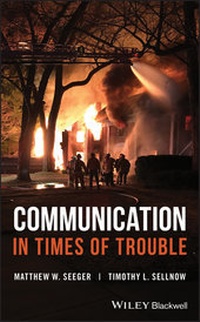
Communication in Times of Trouble
Description

This book covers crisis communication strategies and focuses on practical applications for effective management. It includes an extensive discussion of best practices in pre-crisis, crisis and post crisis stages. The book pays special attention to the needs of meeting the needs of diverse audiences and communicating in a responsive and responsible way. The principles are appropriate for many kinds of events including earthquakes, tornadoes, hurricanes, tsunamis, epidemics, and pandemics as well as industrial accidents, toxic spills, transportation disasters, fires and intentional events.
In the first chapter, Communication in Times of Trouble introduces the concept of best practices and establishes their relevance for crisis communication and emergency risk communication. A chapter is dedicated to each of the ten best practices. In each chapter, the best practice is described, examples of successful and unsuccessful application of the best practice in both organizational crises and natural disasters/emergencies are provided, advice for practical application is given, and a summary is provided. The concluding chapter details the challenges and opportunities for developing and implementing a response strategy that includes the best practices as a whole.
* Focuses on application and explanation in crisis communication to benefit those with backgrounds in emergency management, risk management, political science, disaster sociology, and public health
* Covers natural, large-scale emergencies such as earthquakes, tornadoes, hurricanes, tsunamis, epidemics, and pandemics, which aren't generally detailed in existing crisis communication texts
* Presents 10 best practices for dealing with emergencies: Process Approach; Pre-Event Planning; Partnerships; Public Concern; Honesty; Collaborate; Media access; Compassion; Uncertainty; Empowerment
Communication in Times of Trouble will be of great interest to undergraduate students and practitioners in communication, public relations, public affairs, public information, public health, and emergency management.
More details
Other editions
Additional editions
Persons
MATTHEW W. SEEGER is currently a professor communication and Dean of the College of Fine, Performing and Communication Arts at Wayne State University in Detroit. His research concerns crisis and risk communication, health promotion and communication, crisis response and agency coordination, the role of media, including new media, crisis and communication ethics, failure of complex systems and post-crisis renewal. He has worked with several national and international agencies including the United States Centers for Disease Control and Prevention and the World Health Organization. He is co-author of the CDC's Crisis and Emergency Communication, (2nd ed.) and co-editor of the International Handbook of Crisis Communication.
TIMOTHY L. SELLNOW is a professor of strategic communication in the Nicholson School of Communication and Media at the University of Central Florida. Dr. Sellnow's research focuses on strategic communication for bioterrorism, pre-crisis planning, disaster warning messages, public health, and crisis recovery. He has conducted funded research for the Department of Homeland Security, the United States Department of Agriculture, the Environmental Protection Agency, the United States Geological Survey, and the World Health Organization. He has also served in an advisory role for the National Academy of Sciences and the Food and Drug Administration.
Seeger and Sellnow have both published extensively on risk and crisis communication. They have previously collaborated on six books, including: Communication and Organizational Crisis, Effective Crisis Communication, Communication and the Public Health, Effective Risk Communication, Theorizing Crisis Communication, and Narratives of Crisis: Stories of Ruin and Renewal.
Content
Acknowledgements ix
1 Introduction 1
What Is a Crisis? 2
What Do We Mean by Crisis Communication? 4
What Distinguishes Crisis Communication? 7
What Are Best Practices? 7
Summary 9
References 10
2 Process Approach: Take a Process Approach to Crisis Communication 11
What Do We Mean by "Communication Is a Process"? 12
What Does a Process Approach Mean for Crisis? 12
What Is a Crisis Life Cycle? 14
How Can These Stages Be Used by Crisis Communicators? 16
Why Should Communicators Participate in the Policy Formation Process? 17
Summary 19
References 20
3 Preevent Planning: Engage in Preevent Planning for Crisis
Communication 21
What Does Planning Involve? 21
What Is Crisis Communication Planning? 23
How Is a Plan Created? 24
How Is Risk Assessed? 25
What Is Included in a Crisis Plan? 26
Standard Elements of a Crisis Communication Plan 28
Implementing a Crisis Plan 29
Summary 30
References 31
4 Partnerships: Form Stakeholder Partnerships With Publics 33
Why Do Crisis Leaders Sometimes Avoid Communicating With Their Publics? 33
How Are Relationships With Publics Established? 34
What Is Dialog? 35
Why Do Some Agencies and Organizations Fail to Establish Dialog? 36
How Does Dialog Produce Partnerships With Publics? 37
Are There Times When Dialog Should Be Avoided? 38
What Roles Can Publics Play in Their Partnerships With Organizations and Agencies? 39
Summary 41
References 42
5 Public Concern: Listen to and Acknowledge Concerns of Publics 45
How Do Publics Respond to Risks? 46
What Communication Challenges Do Hazards Create? 46
What Communication Challenges Does Outrage Create? 49
How Should Agencies and Organizations Acknowledge the Concerns of Publics? 50
How Do Organizations and Agencies Anticipate Which Issues Are Likely to Produce Public Outrage? 51
How Can Organizations Communicate to Prevent and Manage Outrage? 52
Summary 54
References 55
6 Honesty: Communication With Honesty, Frankness, and Openness 57
Why Is It So Important to Be Honest? 58
What Does It Really Mean to Be Honest? 60
What Are Some Challenges to Being Honest During a Crisis? 62
How Is Openness Achieved During a Crisis? 64
Summary 66
References 67
7 Collaboration: Collaborate and Coordinate With Credible Sources 69
Who Are the Credible Partners for an Organization? 70
What Do Collaboration and Coordination Mean? 72
Why Are Collaboration and Coordination So Important? 75
How Can an Organization Create Collaboration and Coordination? 76
It Is Possible to Coordinate and Cooperate With Hostile Groups? 76
Summary 77
References 78
8 Media Access: Meet the Needs of the Media and Remain Accessible 79
Why Is Media Access Important? 80
What Does Accessibility Mean? 82
How Does an Organization Maintain Accessibility? 83
What Happens If Organizations Are Not Open During a Crisis? 85
Will the Media Tell a Negative Story Regardless of the Facts? 86
Summary 86
References 87
9 Compassion: Communicate With Compassion 89
What Is a Compassionate Response to Crisis? 90
Who Is the Best Organizational Spokesperson for Expressing Compassion? 92
When Is Expressing Compassion Most Important? 93
Should an Organization Express Compassion If Blame Is Uncertain? 94
How Should an Organization Express Compassion If Blame Is Certain? 94
How Should Spokespersons Express Compassion Through Social Media? 95
What Role Does Culture Play in the Expression of Compassion? 96
Summary 97
References 98
10 Uncertainty: Accept Uncertainty and Ambiguity 101
What Causes Uncertainty for Publics? 101
How Do Publics Respond to Uncertainty? 103
What Kind of Information Do Publics Seek to Reduce Their Uncertainty? 104
How Can Organizations Avoid Overreassuring Their Publics? 105
What Are Some Other Ways to Manage Uncertainty? 106
What Are the Ethical Standards for Managing Uncertainty? 108
Summary 110
References 111
11 Empowerment: Communicate Messages of Empowerment 113
How Can Messages Empower Publics? 113
What Are the Components of an Empowering Message? 114
How Can Risk and Crisis Communicators Help Their Publics Internalize the Risk? 114
How Should Messages Be Distributed to Publics? 116
How Much Explanation of the Crisis Is Necessary? 117
How Should Recommendations for Self-Protective Actions Be Communicated? 118
What If Publics Are Given Competing Recommendations for Empowerment? 120
What Is the Role of Empowering Messages Outside the Acute Phase of Crisis? 121
Summary 122
References 123
12 Conclusion: Implementing the Best Practices 125
Are Crises Really Occurring More Often and Are They Getting Worse? 126
How Can an Organization Repair Its Damaged Image? 128
Are There Ever Positive Outcomes to a Crisis? 130
What Are the Challenges to Implementing the Best Practices? 132
How Can the Best Practices Approach to a Crisis Be Used? 133
Summary 134
References 135
Index 137
1
Introduction
Our world is increasingly complex. Companies and organizations are larger than ever and are tightly connected by complex and changing technologies and long supply chains. Daunting and complicated issues like climate change, population shifts and migration, and global political instability create very rapid and widespread change. Many critical resources such as water and energy are in increasingly short supply. Social, political, environmental, and economic conditions seem unstable and unpredictable. Ways of operating, doing business, making a living, interacting with others, and communicating are constantly evolving. The high level of complexity and change is matched by an escalating number and severity of emergencies, disasters, and crises.
Bad things are happening all the time, all around us. It seems like social media and old or legacy media are constantly reporting on a new threat, crisis, or disaster. Severe weather (e.g., hurricanes, tornadoes, blizzards, floods, heat waves, and droughts) occurs throughout the United States and around the world. Most climate scientists predict more extreme weather because of global climate change. Spills of toxic materials (e.g., oil, industrial chemicals, sewage, and even radiological material) are increasingly common. Earthquakes are regular events in some parts of the world and are among the deadliest naturally occurring crises. In addition, they can lead to secondary crises, such as tsunamis, toxic spills, and industrial disasters, as was the case with the Fukushima Daiichi nuclear disaster in Japan in 2011. Mass shooting and workplace violence, sadly, appear to be happening more often. The 2012 shooting at Sandy Hook Elementary School in Newtown, Conn., killed 20 children and 6 adult staff members. The Parkland, Fla., shootings claimed 17 lives. Transportation accidents, terrorist events, defective products, plant explosions, criminal activity, infectious diseases, and sudden economic downturns all can be considered crises (Sellnow & Seeger, 2013).
Because our society is more complex, technologically sophisticated, dynamic, and interdependent than ever before, these crises can be very disruptive and destructive. Contamination of a basic food product, such as peanut paste, may have consequences for hundreds of consumer products, including cookies, crackers, cakes, cereals, candy, and other snack foods. The 2008 Salmonella contamination at Peanut Corporation of America led to the recall of almost 4,000 separate products that contained the company's peanut paste. A relatively small defect in a safety device may end up in thousands of cars, prompting industry-wide recalls. Takata Corporation's defective airbags were installed in dozens of automotive models. At least 12 companies and over 19 million cars were involved in the recall that likely cost the company at least $5 billion. An outbreak of an infectious disease in a remote part of the world can slow and limit air travel, cost billions in medical preparation, and create global fear. The 2014 Ebola outbreak in West Africa dominated media coverage for weeks and became a significant political issue in the United States because of fears the disease could jump to other parts of the world.
The ways we prepare for, respond to, and understand these and other crisis events are influenced by our communication. Risk communication, the process of informing people about potential hazards, is a central activity in helping people prepare for a crisis. The U.S. Department of Homeland Security () for example, has created a Ready.Gov website and a series of "Preparing Makes Sense" public service announcements to communicate risk information (U.S. Department of Homeland Security, 2015). Crisis communication is essential to emergency management. Alerts such as tornado warnings or fire alarms signal that we need to take immediate action in response to a risk. A tornado warning means there is an immediate risk of severe weather and people should take cover. A fire alarm signals a fire has been detected and people should leave the building. Communication helps us learn about risks and how to avoid them. Communication gives us information so we understand what to do in a crisis. After a crisis is over, communication is the process that helps us determine who to blame for what happened, what we can learn, and how to move beyond the destruction and loss.
What Is a Crisis?
Think for a moment about a traumatic event you experienced. Perhaps it involved severe weather, a fire, a transportation accident, or a flood. Maybe it's something a family member went through or an event you watched develop through the media. What were the event's primary features that made you think of this as a crisis? How did you feel? Were you confused and afraid? What did you do? Did you seek out information and ask others for help? Were you instructed to take some specific action, such as seek shelter or evacuate? What harms occurred as a consequence of the crisis?
We perceive an event as a crisis based on several characteristics and not everyone will see the same event as a crisis. In some regions, a major snowstorm is a routine event and would not be seen as a crisis. In fact, the lack of snow in these regions might be seen as a disruptive and threatening development because people depend on winter tourism. Contamination of a municipal water supply and a boil water advisory might be seen as an annoyance for the first few hours or even the first day, but it will soon develop into a crisis.
Typically, a crisis is seen as a threatening event. Some high-priority goals, such as personal safety, health, or financial stability, are at risk. Sometimes the threat is to the safety of family, friends, pets, property, or community. In other cases, the threat is to reputation, career, or job or economic security. Almost always there is a feeling and a fear that something you value, something very important to you, might be harmed or lost. This threat to something that is highly valued is one of the defining characteristics of a crisis.
A crisis is also associated with uncertainty. Uncertainty is related to an inability to predict an outcome, anticipate what will happen next, or simply to deal with how little is known about what is happening and what might happen. Usually a crisis is not expected and is very surprising and shocking. For example, earthquakes typically occur with very little warning, even though there is good information about where earthquakes happen most frequently. Transportation accidents, fires, and terrorist events are also usually surprising. In other cases, crises are more predictable and less surprising. Hurricanes and tornadoes tend to occur in somewhat predictable locations at the same time of year and, although they may be surprising, are not unexpected. Some crises, such as infectious disease outbreaks or environmental contaminations, are slow moving and may last for months or even years. Predicting their onset is possible even if avoiding them is not. The annual influenza (flu) season regularly claims several thousand lives and typically does not escalate to the level of a serious epidemic. Even in cases where a crisis is predictable, there is still a great deal of uncertainty about what will happen as a consequence of the crisis.
One way a crisis creates uncertainty is by disrupting our sense of what is normal. The flu season is a normal, regular event and most of us know specific steps, such as getting a flu shot, washing hands, and covering coughs and sneezes, can limit the risk of getting sick. In some cases, flu can become a very serious threat to public health, such as the 1918 so-called Spanish flu, which killed between 50 and 100 million people worldwide (Taubenberger & Morens, 2006). When a crisis disrupts our sense of what is normal, we no longer have a clear sense of what to do, how to avoid risks, and what will happen next. In some recent cases of serious flu outbreaks, large public events were reduced or canceled to reduce the spread of the disease.
A final aspect of crisis many people experience is the need to take some action to reduce uncertainty or to contain and offset the harm. This may involve collecting information about what is happening, evacuating neighborhoods, boiling water, or helping victims. Generally, these actions must happen quickly to limit the harm. During tornadoes, for example, public warnings tell people to take cover immediately to save lives. When water supplies are contaminated with bacteria, the more quickly people stop drinking or treat the water through actions such as boiling, the lower the risk that large numbers of people will get sick. Any delay in issuing a boil water advisory can increase the level of harm.
Perceived threat, high levels of uncertainty, and short response time are three defining characteristics of most crises we experience. You probably observed all three conditions in the crisis you experienced and recognized the circumstances were not normal. Most, but not all, crises have all three elements; however, in general, a crisis is an event or series of events that are threatening, create high levels of uncertainty, and require some immediate response (Sellnow & Seeger, 2013). Crises are also disruptive to our sense of security and normalcy; generate high levels of confusion and uncertainty; result in anxiety, fear, and apprehension; and create a need to communicate. Communication is necessary to manage this crisis, reduce uncertainty, and limit the harm.
What Do We Mean by Crisis Communication?
Crisis...
