

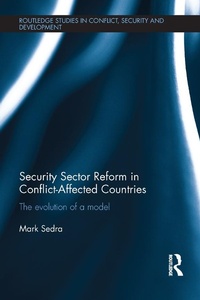
Security Sector Reform in Conflict-Affected Countries
The Evolution of a Model
Published on 3. November 2016
352 pages
978-1-317-39081-7 (ISBN)
Description

This book examines the evolution, impact, and future prospects of the Security Sector Reform (SSR) model in conflict-affected countries in the context of the wider debate over the liberal peace project.
Since its emergence as a concept in the late 1990s, SSR has represented a paradigm shift in security assistance, from the realist, regime-centric, train-and-equip approach of the Cold War to a new liberal, holistic and people-centred model. The rapid rise of this model, however, belied its rather meagre impact on the ground. This book critically examines the concept and its record of achievement over the past two decades, putting it into the broader context of peace-building and state-building theory and practice. It focuses attention on the most common, celebrated and complex setting for SSR, conflict-affected environments, and comparatively examines the application and impacts of donor-supported SSR programing in a series of conflict-affected countries over the past two decades, including Afghanistan, Sierra Leone, the Democratic Republic of Congo, East Timor and Bosnia-Herzegovina. The broader aim of the book is to better understand how the contemporary SSR model has coalesced over the past two decades and become mainstreamed in international development and security policy and practice. This provides a solid foundation to investigate the reasons for the poor performance of the model and to assess its prospects for the future.
This book will be of much interest to students of international security, peacebuilding, statebuilding, development studies and IR in general.
Since its emergence as a concept in the late 1990s, SSR has represented a paradigm shift in security assistance, from the realist, regime-centric, train-and-equip approach of the Cold War to a new liberal, holistic and people-centred model. The rapid rise of this model, however, belied its rather meagre impact on the ground. This book critically examines the concept and its record of achievement over the past two decades, putting it into the broader context of peace-building and state-building theory and practice. It focuses attention on the most common, celebrated and complex setting for SSR, conflict-affected environments, and comparatively examines the application and impacts of donor-supported SSR programing in a series of conflict-affected countries over the past two decades, including Afghanistan, Sierra Leone, the Democratic Republic of Congo, East Timor and Bosnia-Herzegovina. The broader aim of the book is to better understand how the contemporary SSR model has coalesced over the past two decades and become mainstreamed in international development and security policy and practice. This provides a solid foundation to investigate the reasons for the poor performance of the model and to assess its prospects for the future.
This book will be of much interest to students of international security, peacebuilding, statebuilding, development studies and IR in general.
Reviews / Votes
'Mark Sedra's book, Security Sector Reform in Conflict-Affected Countries: The Evolution of a Model, aims at demonstrating the recent dilemmas facing SSR, by presenting its core pillars and assessing the model in conflict-affected countries. The author provides an in-depth case study of Afghanistan demonstrating all its implementation phases, the actors involved, and, last but not least, the flaws and inconsistencies generated by the tensions between local and international actors.'--Ricardo Oliveira dos Santos, Journal of Intervention and Statebuilding, 2019More details
Series
Language
English
Place of publication
London
United Kingdom
Publishing group
Taylor & Francis Ltd
Target group
College/higher education
Professional and scholarly
Illustrations
3 Tables, black and white; 6 Line drawings, black and white
File size
4,38 MB
ISBN-13
978-1-317-39081-7 (9781317390817)
Copyright in bibliographic data and cover images is held by Nielsen Book Services Limited or by the publishers or by their respective licensors: all rights reserved.
Schweitzer Classification
Other editions
Additional editions
Book
05/2018
1st Edition
Routledge
€76.94
Shipment within 10-20 days
Book
10/2016
1st Edition
Routledge
€232.40
Shipment within 10-20 days
Person
Mark Sedra is an Adjunct Assistant Professor in the Department of Political Science at the University of Waterloo and the Balsillie School of International Affairs, Canada. He is author/editor of five books.
Content
Introduction
1. Security Sector Reform and the the Liberal Peace
2. The Origins and Evolution of the Security Sector Reform Model
3. Assessing the Security Sector Reform Model in Conflict-Affected Countries
4. The Ultimate Test: An Overview of Afghanistan's Security Sector Reform Process
5. The Slide toward Expediency in Afghanistan: From Orthodox Security Sector Reform to Realist Train and Equip
Conclusion
1. Security Sector Reform and the the Liberal Peace
2. The Origins and Evolution of the Security Sector Reform Model
3. Assessing the Security Sector Reform Model in Conflict-Affected Countries
4. The Ultimate Test: An Overview of Afghanistan's Security Sector Reform Process
5. The Slide toward Expediency in Afghanistan: From Orthodox Security Sector Reform to Realist Train and Equip
Conclusion
