

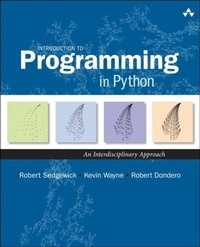
Introduction to Programming in Python
An Interdisciplinary Approach
1st Edition
Published on 27. May 2015
792 pages
978-0-13-407652-2 (ISBN)
Description

Today, anyone in a scientific or technical discipline needs programming skills. Python is an ideal first programming language, and Introduction to Programming in Python is the best guide to learning it.
Princeton University's Robert Sedgewick, Kevin Wayne, and Robert Dondero have crafted an accessible, interdisciplinary introduction to programming in Python that emphasizes important and engaging applications, not toy problems. The authors supply the tools needed for students to learn that programming is a natural, satisfying, and creative experience.
This example-driven guide focuses on Python's most useful features and brings programming to life for every student in the sciences, engineering, and computer science.
Coverage includes
Basic elements of programming: variables, assignment statements, built-in data types, conditionals, loops, arrays, and I/O, including graphics and sound
Functions, modules, and libraries: organizing programs into components that can be independently debugged, maintained, and reused
Object-oriented programming and data abstraction: objects, modularity, encapsulation, and more
Algorithms and data structures: sort/search algorithms, stacks, queues, and symbol tables
Examples from applied math, physics, chemistry, biology, and computer science-all compatible with Python 2 and 3
Drawing on their extensive classroom experience, the authors provide Q&As, exercises, and opportunities for creative practice throughout. An extensive amount of supplementary information is available at introcs.cs.princeton.edu/python. With source code, I/O libraries, solutions to selected exercises, and much more, this companion website empowers people to use their own computers to teach and learn the material.
Princeton University's Robert Sedgewick, Kevin Wayne, and Robert Dondero have crafted an accessible, interdisciplinary introduction to programming in Python that emphasizes important and engaging applications, not toy problems. The authors supply the tools needed for students to learn that programming is a natural, satisfying, and creative experience.
This example-driven guide focuses on Python's most useful features and brings programming to life for every student in the sciences, engineering, and computer science.
Coverage includes
Basic elements of programming: variables, assignment statements, built-in data types, conditionals, loops, arrays, and I/O, including graphics and sound
Functions, modules, and libraries: organizing programs into components that can be independently debugged, maintained, and reused
Object-oriented programming and data abstraction: objects, modularity, encapsulation, and more
Algorithms and data structures: sort/search algorithms, stacks, queues, and symbol tables
Examples from applied math, physics, chemistry, biology, and computer science-all compatible with Python 2 and 3
Drawing on their extensive classroom experience, the authors provide Q&As, exercises, and opportunities for creative practice throughout. An extensive amount of supplementary information is available at introcs.cs.princeton.edu/python. With source code, I/O libraries, solutions to selected exercises, and much more, this companion website empowers people to use their own computers to teach and learn the material.
All prices
More details
Edition
1. Auflage
Language
English
Place of publication
Boston
United States
Publishing group
Pearson Education (US)
Target group
College/higher education
File size
38,34 MB
ISBN-13
978-0-13-407652-2 (9780134076522)
Copyright in bibliographic data and cover images is held by Nielsen Book Services Limited or by the publishers or by their respective licensors: all rights reserved.
Schweitzer Classification
Other editions
Additional editions
Robert Sedgewick | Kevin Wayne | Robert Dondero
Introduction to Programming in Python
An Interdisciplinary Approach
Book
06/2015
Addison Wesley
€64.36
Shipment within 15-20 days
Persons
Robert Sedgewick is the William O. Baker professor of computer science at Princeton University. He has held visiting research positions at several advanced research laboratories and serves on the Adobe Systems board. He is also the coauthor (with Kevin Wayne) of Introduction to Programming in Java and Algorithms, Fourth Edition (both from Addison-Wesley).
Kevin Wayne is the Phillip Y. Goldman senior lecturer in computer science at Princeton University, where he has taught since 1998. He is an ACM Distinguished Educator and holds a Ph.D. in operations research and industrial engineering
from Cornell University.
Robert Dondero is a lecturer in computer science at Princeton University. He has taught there since 2001, earning eight excellence in engineering education awards, and a lifetime achievement award for excellence in teaching. He holds
a Ph.D. in information science and technology from Drexel University.
Kevin Wayne is the Phillip Y. Goldman senior lecturer in computer science at Princeton University, where he has taught since 1998. He is an ACM Distinguished Educator and holds a Ph.D. in operations research and industrial engineering
from Cornell University.
Robert Dondero is a lecturer in computer science at Princeton University. He has taught there since 2001, earning eight excellence in engineering education awards, and a lifetime achievement award for excellence in teaching. He holds
a Ph.D. in information science and technology from Drexel University.
Content
Preface xiii
Chapter 1: Elements of Programming 1
1.1 Your First Program 2
1.2 Built-in Types of Data 14
1.3 Conditionals and Loops 56
1.4 Arrays 100
1.5 Input and Output 140
1.6 Case Study: Random Web Surfer 188
Chapter 2: Functions and Modules 209
2.1 Defining Functions 210
2.2 Modules and Clients 248
2.3 Recursion 290
2.4 Case Study: Percolation 322
Chapter 3: Object-Oriented Programming 351
3.1 Using Data Types 352
3.2 Creating Data Types 402
3.3 Designing Data Types 450
3.4 Case Study: N-Body Simulation 496
Chapter 4: Algorithms and Data Structures 511
4.1 Performance 512
4.2 Sorting and Searching 556
4.3 Stacks and Queues 590
4.4 Symbol Tables 634
4.5 Case Study: Small-World Phenomenon 684
Context 729
Glossary 733
Index 739
Each section concludes with Q&A and Exercises.
Chapter 1: Elements of Programming 1
1.1 Your First Program 2
1.2 Built-in Types of Data 14
1.3 Conditionals and Loops 56
1.4 Arrays 100
1.5 Input and Output 140
1.6 Case Study: Random Web Surfer 188
Chapter 2: Functions and Modules 209
2.1 Defining Functions 210
2.2 Modules and Clients 248
2.3 Recursion 290
2.4 Case Study: Percolation 322
Chapter 3: Object-Oriented Programming 351
3.1 Using Data Types 352
3.2 Creating Data Types 402
3.3 Designing Data Types 450
3.4 Case Study: N-Body Simulation 496
Chapter 4: Algorithms and Data Structures 511
4.1 Performance 512
4.2 Sorting and Searching 556
4.3 Stacks and Queues 590
4.4 Symbol Tables 634
4.5 Case Study: Small-World Phenomenon 684
Context 729
Glossary 733
Index 739
Each section concludes with Q&A and Exercises.
