

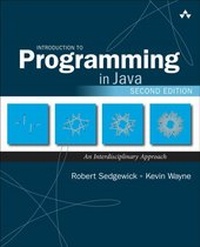
Introduction to Programming in Java
An Interdisciplinary Approach
2nd Edition
Published on 4. April 2017
784 pages
978-0-13-451239-6 (ISBN)
Description

Programming skills are indispensable in today's world, not just for computer science students, but also for anyone in any scientific or technical discipline. Introduction to Programming in Java, Second Edition, by Robert Sedgewick and Kevin Wayne is an accessible, interdisciplinary treatment that emphasizes important and engaging applications, not toy problems. The authors supply the tools needed for students and professionals to learn that programming is a natural, satisfying, and creative experience, and to become conversant with one of the world's most widely used languages.
This example-driven guide focuses on Java's most useful features and brings programming to life for every student in the sciences, engineering, and computer science.
Coverage includes
Basic elements of programming: variables, assignment statements, built-in data types, conditionals, loops, arrays, and I/O, including graphics and sound
Functions, modules, and libraries: organizing programs into components that can be independently debugged, maintained, and reused
Algorithms and data structures: sort/search algorithms, stacks, queues, and symbol tables
Applications from applied math, physics, chemistry, biology, and computer science
Drawing on their extensive classroom experience, throughout the text the authors provide Q&As, exercises, and opportunities for creative engagement with the material. Together with the companion materials described below, this book empowers people to pursue a modern approach to teaching and learning programming.
Companion web site (introcs.cs.princeton.edu/java) contains
Chapter summaries
Supplementary exercises, some with solutions
Detailed instructions for installing a Java programming environment
Program code and test data suitable for easy download
Detailed creative exercises, projects, and other supplementary materials
Companion studio-produced online videos (informit.com/sedgewick) are available for purchase and provide students and professionals with the opportunity to engage with the material at their own pace and give instructors the opportunity to spend their time with students helping them to succeed on assignments and exams.
This example-driven guide focuses on Java's most useful features and brings programming to life for every student in the sciences, engineering, and computer science.
Coverage includes
Basic elements of programming: variables, assignment statements, built-in data types, conditionals, loops, arrays, and I/O, including graphics and sound
Functions, modules, and libraries: organizing programs into components that can be independently debugged, maintained, and reused
Algorithms and data structures: sort/search algorithms, stacks, queues, and symbol tables
Applications from applied math, physics, chemistry, biology, and computer science
Drawing on their extensive classroom experience, throughout the text the authors provide Q&As, exercises, and opportunities for creative engagement with the material. Together with the companion materials described below, this book empowers people to pursue a modern approach to teaching and learning programming.
Companion web site (introcs.cs.princeton.edu/java) contains
Chapter summaries
Supplementary exercises, some with solutions
Detailed instructions for installing a Java programming environment
Program code and test data suitable for easy download
Detailed creative exercises, projects, and other supplementary materials
Companion studio-produced online videos (informit.com/sedgewick) are available for purchase and provide students and professionals with the opportunity to engage with the material at their own pace and give instructors the opportunity to spend their time with students helping them to succeed on assignments and exams.
All prices
More details
Edition
2nd edition
Language
English
Place of publication
Boston
United States
Publishing group
Pearson Education (US)
Target group
Professional and scholarly
File size
15,19 MB
ISBN-13
978-0-13-451239-6 (9780134512396)
Copyright in bibliographic data and cover images is held by Nielsen Book Services Limited or by the publishers or by their respective licensors: all rights reserved.
Schweitzer Classification
Other editions
Additional editions
Book
04/2017
2nd Edition
Addison Wesley
€81.70
Shipment within 10-20 days
Persons
Robert Sedgewick is the William O. Baker Professor of Computer Science at Princeton University, where he was founding chairman of the Department of Computer Science. He has held visiting research positions at Xerox PARC, Institute for Defense Analyses, and INRIA, and served on the board of directors at Adobe Systems. His research interests include analytic combinatorics, design and analysis of algorithms and data structures, and program visualization. He has written seventeen books.
Kevin Wayne is the Phillip Y. Goldman Senior Lecturer in Computer Science at Princeton University, where he has taught since 1998, earning several teaching awards. He is an ACM Distinguished Educator and holds a Ph.D. in operations research and industrial engineering from Cornell University.
Kevin Wayne is the Phillip Y. Goldman Senior Lecturer in Computer Science at Princeton University, where he has taught since 1998, earning several teaching awards. He is an ACM Distinguished Educator and holds a Ph.D. in operations research and industrial engineering from Cornell University.
Content
1. Elements of Programming
2. Functions and Modules
3. Object-Oriented Programming
4. Algorithms and Data Structures
2. Functions and Modules
3. Object-Oriented Programming
4. Algorithms and Data Structures
