

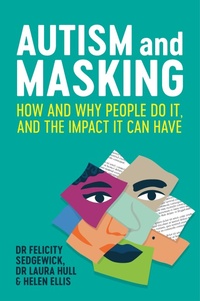
Autism and Masking
Description

This book combines the latest research with personal case studies detailing autistic experiences of masking. It explains what masking is and the various strategies used to mask in social situations. The research also delves into the psychology behind masking and the specifics of masking at school, at social events with peers, and at work. The book looks at the consequences of masking, including the toll it can have on mental and physical health, and suggests guidance for family, professionals, and employers to ameliorate negative effects.
With a diverse range of voices, including perspectives across gender, ethnicity and age, this is the comprehensive guide to masking and how to support autistic people who mask.
More details
Other editions
Additional editions
Persons
Felicity Sedgewick is a developmental and social psychologist, and lectures on Psychology of Education at the University of Bristol. Her research focusses on the social lives and mental health of autistic people of all genders, through a variety of research methods. Her work is participatory and aims to reflect the priorities of the autistic community, and making sure that it has impact in the real-world is one of her key priorities. Laura Hull is a post-doctoral researcher at University College London. Her research focuses on masking and camouflaging in autism, with a specific focus on how these impact diagnosis and mental health outcomes for autistic young people and adults. She is passionate about high-quality, participatory research which has meaningful outcomes for the autism community. Helen Ellis is an autistic adult working for the National Autistic Society as the charity's Equality, Diversity and Inclusion Co-ordinator, a role that largely focusses on internal processes and supporting autistic colleagues in the workplace. She has been involved in various research as a participant since her diagnosis in 2009 (aged 21) such as the Autism in Pink project (2014) and has been an 'expert by experience' speaker and trainer since 2012.
Content
- Intro
- Autism and Masking
- Cover
- Of related interest
- Title page
- Copyright
- Contents
- Acknowledgements
- Preface
- Introduction
- 1. What Is Masking and Who Does It?
- A note on language
- A brief history of masking in autism
- The camouflage hypothesis
- What is masking?
- How to identify when and how much someone is masking
- Measurement: Internal versus external
- Measurement: Self-report
- Who masks? (What we know and what we don't)
- Are there differences in masking across genders?
- When do people start masking?
- Is it only autistic people who mask?
- What about people who do not mask?
- 2. How Do People Mask?
- Mimicry
- Active versus instinctive masking strategies
- Learning to lie
- In conclusion to this chapter.
- 3. Why Do People Mask? And Where?
- Is it just caring what people think of you? Reputation management
- Reasons for masking
- So, where do people mask?
- Masking at school
- Masking at university
- Masking at work
- Masking at social events
- Informal social events
- Large events
- Not masking with autistic people
- 4. What Are the Consequences of Masking?
- Research into masking and mental health
- Risks arising from masking
- In conclusion to this chapter.
- 5. How Can One Help around Masking for Different Groups?
- Guidance for parents, siblings and wider family members
- Guidance for partners/spouses and children (autistic and non-autistic)
- Guidance for education professionals
- Guidance for healthcare professionals
- Guidance for employers
- Guidance for autistic people
- So, to sum up this chapter.
- Conclusion
- Glossary
- Contributors
- Bibliography
- Index
