

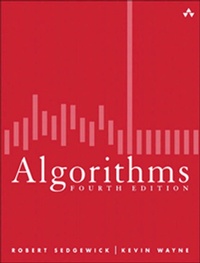
Algorithms
4th Edition
Published on 21. February 2011
976 pages
978-0-13-276256-4 (ISBN)
Description

The leading introduction to computer algorithms in use today, including fifty algorithms every programmer should know
Princeton Computer Science professors, Robert Sedgewick and Kevin Wayne, survey the most important computer algorithms in use and of interest to anyone working in science, mathematics, and engineering, and those who use computation in the liberal arts. They provide a full treatment of data structures and algorithms for key areas that enable you to confidently implement, debug, and put them to work in any computational environment.
Fundamentals:
Basic programming models
Data abstraction
Bags, queues, and stacks
Analysis of algorithms
Sorting
Elementary sorts
Mergesort
Quicksort
Priority queues
Applications
Graphs
Undirected graphs
Directed graphs
Minimum spanning trees
Shortest paths
Strings
String sorts
Tries
Substring search
Regular expressions
Data compression
These algorithms are generally ingenious creations that, remarkably, can each be expressed in just a dozen or two lines of code. As a group, they represent problem-solving power of amazing scope. They have enabled the construction of computational artifacts, the solution of scientific problems, and the development of commercial applications that would not have been feasible without them.
Princeton Computer Science professors, Robert Sedgewick and Kevin Wayne, survey the most important computer algorithms in use and of interest to anyone working in science, mathematics, and engineering, and those who use computation in the liberal arts. They provide a full treatment of data structures and algorithms for key areas that enable you to confidently implement, debug, and put them to work in any computational environment.
Fundamentals:
Basic programming models
Data abstraction
Bags, queues, and stacks
Analysis of algorithms
Sorting
Elementary sorts
Mergesort
Quicksort
Priority queues
Applications
Graphs
Undirected graphs
Directed graphs
Minimum spanning trees
Shortest paths
Strings
String sorts
Tries
Substring search
Regular expressions
Data compression
These algorithms are generally ingenious creations that, remarkably, can each be expressed in just a dozen or two lines of code. As a group, they represent problem-solving power of amazing scope. They have enabled the construction of computational artifacts, the solution of scientific problems, and the development of commercial applications that would not have been feasible without them.
More details
Edition
4th edition
Language
English
Place of publication
Boston
United States
Publishing group
Pearson Education (US)
Target group
College/higher education
File size
45,95 MB
ISBN-13
978-0-13-276256-4 (9780132762564)
Copyright in bibliographic data and cover images is held by Nielsen Book Services Limited or by the publishers or by their respective licensors: all rights reserved.
Schweitzer Classification
Other editions
Additional editions
Robert Sedgewick | Kevin Wayne
Algorithms
Book
03/2011
4th Edition
Addison Wesley
€81.49
Available immediately
Persons
Robert Sedgewick has been a Professor of Computer Science at Princeton University since 1985, where he was the founding Chairman of the Department of Computer Science. He has held visiting research positions at Xerox PARC, Institute for Defense Analyses, and INRIA, and is member of the board of directors of Adobe Systems. Professor Sedgewick's research interests include analytic combinatorics, design and analysis of data structures and algorithms, and program visualization. His landmark book, Algorithms, now in its fourth edition, has appeared in numerous versions and languages over the past thirty years. In addition, with Kevin Wayne, he is the coauthor of the highly acclaimed textbook, Introduction to Programming in Java: An Interdisciplinary Approach (Addison-Wesley, 2008).
Kevin Wayne is the Phillip Y. Goldman Senior Lecturer in Computer Science at Princeton University, where he has been teaching since 1998. He received a Ph.D. in operations research and industrial engineering from Cornell University. His research interests include the design, analysis, and implementation of algorithms, especially for graphs and discrete optimization. With Robert Sedgewick, he is the coauthor of the highly acclaimed textbook, Introduction to Programming in Java: An Interdisciplinary Approach (Addison-Wesley, 2008).
Kevin Wayne is the Phillip Y. Goldman Senior Lecturer in Computer Science at Princeton University, where he has been teaching since 1998. He received a Ph.D. in operations research and industrial engineering from Cornell University. His research interests include the design, analysis, and implementation of algorithms, especially for graphs and discrete optimization. With Robert Sedgewick, he is the coauthor of the highly acclaimed textbook, Introduction to Programming in Java: An Interdisciplinary Approach (Addison-Wesley, 2008).
Content
Preface viii
Chapter 1: Fundamentals 3
1.1 Basic Programming Model 8
1.2 Data Abstraction 64
1.3 Bags, Queues, and Stacks 120
1.4 Analysis of Algorithms 172
1.5 Case Study: Union-Find 216
Chapter 2: Sorting 243
2.1 Elementary Sorts 244
2.2 Mergesort 270
2.3 Quicksort 288
2.4 Priority Queues 308
2.5 Applications 336
Chapter 3: Searching 361
3.1 Symbol Tables 362
3.2 Binary Search Trees 396
3.3 Balanced Search Trees 424
3.4 Hash Tables 458
3.5 Applications 486
Chapter 4: Graphs 515
4.1 Undirected Graphs 518
4.2 Directed Graphs 566
4.3 Minimum Spanning Trees 604
4.4 Shortest Paths 638
Chapter 5: Strings 695
5.1 String Sorts 702
5.2 Tries 730
5.3 Substring Search 758
5.4 Regular Expressions 788
5.5 Data Compression 810
Chapter 6: Context 853
Index 933
List of Algorithms 954
List of Clients 955
Chapter 1: Fundamentals 3
1.1 Basic Programming Model 8
1.2 Data Abstraction 64
1.3 Bags, Queues, and Stacks 120
1.4 Analysis of Algorithms 172
1.5 Case Study: Union-Find 216
Chapter 2: Sorting 243
2.1 Elementary Sorts 244
2.2 Mergesort 270
2.3 Quicksort 288
2.4 Priority Queues 308
2.5 Applications 336
Chapter 3: Searching 361
3.1 Symbol Tables 362
3.2 Binary Search Trees 396
3.3 Balanced Search Trees 424
3.4 Hash Tables 458
3.5 Applications 486
Chapter 4: Graphs 515
4.1 Undirected Graphs 518
4.2 Directed Graphs 566
4.3 Minimum Spanning Trees 604
4.4 Shortest Paths 638
Chapter 5: Strings 695
5.1 String Sorts 702
5.2 Tries 730
5.3 Substring Search 758
5.4 Regular Expressions 788
5.5 Data Compression 810
Chapter 6: Context 853
Index 933
List of Algorithms 954
List of Clients 955
