

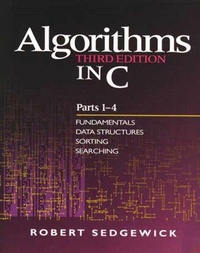
Algorithms in C, Parts 1-4
Fundamentals, Data Structures, Sorting, Searching
3rd Edition
Published on 4. May 2021
720 pages
978-0-13-419013-6 (ISBN)
Description

Robert Sedgewick has thoroughly rewritten and substantially expanded his popular work to provide current and comprehensive coverage of important algorithms and data structures. Many new algorithms are presented, and the explanations of each algorithm are much more detailed than in previous editions. A new text design and detailed, innovative figures, with accompanying commentary, greatly enhance the presentation. The third edition retains the successful blend of theory and practice that has made Sedgewick's work an invaluable resource for more than 250,000 programmers!
This particular book, Parts 1-4, represents the essential first half of Sedgewick's complete work. It provides extensive coverage of fundamental data structures and algorithms for sorting, searching, and related applications. The algorithms and data structures are expressed in concise implementations in C, so that you can both appreciate their fundamental properties and test them on real applications. Of course, the substance of the book applies to programming in any language.
Highlights
Expanded coverage of arrays, linked lists, strings, trees, and other basic data structures
Greater emphasis on abstract data types (ADTs) than in previous editions
Over 100 algorithms for sorting, selection, priority queue ADT implementations, and symbol table ADT (searching) implementations
New implementations of binomial queues, multiway radix sorting, Batcher's sorting networks, randomized BSTs, splay trees, skip lists, multiway tries, and much more
Increased quantitative information about the algorithms, including extensive empirical studies and basic analytic studies, giving you a basis for comparing them
Over 1000 new exercises to help you learn the properties of algorithms
Whether you are a student learning the algorithms for the first time or a professional interested in having up-to-date reference material, you will find a wealth of useful information in this book.
This particular book, Parts 1-4, represents the essential first half of Sedgewick's complete work. It provides extensive coverage of fundamental data structures and algorithms for sorting, searching, and related applications. The algorithms and data structures are expressed in concise implementations in C, so that you can both appreciate their fundamental properties and test them on real applications. Of course, the substance of the book applies to programming in any language.
Highlights
Expanded coverage of arrays, linked lists, strings, trees, and other basic data structures
Greater emphasis on abstract data types (ADTs) than in previous editions
Over 100 algorithms for sorting, selection, priority queue ADT implementations, and symbol table ADT (searching) implementations
New implementations of binomial queues, multiway radix sorting, Batcher's sorting networks, randomized BSTs, splay trees, skip lists, multiway tries, and much more
Increased quantitative information about the algorithms, including extensive empirical studies and basic analytic studies, giving you a basis for comparing them
Over 1000 new exercises to help you learn the properties of algorithms
Whether you are a student learning the algorithms for the first time or a professional interested in having up-to-date reference material, you will find a wealth of useful information in this book.
More details
Edition
3rd edition
Language
English
Place of publication
Boston
United States
Publishing group
Pearson Education (US)
Target group
Professional and scholarly
File size
8,78 MB
ISBN-13
978-0-13-419013-6 (9780134190136)
Copyright in bibliographic data and cover images is held by Nielsen Book Services Limited or by the publishers or by their respective licensors: all rights reserved.
Schweitzer Classification
Other editions
Additional editions
Robert Sedgewick
Algorithms in C, Parts 1-4: Fundamentals, Data Structures, Sorting, Searching
Fundamentals, Data Structures, Sorting, Searching
Book
11/1997
3rd Edition
Addison Wesley
€81.49
Shipment within 3-4 weeks
Person
Robert Sedgewick is the William O. Baker Professor of Computer Science at Princeton University. He is a Director of Adobe Systems and has served on the research staffs at Xerox PARC, IDA, and INRIA. He earned his Ph.D from Stanford University under Donald E. Knuth.
0201314525AB06262002
0201314525AB06262002
Content
I. FUNDAMENTALS.
Introduction.
Algorithms.
A Sample Problem -- Connectivity.
Union-Find Algorithms. Perspective.
Summary Of Topics.
Principles Of Algorithm Analysis.
Empirical Analysis.
Predictions And Guarantees.
Growth Of Functions.
Big-Oh Notation.
Example: Connectivity Algorithms.
Computational Complexity.
Perspective.
II. DATA STRUCTURES.
Elementary Data Structures.
Types And Structures.
Arrays.
Linked Lists.
Elementary List Processing.
Storage Allocation For Lists.
Strings.
Compound Structures.
Perspective.
Trees And Recursion.
Properties Of Trees.
Representing Binary Trees.
Representing Forests.
Traversing Trees.
Elementary Recursive Programs.
Divide-And-Conquer.
Depth-First Search.
Removing Recursion.
Elementary Abstract Data Types.
Pushdown Stack Adt.
Stack Adt Implementations.
Queue Adts And Implementations.
String Adt And Implementations.
Set Adt And Implementations.
Amortized Growth For Array Implementations.
III. SORTING.
Elementary Sorting Methods.
Rules Of The Game.
Selection Sort.
Insertion Sort.
Bubble Sort.
Performance Characteristics Of Elementary Sorts.
Shellsort.
Sorting Other Types Of Data.
Index And Pointer Sorting.
Sorting Linked Lists.
Distribution Counting.
Quicksort.
The Basic Algorithm.
Performance Characteristics Of Quicksort.
Stack Size.
Small Subfiles.
Median-Of-Three Partitioning.
Equal Keys.
Strings And Vectors.
Selection.
Mergesort.
Two-Way Merging.
Abstract Implace Merge.
Top-Down Mergesort.
Improvements To The Basic Algorithm.
Bottom-Up Mergesort.
Performance Characteristics Of Mergesort.
Linked-List Implementations Of Mergesort.
Recursion Revisited.
Priority Queues And Heapsort.
Elementary Implementations.
Heap Data Structure.
Algorithms On Heaps.
Heapsort.
Priority-Queue Abstract Data Type.
Indirect Priority Queues.
Binomial Queues.
Radix Sorting.
Bits, Bytes, And Words.
Binary Quicksort.
Msd Radix Sort.
Three-Way Radix Quicksort.
Lsd Radix Sort.
Performance Characteristics Of Radix Sorts.
Sublinear-Time Sorts.
Special-Purpose Sorts.
Batcher's Odd-Even Mergesort.
Sorting Networks.
External Sorting.
Sort-Merge Implementations.
Parallel Sort/Merge.
IV. SEARCHING.
Symbol Tables And Bsts.
Symbol-Table Abstract Data Type.
Key-Indexed Search.
Sequential Search.
Binary Search.
Binary Search Trees.
Performance Characteristics Of Bsts.
Index Implementations With Symbol Tables.
Insertion At The Root In Bsts.
Bst Implementations Of Other Adt Functions.
Balanced Trees.
Randomized Bsts.
Splay Bsts.
Top-Down 2-3-4 Trees.
Red-Black Trees.
Skip Lists.
Performance Characteristics.
Hashing.
Hash Functions.
Separate Chaining.
Linear Probing.
Double Hashing.
Dynamic Hash Tables.
Perspective.
Radix Searching.
Digital Search Trees.
Tries.
Patricia.
Multiway Tries And Tsts.
Text String Index Applications.
External Searching.
Indexed Sequential Access.
B-Trees.
Extendable Hashing.
Virtual Memory.
Program Index.
List Of Figures.
Index.
Epilogue. 0201314525T04062001
Introduction.
Algorithms.
A Sample Problem -- Connectivity.
Union-Find Algorithms. Perspective.
Summary Of Topics.
Principles Of Algorithm Analysis.
Empirical Analysis.
Predictions And Guarantees.
Growth Of Functions.
Big-Oh Notation.
Example: Connectivity Algorithms.
Computational Complexity.
Perspective.
II. DATA STRUCTURES.
Elementary Data Structures.
Types And Structures.
Arrays.
Linked Lists.
Elementary List Processing.
Storage Allocation For Lists.
Strings.
Compound Structures.
Perspective.
Trees And Recursion.
Properties Of Trees.
Representing Binary Trees.
Representing Forests.
Traversing Trees.
Elementary Recursive Programs.
Divide-And-Conquer.
Depth-First Search.
Removing Recursion.
Elementary Abstract Data Types.
Pushdown Stack Adt.
Stack Adt Implementations.
Queue Adts And Implementations.
String Adt And Implementations.
Set Adt And Implementations.
Amortized Growth For Array Implementations.
III. SORTING.
Elementary Sorting Methods.
Rules Of The Game.
Selection Sort.
Insertion Sort.
Bubble Sort.
Performance Characteristics Of Elementary Sorts.
Shellsort.
Sorting Other Types Of Data.
Index And Pointer Sorting.
Sorting Linked Lists.
Distribution Counting.
Quicksort.
The Basic Algorithm.
Performance Characteristics Of Quicksort.
Stack Size.
Small Subfiles.
Median-Of-Three Partitioning.
Equal Keys.
Strings And Vectors.
Selection.
Mergesort.
Two-Way Merging.
Abstract Implace Merge.
Top-Down Mergesort.
Improvements To The Basic Algorithm.
Bottom-Up Mergesort.
Performance Characteristics Of Mergesort.
Linked-List Implementations Of Mergesort.
Recursion Revisited.
Priority Queues And Heapsort.
Elementary Implementations.
Heap Data Structure.
Algorithms On Heaps.
Heapsort.
Priority-Queue Abstract Data Type.
Indirect Priority Queues.
Binomial Queues.
Radix Sorting.
Bits, Bytes, And Words.
Binary Quicksort.
Msd Radix Sort.
Three-Way Radix Quicksort.
Lsd Radix Sort.
Performance Characteristics Of Radix Sorts.
Sublinear-Time Sorts.
Special-Purpose Sorts.
Batcher's Odd-Even Mergesort.
Sorting Networks.
External Sorting.
Sort-Merge Implementations.
Parallel Sort/Merge.
IV. SEARCHING.
Symbol Tables And Bsts.
Symbol-Table Abstract Data Type.
Key-Indexed Search.
Sequential Search.
Binary Search.
Binary Search Trees.
Performance Characteristics Of Bsts.
Index Implementations With Symbol Tables.
Insertion At The Root In Bsts.
Bst Implementations Of Other Adt Functions.
Balanced Trees.
Randomized Bsts.
Splay Bsts.
Top-Down 2-3-4 Trees.
Red-Black Trees.
Skip Lists.
Performance Characteristics.
Hashing.
Hash Functions.
Separate Chaining.
Linear Probing.
Double Hashing.
Dynamic Hash Tables.
Perspective.
Radix Searching.
Digital Search Trees.
Tries.
Patricia.
Multiway Tries And Tsts.
Text String Index Applications.
External Searching.
Indexed Sequential Access.
B-Trees.
Extendable Hashing.
Virtual Memory.
Program Index.
List Of Figures.
Index.
Epilogue. 0201314525T04062001
