

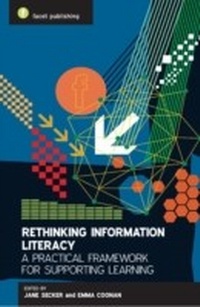
Rethinking Information Literacy
Description

A vision for the future of information literacy teaching.
Based on groundbreaking research, undertaken by the authors as part of the prestigious Arcadia Programme at Cambridge University, this book presents a new and dynamic information literacy curriculum developed for the 21st century information professional. The authors adopt a broad definition of information literacy that encompasses social as well as academic environments and situates IL as a fundamental attribute of the discerning scholar and the informed citizen. It seeks to address in a modular, flexible and holistic way the developing information needs of students entering higher education over the next five years.
The book is organized around the ten 'strands' of the new curriculum, which cover the whole landscape of information literacy development required to succeed as an undergraduate in higher education. Interweaving the authors' research and the reflections of internationally recognized experts from the library, education and information literacy sectors, including Moira Bent, Andy Priestner, Sarah Pavey, Geoff Walton and Elizabeth Tilley, it illustrates how and why this new curriculum will work in practice. Detailed appendices present the curriculum, lesson plans and tools for institutional audit, giving readers all the tools they need to implement it successfully in their institutions.
All prices
More details
Other editions
Additional editions
Persons
Jane Secker (B.A., Ph.D., PGCertHE, FHEA) is Copyright and Digital and Literacy Advisor at LSE, where she has responsibility for the digital literacy programme for staff and PhD students. She also advises staff about copyright issues particularly related to their use of digital resources and e-learning. She has published widely and led several externally funded projects, most recently being project manager for the DELILA (Developing Educators Learning and Information Literacies for Accreditation) funded by JISC and the Higher Education Academy to release digital and information literacy materials and open educational resources.
Emma Coonan (M.St., Ph.D., M.Sc.) is Research Skills and Development Librarian at Cambridge University Library, where she has responsibility for designing and teaching classes on various facets of information finding, handling and management. She blogs as the Mongoose Librarian and Tweets as LibGoddess.
Content
Strand One: Transition from school to higher education - Sarah Pavey
Strand Two: Becoming an independent learner - Geoff Walton and Jamie Cleland
Strand Three: Developing academic Literacies - Moira Bent
Strand Four: Mapping and evaluating the information landscape - Clare McCluskey
Strand Five: Resource discovery in your discipline - Isla Kuhn
Strand Six: Managing information - Elizabeth Tilley
Strand Seven: The ethical dimension of information - Lyn Parker
Strand Eight: Presenting and communicating knowledge - Andy Priestner
Strand Nine: Synthesizing information and creating new knowledge - Emma Coonan
Strand Ten: The social dimension of information - Helen Webster
Afterword: 'Ownership is a flawed concept' - Katy Wrathall
Conclusion Appendix 1: A New Curriculum for Information Literacy (ANCIL): the curriculum Appendix 2: ANCIL Lesson Plan Appendix 3: ANCIL Institutional Audit: worksheet Appendix 4: ANCIL Institutional Audit: interview questions
