

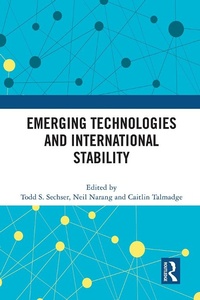
Emerging Technologies and International Stability
1st Edition
Published on 28. November 2021
308 pages
978-1-000-48553-0 (ISBN)
Description

Technology has always played a central role in international politics; it shapes the ways states fight during wartime and compete during peacetime. Today, rapid advancements have contributed to a widespread sense that the world is again on the precipice of a new technological era.
Emerging technologies have inspired much speculative commentary, but academic scholarship can improve the discussion with disciplined theory-building and rigorous empirics. This book aims to contribute to the debate by exploring the role of technology - both military and non-military - in shaping international security. Specifically, the contributors to this edited volume aim to generate new theoretical insights into the relationship between technology and strategic stability, test them with sound empirical methods, and derive their implications for the coming technological age.
This book is very novel in its approach. It covers a wide range of technologies, both old and new, rather than emphasizing a single technology. Furthermore, this volume looks at how new technologies might affect the broader dynamics of the international system rather than limiting the focus to a stability. The contributions to this volume walk readers through the likely effects of emerging technologies at each phase of the conflict process. The chapters begin with competition in peacetime, move to deterrence and coercion, and then explore the dynamics of crises, the outbreak of conflict, and war escalation in an environment of emerging technologies.
The chapters in this book, except for the Introduction and the Conclusion, were originally published in the Journal of Strategic Studies.
Emerging technologies have inspired much speculative commentary, but academic scholarship can improve the discussion with disciplined theory-building and rigorous empirics. This book aims to contribute to the debate by exploring the role of technology - both military and non-military - in shaping international security. Specifically, the contributors to this edited volume aim to generate new theoretical insights into the relationship between technology and strategic stability, test them with sound empirical methods, and derive their implications for the coming technological age.
This book is very novel in its approach. It covers a wide range of technologies, both old and new, rather than emphasizing a single technology. Furthermore, this volume looks at how new technologies might affect the broader dynamics of the international system rather than limiting the focus to a stability. The contributions to this volume walk readers through the likely effects of emerging technologies at each phase of the conflict process. The chapters begin with competition in peacetime, move to deterrence and coercion, and then explore the dynamics of crises, the outbreak of conflict, and war escalation in an environment of emerging technologies.
The chapters in this book, except for the Introduction and the Conclusion, were originally published in the Journal of Strategic Studies.
More details
Edition
1. Auflage
Language
English
Place of publication
London
United Kingdom
Publishing group
Taylor & Francis Ltd
Target group
College/higher education
ISBN-13
978-1-000-48553-0 (9781000485530)
Copyright in bibliographic data and cover images is held by Nielsen Book Services Limited or by the publishers or by their respective licensors: all rights reserved.
Schweitzer Classification
Other editions
Additional editions
Todd S. Sechser | Neil Narang | Caitlin Talmadge
Emerging Technologies and International Stability
Book
09/2023
1st Edition
Routledge
€65.80
Shipment within 10-20 days
Todd S. Sechser | Neil Narang | Caitlin Talmadge
Emerging Technologies and International Stability
Book
11/2021
1st Edition
Routledge
€206.90
Shipment within 10-20 days
Persons
Todd S. Sechser is the Pamela Feinour Edmonds and Franklin S. Edmonds Jr. Discovery Professor of Politics and Public Policy at the University of Virginia, USA, Senior Fellow at the Miller Center of Public Affairs, and Director of the University of Virginia's Democratic Statecraft Lab. Dr. Sechser's research interests include coercive diplomacy, nuclear security, emerging technologies, and the psychological effects of political violence.
Neil Narang is Associate Professor in the Department of Political Science at the University of California, Santa Barbara, USA, Research Director at the Institute for Global Conflict and Cooperation (IGCC), and Jeane Kirkpatrick Visiting Scholar at the American Enterprise Institute. He is currently an advisor to the Director's Office of Los Alamos National Laboratory, a faculty affiliate at the Stanford University Center for International Security, and Term Member of the Council on Foreign Relations. He previously served as Senior Advisor in the U.S. Department of Defense. Narang specializes in international relations, with a focus on issues of international security and conflict management.
Caitlin Talmadge is Associate Professor of Security Studies at Georgetown University, USA, where her research and teaching focus on nuclear deterrence, military effectiveness, civil-military relations, and security issues in Asia and the Persian Gulf. She is a Non-Resident Senior Fellow at the Brookings Institution and previously worked as a consultant to the U.S. Department of Defense.
Neil Narang is Associate Professor in the Department of Political Science at the University of California, Santa Barbara, USA, Research Director at the Institute for Global Conflict and Cooperation (IGCC), and Jeane Kirkpatrick Visiting Scholar at the American Enterprise Institute. He is currently an advisor to the Director's Office of Los Alamos National Laboratory, a faculty affiliate at the Stanford University Center for International Security, and Term Member of the Council on Foreign Relations. He previously served as Senior Advisor in the U.S. Department of Defense. Narang specializes in international relations, with a focus on issues of international security and conflict management.
Caitlin Talmadge is Associate Professor of Security Studies at Georgetown University, USA, where her research and teaching focus on nuclear deterrence, military effectiveness, civil-military relations, and security issues in Asia and the Persian Gulf. She is a Non-Resident Senior Fellow at the Brookings Institution and previously worked as a consultant to the U.S. Department of Defense.
Content
PART I: INTRODUCTION Emerging technologies and international stability PART II: COMPETITION AND COERCION IN THE TECHNOLOGICAL AGE 1. The capability/vulnerability paradox and military revolutions: Implications for computing, cyber, and the onset of war 2. Cheap fights, credible threats: The future of armed drones and coercion 3. Extended deterrence and assurance in an emerging technology environment PART III: CRISIS, CONFLICT, AND WAR 4. Blood and robots: How remotely piloted vehicles and related technologies affect the politics of violence 5. When speed kills: Lethal autonomous weapon systems, deterrence and stability 6. Emerging technology and intra-war escalation risks: Evidence from the Cold War, implications for today PART IV: OFFENSE, DEFENSE, AND STABILITY 7. Asymmetric arms control and strategic stability: Scenarios for limiting hypersonic glide vehicles 8. Dual-use distinguishability: How 3D-printing shapes the security dilemma for nuclear programs 9. How does the offense-defense balance scale? PART V: LESSONS LEARNED AND FUTURE DIRECTIONS 10. Conclusion
