

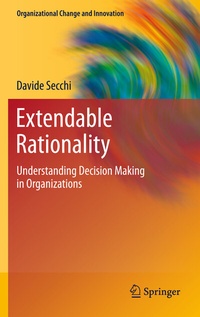
Extendable Rationality
Understanding Decision Making in Organizations
1st Edition
Published on 20. October 2010
XIX, 161 pages
978-1-4419-7542-3 (ISBN)
Description

"How do people make decisions in organizations?" is the question at the core of this book. Do people act rationally? Under what conditions can information and knowledge be shared to improve decision making? Davide Secchi applies concepts and theories from cognitive science, organizational behavior, and social psychology to explore the dynamics of decision making. In particular, he integrates "bounded rationality" (people are only partly rational; they have (a) limited computational capabilities and (b) limited access to information) and "distributed cognition" (knowledge is not confined to an individual, but is distributed across the members of a group) to build upon the pioneering work of Herbert Simon (1916-2001) on rational decision making and contribute fresh insights.
This book is divided into two parts. The first part (Chapters 2 to 5) explores how recent studies on biases, prospect theory, heuristics, and emotions provide the so-called "map" of bounded rationality. The second part (Chapter 6 to 8) presents the idea of extendable rationality. In this section, Secchi identifies the limitations of bounded rationality and focuses more heavily on socially-based decision processes and the role of "docility" in teaching, managing, and executing decisions in organizations. The practical implications extend broadly to issues relating to change and innovation, as organizations adapt to evolving market conditions, implementing new systems, and effectively managing limited resources. The final chapter outlines an agenda for future research to help understand the decision making characteristics and capabilities of an organization.
More details
Series
Language
English
Place of publication
New York
United States
Publishing group
Springer US
Target group
Professional and scholarly
Product notice
Reflowable
Illustrations
XIX, 161 p.
File size
1,84 MB
ISBN-13
978-1-4419-7542-3 (9781441975423)
DOI
10.1007/978-1-4419-7542-3
Schweitzer Classification
Other editions
Additional editions
Book
10/2010
1st Edition
Springer
€106.99
Shipment within 15-20 days
Person
Davide Secchi, PhD, is an Assistant Professor of Organizational Behavior at the University of Wisconsin-La Crosse. His research interests include "distributed cognition" and its implications for management; human cognition and decision making; and social responsibility. He received his masters degrees (in venture finance and international finance) and his doctorate from the University of Pavia in Italy, and holds a BS from the University of Cagliari. He presents frequently at conferences and has published widely in scholarly journals and edited volumes, including the Journal of Business Ethics (Springer).
Content
1 - Preface [Seite 6]
2 - Acknowledgments [Seite 10]
3 - Contents [Seite 13]
4 - List of Figures [Seite 15]
5 - List of Tables [Seite 16]
6 - 1 Introduction [Seite 17]
6.1 - What to Expect [Seite 18]
6.2 - Book Structure [Seite 21]
6.3 - Notes [Seite 22]
7 - Part I The Limited Cognition [Seite 23]
7.1 - 2 Rationalization and Rationality [Seite 24]
7.1.1 - Kinds of Decisions [Seite 24]
7.1.1.1 - Mechanical Decisions [Seite 24]
7.1.1.2 - Decisions that Imply a Choice [Seite 25]
7.1.1.3 - Creative Decisions [Seite 27]
7.1.1.4 - Epistemological Corner [Seite 27]
7.1.2 - The Legacy of Herbert Simon [Seite 28]
7.1.2.1 - Rationalization [Seite 29]
7.1.2.2 - Rationality [Seite 31]
7.1.3 - Summary [Seite 32]
7.1.4 - Notes [Seite 32]
7.2 - 3 Bounded Rationality [Seite 34]
7.2.1 - What Is Bounded Rationality [Seite 34]
7.2.1.1 - Substantive and Procedural Rationality [Seite 35]
7.2.1.2 - External and Internal Limitations [Seite 37]
7.2.1.3 - Satisficing [Seite 37]
7.2.1.4 - Bounds or Limits? [Seite 38]
7.2.2 - Summary [Seite 39]
7.2.3 - Notes [Seite 39]
7.3 - 4 Maps of Bounded Rationality (I) [Seite 41]
7.3.1 - Prospect Theory [Seite 41]
7.3.1.1 - The Certainty Effect [Seite 41]
7.3.1.2 - The Possibility Violation [Seite 43]
7.3.1.3 - The Reflection Effect [Seite 44]
7.3.1.4 - The Point on Bounded Rationality [Seite 45]
7.3.2 - This Is a Biased World [Seite 45]
7.3.2.1 - The Endowment Effect [Seite 45]
7.3.2.2 - The Status Quo Bias [Seite 46]
7.3.2.3 - Anchor Bias [Seite 47]
7.3.2.4 - Bandwagon Effect [Seite 48]
7.3.2.5 - Prejudices [Seite 49]
7.3.2.6 - Errors [Seite 50]
7.3.3 - Summary [Seite 52]
7.3.4 - Notes [Seite 52]
7.4 - 5 Maps of Bounded Rationality (II) [Seite 54]
7.4.1 - Heuristics [Seite 54]
7.4.1.1 - The Fast and the !Frugal! [Seite 55]
7.4.1.2 - Organizational Heuristics [Seite 57]
7.4.1.3 - Emotionally Bounded [Seite 59]
7.4.2 - Accessibility, Representation, and Framing [Seite 61]
7.4.2.1 - Epistemological Corner [Seite 62]
7.4.3 - Two Logics [Seite 64]
7.4.3.1 - The Logic of Consequence [Seite 65]
7.4.3.2 - The Logic of Appropriateness [Seite 66]
7.4.4 - Implications of Using One or More Maps [Seite 67]
7.4.4.1 - The Biases Paradigm [Seite 67]
7.4.4.2 - The Toolbox Paradigm [Seite 68]
7.4.4.3 - Final Remarks [Seite 68]
7.4.5 - Summary [Seite 69]
7.4.6 - Notes [Seite 69]
8 - Part II The Extended Brain [Seite 73]
8.1 - 6 Simons Error [Seite 74]
8.1.1 - Distributing Cognition [Seite 75]
8.1.1.1 - An Irreverent Hypothesis on Cognition [Seite 76]
8.1.1.2 - Boundaries of the Mind: The Through Doing Logic [Seite 79]
8.1.1.3 - Externalizing and Reprojecting [Seite 81]
8.1.1.4 - The Extended Mind [Seite 84]
8.1.2 - How Bounded Is Rationality? [Seite 85]
8.1.2.1 - Cognition and Rationality [Seite 85]
8.1.2.2 - Problem Solving [Seite 85]
8.1.2.3 - Moving Bounds [Seite 86]
8.1.2.4 - What Error? [Seite 87]
8.1.3 - Summary [Seite 88]
8.1.4 - Notes [Seite 88]
8.2 - 7 Stretching the Bounds (I) [Seite 91]
8.2.1 - Through Doing Decision Making [Seite 92]
8.2.1.1 - Emotions and Decision Making [Seite 93]
8.2.1.2 - Morality [Seite 95]
8.2.1.3 - A Third Logic: The Logic of Adaptiveness [Seite 97]
8.2.2 - The Rationality of Change [Seite 99]
8.2.2.1 - Innovative High Technology [Seite 99]
8.2.2.2 - The Process of Change [Seite 101]
8.2.3 - Summary [Seite 103]
8.2.4 - Notes [Seite 103]
8.3 - 8 Stretching the Bounds (II) [Seite 106]
8.3.1 - The Others [Seite 106]
8.3.2 - Advice Taking [Seite 107]
8.3.2.1 - The Judge-Advisor System [Seite 108]
8.3.2.2 - Variables Affecting Advice Taking [Seite 110]
8.3.2.3 - Information Richness [Seite 111]
8.3.2.4 - Information Richness and Advice Taking: A Proposal [Seite 113]
8.3.2.5 - Perspectives on Advice Taking [Seite 116]
8.3.3 - Passive Advice Taking xx [Seite 117]
8.3.4 - Summary [Seite 119]
8.3.5 - Notes [Seite 119]
8.4 - 9 The Docile Organization [Seite 121]
8.4.1 - The Docile Individual [Seite 121]
8.4.1.1 - Fitness [Seite 123]
8.4.1.2 - From Evolution to Social Relations [Seite 124]
8.4.1.3 - Active and Passive [Seite 126]
8.4.2 - Levels of Docility [Seite 127]
8.4.2.1 - The Prerequisites of Docility [Seite 127]
8.4.2.2 - Docility in Organizations [Seite 129]
8.4.3 - Understanding Docility [Seite 131]
8.4.3.1 - Bandwagon Versus Docility [Seite 131]
8.4.3.2 - Individual Social Responsibility xxxii [Seite 134]
8.4.3.3 - A Theoretical Framework for Advice Giving and Taking [Seite 136]
8.4.4 - What Is a Docile Organization? [Seite 137]
8.4.5 - Summary [Seite 139]
8.4.6 - Notes [Seite 139]
8.5 - 10 Conclusions [Seite 142]
8.5.1 - The Point on Rationality [Seite 142]
8.5.2 - What Are We Mapping? [Seite 144]
8.5.3 - The Individual and the Group [Seite 145]
8.5.4 - A Methodological Note [Seite 148]
8.5.5 - Extendable Rationality [Seite 150]
8.5.6 - Notes [Seite 151]
9 - Afterword [Seite 153]
10 - References [Seite 154]
11 - Index [Seite 164]
2 - Acknowledgments [Seite 10]
3 - Contents [Seite 13]
4 - List of Figures [Seite 15]
5 - List of Tables [Seite 16]
6 - 1 Introduction [Seite 17]
6.1 - What to Expect [Seite 18]
6.2 - Book Structure [Seite 21]
6.3 - Notes [Seite 22]
7 - Part I The Limited Cognition [Seite 23]
7.1 - 2 Rationalization and Rationality [Seite 24]
7.1.1 - Kinds of Decisions [Seite 24]
7.1.1.1 - Mechanical Decisions [Seite 24]
7.1.1.2 - Decisions that Imply a Choice [Seite 25]
7.1.1.3 - Creative Decisions [Seite 27]
7.1.1.4 - Epistemological Corner [Seite 27]
7.1.2 - The Legacy of Herbert Simon [Seite 28]
7.1.2.1 - Rationalization [Seite 29]
7.1.2.2 - Rationality [Seite 31]
7.1.3 - Summary [Seite 32]
7.1.4 - Notes [Seite 32]
7.2 - 3 Bounded Rationality [Seite 34]
7.2.1 - What Is Bounded Rationality [Seite 34]
7.2.1.1 - Substantive and Procedural Rationality [Seite 35]
7.2.1.2 - External and Internal Limitations [Seite 37]
7.2.1.3 - Satisficing [Seite 37]
7.2.1.4 - Bounds or Limits? [Seite 38]
7.2.2 - Summary [Seite 39]
7.2.3 - Notes [Seite 39]
7.3 - 4 Maps of Bounded Rationality (I) [Seite 41]
7.3.1 - Prospect Theory [Seite 41]
7.3.1.1 - The Certainty Effect [Seite 41]
7.3.1.2 - The Possibility Violation [Seite 43]
7.3.1.3 - The Reflection Effect [Seite 44]
7.3.1.4 - The Point on Bounded Rationality [Seite 45]
7.3.2 - This Is a Biased World [Seite 45]
7.3.2.1 - The Endowment Effect [Seite 45]
7.3.2.2 - The Status Quo Bias [Seite 46]
7.3.2.3 - Anchor Bias [Seite 47]
7.3.2.4 - Bandwagon Effect [Seite 48]
7.3.2.5 - Prejudices [Seite 49]
7.3.2.6 - Errors [Seite 50]
7.3.3 - Summary [Seite 52]
7.3.4 - Notes [Seite 52]
7.4 - 5 Maps of Bounded Rationality (II) [Seite 54]
7.4.1 - Heuristics [Seite 54]
7.4.1.1 - The Fast and the !Frugal! [Seite 55]
7.4.1.2 - Organizational Heuristics [Seite 57]
7.4.1.3 - Emotionally Bounded [Seite 59]
7.4.2 - Accessibility, Representation, and Framing [Seite 61]
7.4.2.1 - Epistemological Corner [Seite 62]
7.4.3 - Two Logics [Seite 64]
7.4.3.1 - The Logic of Consequence [Seite 65]
7.4.3.2 - The Logic of Appropriateness [Seite 66]
7.4.4 - Implications of Using One or More Maps [Seite 67]
7.4.4.1 - The Biases Paradigm [Seite 67]
7.4.4.2 - The Toolbox Paradigm [Seite 68]
7.4.4.3 - Final Remarks [Seite 68]
7.4.5 - Summary [Seite 69]
7.4.6 - Notes [Seite 69]
8 - Part II The Extended Brain [Seite 73]
8.1 - 6 Simons Error [Seite 74]
8.1.1 - Distributing Cognition [Seite 75]
8.1.1.1 - An Irreverent Hypothesis on Cognition [Seite 76]
8.1.1.2 - Boundaries of the Mind: The Through Doing Logic [Seite 79]
8.1.1.3 - Externalizing and Reprojecting [Seite 81]
8.1.1.4 - The Extended Mind [Seite 84]
8.1.2 - How Bounded Is Rationality? [Seite 85]
8.1.2.1 - Cognition and Rationality [Seite 85]
8.1.2.2 - Problem Solving [Seite 85]
8.1.2.3 - Moving Bounds [Seite 86]
8.1.2.4 - What Error? [Seite 87]
8.1.3 - Summary [Seite 88]
8.1.4 - Notes [Seite 88]
8.2 - 7 Stretching the Bounds (I) [Seite 91]
8.2.1 - Through Doing Decision Making [Seite 92]
8.2.1.1 - Emotions and Decision Making [Seite 93]
8.2.1.2 - Morality [Seite 95]
8.2.1.3 - A Third Logic: The Logic of Adaptiveness [Seite 97]
8.2.2 - The Rationality of Change [Seite 99]
8.2.2.1 - Innovative High Technology [Seite 99]
8.2.2.2 - The Process of Change [Seite 101]
8.2.3 - Summary [Seite 103]
8.2.4 - Notes [Seite 103]
8.3 - 8 Stretching the Bounds (II) [Seite 106]
8.3.1 - The Others [Seite 106]
8.3.2 - Advice Taking [Seite 107]
8.3.2.1 - The Judge-Advisor System [Seite 108]
8.3.2.2 - Variables Affecting Advice Taking [Seite 110]
8.3.2.3 - Information Richness [Seite 111]
8.3.2.4 - Information Richness and Advice Taking: A Proposal [Seite 113]
8.3.2.5 - Perspectives on Advice Taking [Seite 116]
8.3.3 - Passive Advice Taking xx [Seite 117]
8.3.4 - Summary [Seite 119]
8.3.5 - Notes [Seite 119]
8.4 - 9 The Docile Organization [Seite 121]
8.4.1 - The Docile Individual [Seite 121]
8.4.1.1 - Fitness [Seite 123]
8.4.1.2 - From Evolution to Social Relations [Seite 124]
8.4.1.3 - Active and Passive [Seite 126]
8.4.2 - Levels of Docility [Seite 127]
8.4.2.1 - The Prerequisites of Docility [Seite 127]
8.4.2.2 - Docility in Organizations [Seite 129]
8.4.3 - Understanding Docility [Seite 131]
8.4.3.1 - Bandwagon Versus Docility [Seite 131]
8.4.3.2 - Individual Social Responsibility xxxii [Seite 134]
8.4.3.3 - A Theoretical Framework for Advice Giving and Taking [Seite 136]
8.4.4 - What Is a Docile Organization? [Seite 137]
8.4.5 - Summary [Seite 139]
8.4.6 - Notes [Seite 139]
8.5 - 10 Conclusions [Seite 142]
8.5.1 - The Point on Rationality [Seite 142]
8.5.2 - What Are We Mapping? [Seite 144]
8.5.3 - The Individual and the Group [Seite 145]
8.5.4 - A Methodological Note [Seite 148]
8.5.5 - Extendable Rationality [Seite 150]
8.5.6 - Notes [Seite 151]
9 - Afterword [Seite 153]
10 - References [Seite 154]
11 - Index [Seite 164]
