

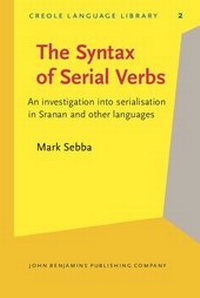
The Syntax of Serial Verbs
An investigation into serialisation in Sranan and other languages
1st Edition
Published on 1. January 1987
XV, 218 pages
978-90-272-7902-6 (ISBN)
Description

This monograph is about the chains of verbs commonly found in Creole Languages, West African languages, in particular the Kwa sub-group of Niger-Congo, Chinese and certain other languages and have acquired the name of 'serial verbs' in the literature. As a case study, the serial constructions of Sranan, a creole language of Surinam with an English lexical base, are examined in detail.
More details
Other editions
Additional editions
Mark Sebba
The Syntax of Serial Verbs
An investigation into serialisation in Sranan and other languages
Book
01/1987
John Benjamins Publishing Co
€111.30
Shipment within 10-15 days
Content
- THE SYNTAX OF SERIAL VERBS
- Editorial Page
- Title page
- Copyright page
- A NOTE ON THE TEXT
- NOTE ON THE SRANAN DATA
- ABSTRACT
- ACKNOWLEDGEMENTS
- Table of contents
- CHAPTER 1: IN SEARCH OF SERIAL VERBS
- 1. INTRODUCTION.
- 2. PROBLEMS OF DESCRIPTION
- 3. PREVIOUS WRITERS' ANALYSES OF "SERIALISATION
- 3.1 Christaller
- 3.2 Westermann
- 3.3 Stewart: The First Transformational Analysis
- 3.4 Ansre
- 3.5 Stahlke
- 3.6 Bamgbose
- 3.7 Schachter
- 3.8 Williams
- 3.9 Voorhoeve
- 3.10 Jansen, Koopman And Muysken
- 3.11 Lightfoot
- 3.12 Oyelaran
- 3.13 Chinese Serial Verbs: Li And Thompson
- 3.14 Alternatives To Li And Thompson: Lu And See Gebauer
- 4. CONCLUSION
- FOOTNOTES TO CHAPTER 1
- CHAPTER 2: SERIAL VERBS IN SRANAN
- 1. SERIAL CONSTRUCTIONS IN SRANAN
- 2. MORE SRANAN SERIAL VERBS
- 1. kaba
- 2. gi
- 3. moro
- 4. pasa
- 5. taki
- 6. meki
- 7. go and kon
- 8. teki
- 3. CONCLUSION
- CHAPTER 3: THE SYNTAX OF SERIALISATION
- 1. DISTINGUISHING SERIAL VERBS FROM OTHER STRUCTURES
- 1.1 "Implicative Verbs
- 1.2 "Control Verbs
- 1.3 Other Complement-taking Verbs
- 1.4 Coordinate Sentences, Verb Phrases, And Verb Conjoining
- 1.4.1 Coordinate Sentences And Verb Phrases
- 1.4.2 Verb Conjoining
- 1.5 Purpose Clauses
- 1.6 Factitives
- 1.7 Conclusion
- 2. THE SYNTACTIC ANALYSIS OF SERIALISATION
- 2.1
- 2.2 Serialisation: Coordinate Or Subordinate?
- 2.3 Subordinating Serial Constructions
- 3. A POSSIBLE SEMANTIC ANALYSIS FOR SERIAL VERBS
- 4. CONCLUSION
- FOOTNOTES TO CHAPTER 3
- CHAPTER 4: SERIAL VERBS IN OTHER LANGUAGES
- 1. INTRODUCTION
- 1.1 Akan (Twi/Fanti)
- 1.2 Anyi-Baule
- 1.3 Yoruba
- 1.4 Ijq (Izon)
- 1.5 Saramaccan
- 1.6 Papiamentu
- 1.7 Mandarin
- 2. "COORDINATE" AND "SUBORDINATE" STRUCTURES
- 2.1 Akan (Twi/Fanti)
- 2.2 Anyi-Baule
- 2.3 Yoruba
- 2.4 Ijo
- 2.5 Saramaccan
- 2.6 Papiamentu
- 2.7 Mandarin
- 3. "TAKE" CONSTRUCTIONS
- 3.1 Akan
- 3.2 Anyi-Baule
- 3.3 Yoruba
- 3.4 Ijo
- 3.5 Saramaccan
- 3.6 Papiamentu
- 3.7 Mandarin
- 4. GIVE CONSTRUCTIONS
- 4.1 Akan
- 4.2 Anyi-Baule
- 4.3 Yoruba
- 4.4 Ijo
- 4.5 Saramaccan
- 4.6 Papiamentu
- 4.7 Mandarin
- 5. OTHER THREE-PLACE VERBS AND SIMILAR "RELATIONAL" CONSTRUCTIONS
- 5.1 Akan
- 5.2 Ijo
- 5.3 Saramaccan
- 6. GO, COME AND OTHER MOTION VERBS
- 6.1 Akan
- 6.2 Yoruba
- 6.3 Ijo
- 6.4 Saramaccan
- 6.5 Papiamentu
- 6.6 Mandarin
- 7. "DOUBLE-GO" CONSTRUCTIONS
- 7.1 Akan
- 7.2 Saramaccan
- 7.3 Papiamentu
- 7.4 Mandarin
- 8. LEXICAL IDIOMS
- 8.1 Akan
- 8.2 Anyi-Baule
- 8.3 Yoruba
- 8.4 Saramaccan
- 8.5 Papiamentu
- 8.6 Mandarin
- 9. COMPARATIVE CONSTRUCTIONS
- 9.1 Akan
- 9.2 Yoruba
- 9.3 Ijo
- 9.4 Saramaccan
- 9.5 Mandarin
- 10. OTHER FUNCTIONAL SERIAL VERBS
- 11. CONCLUSION
- FOOTNOTES TO CHAPTER 4
- CHAPTER 5: CONCLUSION
- 1. SERIAL VERBS ARE REAL
- 2. UNIVERSALS VERSUS SUBSTRATE
- 3. SERIAL VERBS AS ARGUMENT-EXPANDERS
- 4. SERIAL VERBS AS LEXICON-EXPANDERS
- 5. TO CONCLUDE
- BIBLIOGRAPHY
