

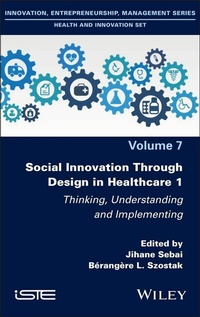
Social Innovation Through Design in Healthcare 1
Description

Design, as a creative discipline, can improve interactions between the multiple dimensions of the healthcare system by proposing solutions that take into account patients' needs and values, while respecting the constraints faced by healthcare professionals. This approach offers stakeholders in the sector the opportunity to formulate new human-centered questions and develop innovative responses in collaboration with experts from a variety of disciplines.
In addition to presenting the conceptual framework behind its theme, this book outlines concrete ways to implement social innovation through design in the field of healthcare.
Jihane Sebai is associate professor in management and a member of LAREQUOI - Research Center in Management at the University of Versailles, University of Paris-Saclay, France. Her research focuses on public, strategic and health management.
Bérangère L. Szostak is Professor at the LAREQUOI laboratory, University of Versailles-Saint-Quentin-en-Yvelines, University of Paris-Saclay, France. Her research focuses on the strategic management of innovation and organizational creativity, particularly through the lens of 'design'.
More details
Other editions
Additional editions
Persons
Bérangère L. Szostak is Professor at the LAREQUOI laboratory, University of Versailles-Saint-Quentin-en-Yvelines, University of Paris-Saclay, France. Her research focuses on the strategic management of innovation and organizational creativity, particularly through the lens of "design".
Content
Introduction
Social Innovation Through Design in Healthcare: A Major Work in Progress
To be a surrealist means barring from your mind all remembrance of what you have seen, and being always on the lookout for what has never been.1
René MAGRITTE,
quote from the Magritte Museum, Brussels
This two-volume work on social innovation through design in healthcare is surrealist in the Magritte sense: while each word in the subject matter has already "been seen", when put together, they form a surrealist work, a holistic and unprecedented work that is still under construction, because it has "never been". The primary word in this title is "innovation", which implies the creation of value, novelty in a given field, or even the disruption of that field. Accompanying the latter is the word "social": it reflects the roots of this innovation. In other words, the value created is to be defined in relation to a group of individuals forming a whole, such as a society - but also an organization. The third word, "design", refers to the notion of conception and creativity under constraints; the formal and cultural aspects of the result and the process leading to it are just as important as the functional and economic aspects. The fourth and final word, "healthcare", opens up a specific imaginary world of "social innovation through design", as it touches on the aspects of life and sometimes illness and death. It thus brings together all of the actors in this world, as well as the institutions that enable caregivers to carry out their work.
While each of these words is familiar, it must be acknowledged that the literature does not offer unambiguous definitions. For this reason, we propose this initial, very simple and basic framework, as the work represented by "innovation through design in healthcare" is much more complex and richer for all of the authors featured in this book. Indeed, this theme is rarely addressed in the way this academic work is presented: it brings together knowledge defended by academic experts, researchers and practitioners in management, design and healthcare. Opening this book is like delving into a giant work of art, such as Richard Serra's immense installations at the Guggenheim Museum in Bilbao. The space created by this theme opens enormous research opportunities in management, design and healthcare, which must be explored thoroughly, from start to finish, navigating through the various pages to approach the subject from these three perspectives. This is the ambition of this book.
That being said, it should be obvious that these perspectives should be explored for at least two reasons. First, the healthcare sector in France is constantly evolving and faces complex and multidimensional challenges (Sebai 2021b). For example, on the patient side, there are growing expectations for access to quality care throughout the country, which means that work needs to be done to combat medical isolation (Courie-Lemeur et al. 2024). Patients also want to be involved in decisions that affect them and therefore in the design of care protocols, especially as they become increasingly well informed (Yatim and Sebai 2023). Patients also need to feel accompanied, supported and confident with their caregivers, which takes time, as trust cannot be imposed (Sebai 2021a).
On the professional side, it should be remembered that they face numerous socioeconomic, human, legal and administrative constraints that characterize the healthcare sector (Sebai and Szostak 2024). There is a shortage of healthcare personnel, but some do not want to leave the sector2. The level of complexity heavily affects these professionals and exhausts them, especially when they would like to practice their profession in a context that promotes a rewarding and fulfilling career.
Second, the recurring conclusion of surveys conducted by health experts, researchers and even patient groups is that there is an urgent need to radically redefine healthcare models and management practices in healthcare facilities. The current system has certainly succeeded in responding to many crises, but the economic, physical, human and moral costs are too high to be satisfactory. New ways of organizing, running and controlling this sector must therefore be devised (Courie-Lemeur 2024). However, this must not be done without considering the social and societal roots of this sector.
In this context, social innovation is emerging as a promising approach for rethinking healthcare services and environments, enriching the quality of life of professionals, improving the user experience and encouraging more seamless interactions between various actors in the healthcare system. Whether in terms of services, products or processes, healthcare organizations are currently seeking to address key human challenges while integrating the necessary behavioral changes within their teams and among their partners.
To bring about this change, some organizations are turning to design tools and methods. This discipline, whose origins date back to the first industrial revolution, has gradually developed methods such as design thinking and tools such as empathy maps, personas and prototyping, which draw inspiration from the humanities and social sciences (anthropology, sociology, psychology, history, etc.).
When applied to the healthcare field, design aims to improve interactions between the numerous aspects of the healthcare system by creating solutions that consider the needs and values of patients while respecting the constraints of healthcare professionals. This approach enables healthcare actors to ask new human-centered questions and develop innovative responses in collaboration with experts from various disciplines. However, such practices are still rarely widespread in the healthcare sector in France, and innovative initiatives often encounter organizational, cultural, financial or legal obstacles.
This is why this Introduction begins by reviewing the major research findings on the subject, followed by a presentation of the book as a whole in the second section, with each section introduction presenting the texts that follow.
I.1. Social innovation through design in healthcare: defining the scope of the research topic
I.1.1. Research on social innovation through design
The research topic addressed in this book refers first to the concept of "social innovation", which is quite different from "technological innovation" as defined in the Oslo Manual. This concept is not new, as, according to Moulaert et al. (2007), it dates back to the 18th century. However, it took off in the economics and management literature in the 2000s. In contrast, the concept should be viewed as a "whole"; it is not a matter of considering the concept of "innovation" and attaching the adjective "social" to it. In other words, there is no such thing as "non-social" innovation. This concept forms a whole that should first be understood as contributing to the pursuit of benefits that are neither commercial nor organizational, but are social, such as the reduction of discrimination, the inclusion of vulnerable people, access to healthcare for all, etc. (Moulaert et al. 2007; Richez-Battesti et al. 2012; Muller 2021). Second, social innovation involves a large number of actors, which are also varied in nature, making its design more complex. There are organizations such as associations, mutual societies, cooperatives and foundations; institutions such as the government, ministries, elected officials and educational establishments; and individuals who may be social entrepreneurs, volunteers, activists or beneficiaries.
Furthermore, Muller et al. (2024) point out that social innovations are embedded in specific dynamics, which need to be specified in detail. Those involved in developing social innovations are experts in these dynamics, as they must navigate them and identify which ones are conducive to the design, implementation and sustainability of the innovation. It is also necessary to understand the connections between actors. As a result of this context, social innovations often provide an opportunity to experiment with democratic governance in practice (Yatim and Sebai 2023). In line with Sebai (2020), Muller et al. (2024) emphasize the role now played by digital tools and artificial intelligence (AI): they are means of achieving a purpose other than that generally induced by technology, which, in this case, is a commercial purpose. These tools enable the transformation of social relations and an original approach to problems.
That being said, it is now necessary to clarify what the literature says about "social innovation through design". First, it is important to understand that this concept forms a conceptual unit insofar as it stems from work in the field of design. This is not a new concept, but it has become increasingly relevant in recent years because social, economic and technological changes affect our society (Catoir-Brisson and Royer 2017). We cannot consider this concept to be new given the historical origins of design. Design historians such as Lucie-Smith (1983) and de Noblet (1988) remind us that design originated in a society marked by major disruptions in economic activity. From the world of craftsmanship, where products were designed and...
