


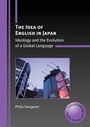
The Idea of English in Japan
Ideology and the Evolution of a Global Language
Published on 4. August 2009
192 pages
978-1-84769-691-5 (ISBN)
Description

This book examines the ways in which English is conceptualised as a global language in Japan, and considers how the resultant language ideologies - drawn in part from universal discourses; in part from context-specific trends in social history - inform the relationships that people in Japan have towards the language. The book analyses the specific nature of the language's symbolic meaning in Japan, and how this meaning is expressed and negotiated in society. It also discusses how the ideologies of English that exist in Japan might have implications for the more general concept of 'English as a global language'. To this end it considers the question of what constitutes a 'global' language, and how, if at all, a balance can be struck between the universal and the historically-contingent when it comes to formulating a theory of English within the world.
Reviews / Votes
The idea of English in Japan is the first book-length treatment of globalization and ideology of English in Japan. Seargeant critically analyzes English both as a language to be communicated in and as a concept to be symbolized and reflected in non-linguistic practices in the society. The book is a must-read not only for scholars of English in Japan but also for anyone who is interested in theorizing English as a global language from linguistic and ideological perspectives. -- Aya Matsuda, Mary Lou Fulton Institute and Graduate School of Education, Arizona State University, USA This is a book that is highly relevant to the global study of applied linguistics. Seargeant's review of the monocentric/polycentric debate is both clear and succinct and at the same time subtle and well-informed. This well-written book draws on a wide-ranging body of literature, which is always germane to the central argument and never a distraction. The Idea of English in Japan is a thoughtful and thought-provoking work that deserves space on the bookshelves of anyone interested in the concept of global English. * Alison Stewart, Gakushuin University, Japan, System (2010) * By recourse to rich, empirical examples, The Idea of English in Japan effectively engages with postmodern conceptions of global Englishes without succumbing to postmodenlism's more nihilistic excesses. Traditionalists in applied linguistics may chunter that Seargeant's methodologies are unclear; his data too limited for quantitative generalisation or even thick qualitative description; that the book is messy, cluttered, and does not offer anything approaching a linear nalTative or neat conclusion. But this is precisely the point. Seargeant's subject-a globalised language in particular local contexts-is all of these things: fractured, sprawling, circular, self-reflexive, versatile, thought-provoking. His book not only reflects these qualities of English as a global language, but actively embodies them as well. * Gareth Price, Duke University in Language Policy (2011) 10:265-267 *More details
Series
Language
English
Place of publication
Bristol
United Kingdom
Publishing group
Channel View Publications Ltd
Target group
Professional and scholarly
Product notice
Reflowable
ISBN-13
978-1-84769-691-5 (9781847696915)
Copyright in bibliographic data and cover images is held by Nielsen Book Services Limited or by the publishers or by their respective licensors: all rights reserved.
Schweitzer Classification
Other editions
Additional editions
Book
08/2009
Multilingual Matters
€42.00
Shipment within 10-20 days
Person
Philip Seargeant is Senior Lecturer in Applied Linguistics in the Centre for Language and Communication, The Open University. He is author of The Idea of English in Japan (Multilingual Matters, 2009) and Exploring World Englishes (Routledge), and editor of English in Japan in the Era of Globalization (Palgrave Macmillan, 2011) and English in the World: History, Diversity, Change (Routledge, 2012, with Joan Swann).
Content
Acknowledgements
List of Figures
Chapter 1: Introduction
Chapter 2: The Concept of English as a Global Language
Chapter 3: Language Ideology and Global English
Chapter 4: English in Japan: The Current Shape of the Debate
Chapter 5: Globalisation - 'Enriching Japanese Culture Through Contact with Other Cultures'
Chapter 6: Authenticity - 'More English than England Itself'
Chapter 7: Aspiration - 'Enhancing Lifestyles and Living out Dreams'
Chapter 8: The Unknown Language
Chapter 9: Rival Ideologies in Applied Linguistics
References
List of Figures
Chapter 1: Introduction
Chapter 2: The Concept of English as a Global Language
Chapter 3: Language Ideology and Global English
Chapter 4: English in Japan: The Current Shape of the Debate
Chapter 5: Globalisation - 'Enriching Japanese Culture Through Contact with Other Cultures'
Chapter 6: Authenticity - 'More English than England Itself'
Chapter 7: Aspiration - 'Enhancing Lifestyles and Living out Dreams'
Chapter 8: The Unknown Language
Chapter 9: Rival Ideologies in Applied Linguistics
References
