

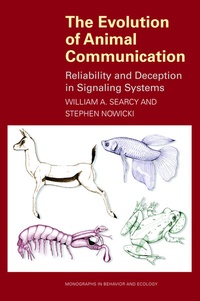
The Evolution of Animal Communication
Reliability and Deception in Signaling Systems
1st Edition
Published on 1. January 2010
288 pages
978-1-4008-3572-0 (ISBN)
Description

Gull chicks beg for food from their parents. Peacocks spread their tails to attract potential mates. Meerkats alert family members of the approach of predators. But are these--and other animals--sometimes dishonest? That's what William Searcy and Stephen Nowicki ask in The Evolution of Animal Communication. They take on the fascinating yet perplexing question of the dependability of animal signaling systems.
The book probes such phenomena as the begging of nesting birds, alarm calls in squirrels and primates, carotenoid coloration in fish and birds, the calls of frogs and toads, and weapon displays in crustaceans. Do these signals convey accurate information about the signaler, its future behavior, or its environment? Or do they mislead receivers in a way that benefits the signaler? For example, is the begging chick really hungry as its cries indicate or is it lobbying to get more food than its brothers and sisters?
Searcy and Nowicki take on these and other questions by developing clear definitions of key issues, by reviewing the most relevant empirical data and game theory models available, and by asking how well theory matches data. They find that animal communication is largely reliable--but that this basic reliability also allows the clever deceiver to flourish. Well researched and clearly written, their book provides new insight into animal communication, behavior, and evolution.
The book probes such phenomena as the begging of nesting birds, alarm calls in squirrels and primates, carotenoid coloration in fish and birds, the calls of frogs and toads, and weapon displays in crustaceans. Do these signals convey accurate information about the signaler, its future behavior, or its environment? Or do they mislead receivers in a way that benefits the signaler? For example, is the begging chick really hungry as its cries indicate or is it lobbying to get more food than its brothers and sisters?
Searcy and Nowicki take on these and other questions by developing clear definitions of key issues, by reviewing the most relevant empirical data and game theory models available, and by asking how well theory matches data. They find that animal communication is largely reliable--but that this basic reliability also allows the clever deceiver to flourish. Well researched and clearly written, their book provides new insight into animal communication, behavior, and evolution.
More details
Edition
Course Book
Language
English
Place of publication
Princeton, NJ
United States
Publishing group
De Gruyter
Target group
Professional and scholarly
Edition type
Digital original
Illustrations
45 line illus. 1 table.
File size
1,26 MB
ISBN-13
978-1-4008-3572-0 (9781400835720)
Schweitzer Classification
Other editions
Additional editions
William A. Searcy | Stephen Nowicki
The Evolution of Animal Communication
Reliability and Deception in Signaling Systems
Book
09/2005
Princeton University Press
€86.66
Article exhausted; check different version
William A. Searcy | Stephen Nowicki
The Evolution of Animal Communication
Reliability and Deception in Signaling Systems
Book
09/2005
Princeton University Press
€70.60
Article not available at the moment
Persons
William A. Searcy is the Robert E. Maytag Professor of Ornithology at the University of Miami. He is the author, with Ken Yasukawa, of Polygyny and Sexual Selection in Red-Winged Blackbirds (Princeton). Stephen Nowicki is Bass Fellow and Professor of Biology, Psychological and Brain Sciences, and Neurobiology at Duke University, where he currently serves as Dean of the Natural Sciences. He has published more than 65 scientific papers on animal communication and behavior, including work on birds, insects, spiders, and mammals.
Content
Figures, Boxes, and Table ix
Acknowledgments xiii
Introduction 1
Chapter 1: Definitions 2
Some History 6
Categories of Signal Costs 13
Alternative Explanations for Reliability 16
Deception Redux 17
Evolutionary Interests of Signalers and Receivers 20
Chapter 2: Signaling When Interests Overlap 24
Signaling Between Relatives: Theory 24
Begging 36
Alarms 53
Food Calls 68
Individually Directed Skepticism 73
Conclusions 77
Chapter 3: Signaling When Interests Diverge 78
Mating Signals: Theory 78
Carotenoid Pigmentation 86
Songs in Oscine Birds 97
Tail Length in Birds 123
Conclusions 131
Chapter 4: Signaling When Interests Oppose 134
Signaling in Aggressive Contexts: Theory 134
Postural Displays of Aggression in Birds 141
Badges of Status 147
Weapon Displays in Crustaceans 160
Dominant Frequency in Calls of Frogs and Toads 169
Conclusions 178
Chapter 5: Honesty and Deception in Communication Networks 181
Third-Party Receivers 182
"Eavesdropping" versus "Interception" 183
Eavesdropping in Signaling Interactions 185
Third-Party Receivers and Reliability 203
Conclusions 206
Chapter 6: Conclusions 207
Reliability 208
Alternatives to the Handicap Mechanism 214
Deceit 218
The Balance of Reliability and Deceit 223
References 225
Author Index 257
Subject Index 263
Acknowledgments xiii
Introduction 1
Chapter 1: Definitions 2
Some History 6
Categories of Signal Costs 13
Alternative Explanations for Reliability 16
Deception Redux 17
Evolutionary Interests of Signalers and Receivers 20
Chapter 2: Signaling When Interests Overlap 24
Signaling Between Relatives: Theory 24
Begging 36
Alarms 53
Food Calls 68
Individually Directed Skepticism 73
Conclusions 77
Chapter 3: Signaling When Interests Diverge 78
Mating Signals: Theory 78
Carotenoid Pigmentation 86
Songs in Oscine Birds 97
Tail Length in Birds 123
Conclusions 131
Chapter 4: Signaling When Interests Oppose 134
Signaling in Aggressive Contexts: Theory 134
Postural Displays of Aggression in Birds 141
Badges of Status 147
Weapon Displays in Crustaceans 160
Dominant Frequency in Calls of Frogs and Toads 169
Conclusions 178
Chapter 5: Honesty and Deception in Communication Networks 181
Third-Party Receivers 182
"Eavesdropping" versus "Interception" 183
Eavesdropping in Signaling Interactions 185
Third-Party Receivers and Reliability 203
Conclusions 206
Chapter 6: Conclusions 207
Reliability 208
Alternatives to the Handicap Mechanism 214
Deceit 218
The Balance of Reliability and Deceit 223
References 225
Author Index 257
Subject Index 263
