

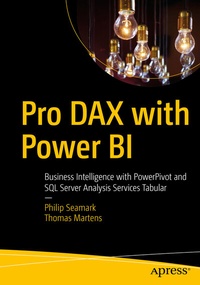
Pro DAX with Power BI
Description

Often a task seems complex due to a lack of understanding, or a misunderstanding of core principles, and how certain components interact with each other. The authors of this book use solutions and examples to teach you how to solve complex problems. They explain the intricate workings of important concepts such as Filter Context and Context Transition. You will learn how Power BI, through combining DAX building blocks (such as measures, table filtering, and data lineage), can yield extraordinary analytical power. Throughout Pro Dax with Power BI these building blocks are used to create and compose solutions for advanced DAX problems, so you can independently build solutions to your own complex problems, and gain valuable insight from your data.
What You Will Learn
-
Understand the intricate workings of DAX to solve advanced problems
-
Deconstruct problems into manageable parts in order to create your own recipes
-
Apply predefined solutions for addressing problems, and link back step-by-step to the mechanics of DAX, to know the foundation of this powerful query language
- Get fully on board with DAX, a new and evolving language, by learning best practices
Who This Book Is For
Anyone who wants to use Power BI to build advanced and complex models. Some experience writing DAX is helpful, but not essential if you have experience with other data query languages such as MDX or SQL.
More details
Other editions
Additional editions
Persons
Philip Seamark is an experienced data warehouse (DW) and business intelligence (BI) consultant with a deep understanding of the Microsoft stack and extensive knowledge of DW methodologies and enterprise data modeling. Recognized for his analytical, conceptual, and problem-solving abilities, he has more than 25 years of commercial experience delivering business applications across a broad range of technologies. His expertise runs the gamut from project management, dimensional modeling, performance tuning, ETL design, development and optimization, and report and dashboard design to installation and administration.
In 2017 Phil received a Microsoft Data Platform MVP award for his contributions to the Power BI community site, and in 2018 he was named a top 10 influencer in the Power BI space. He can be found speaking at many data, analytic, and reporting events around the world. He is also the founder and organizer of the Wellington Power BI User Group. Hecan be reached through Twitter at PhilSeamark.
Thomas Martens has more than 20 years of experience in the fields of BI, DW, and analytics. In his current role as Principal Consultant of Business Intelligence and Analytics, he helps large enterprises to implement sustainable analytical applications. He specializes in the visualization of data, and the application of analytical methods to large amounts of data. He recognizes DAX as a powerful query language available in many products and wants to leverage his hard-earned experience in creating solutions to bring DAX users to the next level. He can be reached at Twitter at tommartens68.
Content
Part I: The Foundation. - Chapter 1: DAX Mechanic.- Chapter 2: Data Modeling.- Chapter 3: DAX Lineage.- Part II: Core Concepts .- Chapter 4: This Weird Context Thing; Two Approaches.- Chapter 5: Filtering in DAX.- Chapter 6: Iterators.- Chapter 7: Filtering Using Measures.- Part III: DAX to Solve Advanced Everyday Problems .- Chapter 8: Using DAX to Solve Advanced Reporting Requirements.- Chapter 9: Time Intelligence.- Chapter 10: Finding What's Not There.- Chapter 11: Row Level Security.- Part IV: Debugging and Optimization .- Chapter 12: DAX Studio.- Chapter 13: Query Plans.- Chapter 14: Scale your Models.
