

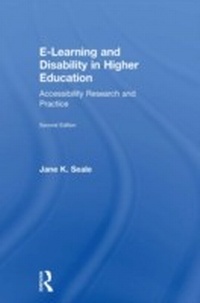
E-learning and Disability in Higher Education
Accessibility Research and Practice
2nd Edition
Published on 8. October 2013
280 pages
978-1-136-21650-3 (ISBN)
Description

Most people working within the higher education sector understand the importance of making e-learning accessible to students with disabilities, yet it is not always clear exactly how this should be accomplished. E-Learning and Disability in Higher Education evaluates current accessibility practice and critiques the extent to which 'best' practices can be confidently identified and disseminated. This second edition has been fully updated and includes a focus on research that seeks to give 'voice' to disabled students in a way that provides an indispensible insight into their relationship with technologies and the institutions in which they study.
Examining the social, educational, and political background behind making online learning accessible in higher and further education, E-Learning and Disability in Higher Education considers the roles and perspectives of the key stake-holders involved in e-learning: lecturers, professors, instructional designers, learning technologists, student support services, staff developers, and senior managers and administrators.
Examining the social, educational, and political background behind making online learning accessible in higher and further education, E-Learning and Disability in Higher Education considers the roles and perspectives of the key stake-holders involved in e-learning: lecturers, professors, instructional designers, learning technologists, student support services, staff developers, and senior managers and administrators.
Reviews / Votes
"In this second edition of Seale's go-to text, she accurately re-imagines the disability and e-learning landscape in accordance with shifting paradigms, moving away from a role-based emphasis towards a stakeholder approach that emphasises a more socially inclusive perspective. This book should be read in its entirety by anyone working in e-learning or accessibility, and provides a useful resource for anyone teaching in higher education today."-Dr. Simon Ball, Senior Advisor at Jisc TechDis"This book makes a powerful argument to transform accessibility into a more participatory and inclusive concept. Drawing on Freire's notion of critical pedagogy, Seale offers a critical, detailed analysis of research surrounding accessibility practice and shows that there are alternatives, such as participatory research, that foster 'digital inclusion' and increase agency for people with disabilities."-Dr. Alan R. Foley, Associate Professor of Instructional Technology, Syracuse University
"Seale provides a very comprehensive yet personalized, practical approach to the topic of e-learning, disability, and higher education. This is an important read for instructors, researchers, disability service providers and, of course, students with disabilities in higher education."-Dr. Robert A. Stodden, Director and Professor, Center on Disability Studies, University of Hawaii at Manoa
More details
Edition
2nd edition
Language
English
Place of publication
London
United Kingdom
Publishing group
Taylor & Francis Ltd
Target group
College/higher education
Edition type
Revised edition
Product notice
Reflowable
Illustrations
13 s/w Tabellen
13 Tables, black and white
File size
1,85 MB
ISBN-13
978-1-136-21650-3 (9781136216503)
Copyright in bibliographic data and cover images is held by Nielsen Book Services Limited or by the publishers or by their respective licensors: all rights reserved.
Schweitzer Classification
Other editions
Additional editions
Book
08/2013
2nd Edition
Routledge
€206.60
Shipment within 15-20 days
Book
08/2013
2nd Edition
Routledge
€60.50
Shipment within 15-20 days
Person
Dr. Jane K. Seale is a Professor of Inclusive Education in the Graduate School of Education, University of Exeter, UK.
Content
1. CONTEXTUALING THE SCENE
Chapter 1: Opening up spaces for dialogue, critique and imagination in accessibility research and practice.
Chapter 2: Being a disabled student in higher education.
Chapter 3: Drivers for change in higher education accessibility practice.
Chapter 4: The stakeholders of accessibility practice.
2. SURVEYING THE SCENE: MAKING SENSE OF PRACTICE
Chapter 5: Guiding accessibility practice.
Chapter 6: Evaluating accessibility practice.
Chapter 7: Conceptualising accessibility practice.
3. CRITIQUING THE SCENE: MAKING SENSE OF VOICES AND SILENCES
Chapter 8: Mediated voices: what do we really know about disabled students' accessibility experiences?
Chapter 9: Missing voices: What do we really know about the perspectives
and experiences of accessibility stakeholders?
Chapter 10: The call for accessibility training and the silences surrounding what works.
Chapter 11: Critical silences around Universal Design.
4. RE-IMAGINING THE SCENCE: VOICING THE FUTURE FOR ACCESSIBILITY RESEARCH AND PRACTICE
Chapter 12: Re-imagining accessibility research: methods to enable a democratic voice to be heard.
Chapter 13: Re-imagining accessibility practice: embracing the discourse of digital inclusion.
Chapter 1: Opening up spaces for dialogue, critique and imagination in accessibility research and practice.
Chapter 2: Being a disabled student in higher education.
Chapter 3: Drivers for change in higher education accessibility practice.
Chapter 4: The stakeholders of accessibility practice.
2. SURVEYING THE SCENE: MAKING SENSE OF PRACTICE
Chapter 5: Guiding accessibility practice.
Chapter 6: Evaluating accessibility practice.
Chapter 7: Conceptualising accessibility practice.
3. CRITIQUING THE SCENE: MAKING SENSE OF VOICES AND SILENCES
Chapter 8: Mediated voices: what do we really know about disabled students' accessibility experiences?
Chapter 9: Missing voices: What do we really know about the perspectives
and experiences of accessibility stakeholders?
Chapter 10: The call for accessibility training and the silences surrounding what works.
Chapter 11: Critical silences around Universal Design.
4. RE-IMAGINING THE SCENCE: VOICING THE FUTURE FOR ACCESSIBILITY RESEARCH AND PRACTICE
Chapter 12: Re-imagining accessibility research: methods to enable a democratic voice to be heard.
Chapter 13: Re-imagining accessibility practice: embracing the discourse of digital inclusion.
