

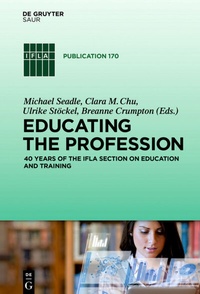
Educating the Profession
Description

Education and training for the library profession have changed over the decades, and this publication looks both at the past and the future of these developments at schools of library and information science as well as the role of IFLA's Section on Education and Training. The chapters cover regional developments in Europe, Asia, Africa, Australia and the Americas; special topics, such as quality assurance and case studies; and future considerations in LIS education.
More details
Other editions
Additional editions
Persons
Michael Seadle, Humboldt-Universität, Berlin, and Clara Chu , University of North Carolina at Greensboro.
Content
- Intro
- Contents
- About IFLA
- Acknowledgement
- Welcome. Introduction to the book
- 1. Development of the Profession. A History of the IFLA Section for Education & Training from 2004 to 2014
- Section 1: Europe
- Introduction
- 2. European Library and Information Science Schools
- 3. "Expertise ... Certification ... Cultural Capital". The Education of Librarians in the UK
- 4. New Approaches, Structural and Organizational Changes in the PhD Programme in LIS/IS
- 5. Library and Information Science Education and Training in Serbia
- Section 2: Africa
- Introduction
- 6. Anglophone Africa: Ibadan Sixty Years on. An Historical Survey and Review of Trends in African LIS Education
- 7. Fifteen Years of Training Librarians in French-speaking Sub-Saharan Africa. Outcomes and Perspectives
- 8. Library Education in Nigeria. Repositioning for Professional Relevance in the 21st Century
- Section 3: Americas
- Introduction
- 9. What's in a Name? A Brief History of Informatics Education
- 10. Library and Information Science (LIS) Education in Mexico
- 11. Library Education in Peru. Historical and Future Perspectives
- Section 4: Asia and Australia
- Introduction
- 12. LIS Education in the United Arab Emirates. Past and Future Directions
- 13. Looking back through More than One Hundred Years of LIS Education in India and Looking ahead
- 14. The Development, Challenges, and Opportunities of Library and Information Science Education in Indonesia
- 15. The University of the Philippines (UP) School of Library and Information Studies. Legacies, Challenges and Commitment to the Profession through Excellence in LIS Education
- 16. The Australian LIS Education Journey. From Practice to Profession
- Section 5: Special Perspective on Library and Information Science Education and Training
- Introduction
- 17. International Quality Assurance in LIS Education
- 18. The Rise and Fall of the Library Science Library. A History of Library Support for North American LIS Education
- 19. The Bibliotheca Alexandrina's Role in Library and Information Science Education and Training
- Section 6: Possible Future Educational Approaches for LIS and its Development
- Introduction
- 20. Trends in Librarianship Training in Germany
- 21. Undergraduate Distance Education in LIS in Spain 1999-2014. An Historical Perspective
- 22. In Search of New Horizons. Agenda of LIS Schools in Pakistan
- 23. From Professional Qualifications to iSchool@northumbria. A 65-year Journey
- Contributors
