

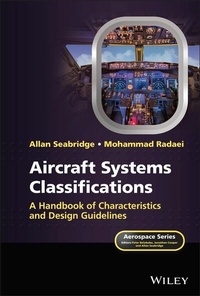
Aircraft Systems Classifications
Description

Enables aerospace professionals to quickly and accurately reference key information about all types of aircraft systems
Aircraft Systems Classifications: A Handbook of Characteristics and Design Guidelines provides comprehensive information on aircraft systems delivered in a concise, direct, and standardized way, allowing readers to easily find the information they need. The book presents a full set of characteristics and requirements for all types of aircraft systems, including avionic, mission, and supporting ground systems, in a single volume. Readers can delve further into specific topics by referencing the detailed glossary and bibliography.
To aid in reader comprehension, each aircraft system is broken down according to various criteria, such as:
* Purpose, description, and safety
* Integration with other systems
* Key interfaces and design drivers
* Modeling and simulation
* Best practices and future trends
Written for aerospace professionals, researchers, and advanced students with some existing knowledge of the aircraft industry, this book allows readers to quickly reference information on every aspect of aircraft systems.
More details
Other editions
Additional editions
Persons
Allan Seabridge is a member of the BAE Systems Heritage Department at Warton and retired as Head of Flight Systems Engineering after a long career with BAE Systems. He has over 50 years' experience in aerospace systems engineering, business development, and research & development, working on major projects including Canberra, Jaguar, Tornado, EAP, Typhoon, and Nimrod. Since retiring he has developed an interest in engineering education leading to the design and delivery of systems and engineering courses at a number of UK universities at the undergraduate and postgraduate level.
Mohammad Radaei has a PhD from Cranfield University in aerospace engineering, specializing in avionics systems integration. He obtained a BSc in aeronautical engineering from Air University, and MSc in aerospace engineering from National University of Iran in Tehran. He also holds a commercial pilot's license. His research interests include aircraft systems design, avionics systems integration, systems architecting, aircraft and systems flight testing, applied mathematics, flight dynamics and control of manned and unmanned aircraft, as well as human machine interactions. He is currently lecturing in avionics systems at a number of universities.
Content
About the Authors ix
Acknowledgements xi
Sources of Background Information xiii
Glossary xv
1 Introduction 1
Further Reading 4
2 The Airframe and Systems Overview 5
2.1 Introduction 5
2.2 The Airframe 6
2.3 The Aircraft Systems 10
2.4 Classification of Aircraft Roles 14
2.5 Classification of Systems 25
2.6 Stakeholders 26
2.7 Example Architectures 27
2.8 Data Bus 29
2.9 Summary and Conclusions 34
References 34
Exercises 35
3 Vehicle Systems 37
3.1 Propulsion System 38
3.2 Fuel System 44
3.3 Electrical Power Generation and Distribution 49
3.4 Hydraulic Power Generation and Distribution 53
3.5 Bleed Air System 56
3.6 Secondary Power Systems 59
3.7 Emergency Power Systems 61
3.8 Flight Control System 65
3.9 Landing Gear 68
3.10 Brakes and Anti-skid 71
3.11 Steering System 73
3.12 Environmental Control System 76
3.13 Fire Protection System 79
3.14 Ice Detection 82
3.15 Ice Protection 84
3.16 External Lighting 86
3.17 Probe Heating 89
3.18 Vehicle Management System (VMS) 91
3.19 Crew Escape 93
3.20 Canopy Jettison 97
3.21 Oxygen 99
3.22 Biological and Chemical Protection 102
3.23 Arrestor Hook 104
3.24 Brake Parachute 107
3.25 Anti-spin Parachute 110
3.26 Galley 112
3.27 Passenger Evacuation 115
3.28 In-Flight Entertainment 117
3.29 Toilet and Water Waste 119
3.30 Cabin and Emergency Lighting 122
References 123
Exercise 126
4 Avionic Systems 127
4.1 Displays and Controls 127
4.2 Communications 131
4.3 Navigation 134
4.4 Example Navigation System Architecture 135
4.5 Flight Management System (FMS) 138
4.6 Weather Radar 140
4.7 Air Traffic Control (ATC) Transponder 143
4.8 Traffic Collision and Avoidance System (TCAS) 146
4.9 Terrain Avoidance and Warning System (TAWS) 149
4.10 Distance Measuring Equipment (DME)/TACAN 152
4.11 VHF Omni-Ranging (VOR) 154
4.12 Automatic Flight Control System 156
4.13 Radar Altimeter (Rad Alt) 160
4.14 Automated Landing Aids 163
4.15 Air Data System (ADS) 168
4.16 Accident Data Recording System (ADRS) 172
4.17 Electronic Flight Bag (EFB) 174
4.18 Prognostics and Health Management System (PHM) 178
4.19 Internal Lighting 181
4.20 Integrated Modular Architecture (IMA) 183
4.21 Antennas 185
References 189
5 Mission Systems 191
5.1 Radar System 192
5.2 Electro-optical System 197
5.3 Electronic Support Measures (ESM) 200
5.4 Magnetic Anomaly Detection (MAD) 202
5.5 Acoustic System 205
5.6 Mission Computing System 207
5.7 Defensive Aids 209
5.8 Station Keeping System 212
5.9 Electronic Warfare System 214
5.10 Camera System 217
5.11 Head Up Display (HUD) 220
5.12 Helmet Mounted Systems 222
5.13 Data Link 224
5.14 Weapon System 227
5.15 Mission System Displays and Controls 230
5.16 Mission System Antennas 234
References 237
Further Reading 239
Exercises 239
6 Supporting Ground Systems 241
6.1 Flight Test Data Analysis 243
6.2 Maintenance Management System 246
6.3 Accident Data Recording 248
6.4 Mission Data Management (Mission Support System) 250
6.5 UAV Control 252
References 254
Exercises 255
7 Modelling of Systems Architectures 257
7.1 Introduction 257
7.2 Literature Survey of Methods 259
7.3 Avionics Integration Architecture Methodology 277
7.4 Avionics Integration Modelling of Optimisation 292
7.5 Simulations and Results for a Sample Architecture 297
7.6 Conclusion 300
References 300
8 Summary and Future Developments 305
8.1 Introduction 305
8.2 Systems of Systems 305
8.3 Architectures 314
8.4 Other Considerations 315
8.5 Conclusion 323
8.6 What's Next? 323
Exercise 327
Index 329
Glossary
This glossary is intended to be of assistance to readers of other documents provided in the references and sources of material in this Handbook. The Glossary contains, therefore, many more entries than the abbreviations, units, and terms used in this book. It will not be complete, terms change and new terms emerge. The Internet is a good place to find many terms, abbreviations, and acronyms in general use.
- 3D
- three dimensional
- 4D
- four dimensional
- AAA
- anti-aircraft artillery (triple A)
- A&AE
- Aircraft & Armament Evaluation (Squadron, Boscombe Down) see A&AEE
- A&AEE
- Aircraft & Armament Experimental Establishment
- A4A
- Airlines for America
- AADL
- architecture analysis and design language
- ABL
- airborne laser
- ABS
- automatic braking system
- AC
- airworthiness circular - document offering advice on specific aircraft operations
- AC
- alternating current
- ACA
- Agile Combat Aircraft
- ACARS
- aircraft communications and reporting system
- ACARS
- ARINC communications and reporting system
- ACE
- actuator control electronics
- ACFD
- advanced civil flight deck
- ACK
- receiver acknowledge
- ACM
- air cycle machine
- ACM
- air driven motor pump
- ACO
- ant colony optimisation
- ACP
- audio control panel
- ACS
- active control system
- ACT
- active control technology
- A-D
- analogue to digital
- Ada
- a high order software language
- ADC
- air data computer
- ADC
- analogue to digital conversion/converter
- ADCN
- Aircraft Data Communication Network
- ADD
- airstream direction detector
- ADF
- automatic direction finding
- ADI
- attitude direction indicator
- ADIRS
- air data and inertial reference system
- ADIRU
- air data and inertial reference unit (B777)
- ADM
- air data module
- ADMC
- actuator drive and monitoring computer
- ADN
- Avionics Data Network
- ADP
- air driven pump
- ADR
- accident data recorder
- ADS-A
- automatic dependent surveillance - address
- ADS-B
- automatic dependent surveillance - broadcast
- ADU
- actuator drive unit
- ADV
- Air Defence Variant (of Panavia Tornado)
- AE
- acoustic emission
- AESA
- active electronically scanned array
- AEU
- antenna electronic unit
- AEW
- airborne early warning
- AEW&C
- airborne early warning and control
- AFCS
- automatic flight control system
- AFDC
- autopilot flight director computer
- AFDS
- autopilot flight director system
- AFDX
- avionics full-duplex switched Ethernet
- AGARD
- advisory group for aerospace and development
- AGC
- automatic gain control
- AH
- ampere hour
- AH
- artificial horizon
- AHARS
- attitude and heading reference system
- AI
- airborne interception
- AI
- artificial intelligence
- AICS
- air intake control system
- AIFF
- advanced IFF
- AIMS
- aircraft information management system (B777)
- AIT
- Aeritalia
- Al
- aluminium
- ALARM
- air launched anti-radar missile
- ALARP
- as low as reasonably practical
- ALF
- ambient lighting facility
- AlGaAs
- aluminium gallium arsenide
- ALT
- barometric altitude
- ALU
- arithmetic logic unit
- AM
- amplitude modulation
- AMAD
- airframe mounted accessory gearbox
- AMCC
- Applied Micro Circuits Corporation
- AMECS
- advanced military engine control system
- AMLCD
- active matrix liquid crystal displays
- AMP
- air driven motor pump, avionics modification programme
- AMRAAM
- advanced medium range air to air missile
- AMSU
- aircraft motion sensor unit
- ANO
- air navigation order
- ANP
- actual navigation performance
- AoA
- angle of attack
- AOC
- Airline Operational Centre
- AOR-E
- Azores Oceanic Region - East
- AOR-W
- Azores Oceanic Region - West
- AP
- autopilot
- APEX
- application executive
- APGS
- auxiliary power generation system
- API
- application programming interface
- APSCU
- air supply and pressure control unit
- APU
- auxiliary power unit
- ARI
- Air Radio Installation
- ARINC 400 series
- ARINC specifications providing a design foundation for avionic equipment
- ARINC 404
- early ARINC standard relating to the packaging of avionic equipment
- ARINC 429
- widely used civil aviation data bus standard
- ARINC 500 Series
- ARINC specifications relating to the design of analogue avionic equipment
- ARINC 578
- ARINC standard relating to the design of VHF omni-range (VOR)
- ARINC 579
- ARINC standard relating to the design of instrument landing system (ILS)
- ARINC 600
- later ARINC standard relating to the packaging of avionic equipment
- ARINC 600 Series
- ARINC specifications relating to enabling technologies for avionic equipment
- ARINC 629
- ARINC standard relating to a 2 Mbit/s digital data bus
- ARINC 664
- ARINC standard relating to aircraft full multiplex (AFDX) digital data bus
- ARINC 700 Series
- ARINC specifications relating to the design of digital avionic equipment
- ARINC 708
- ARINC Standard relating to the design of weather radar
- ARINC 755
- ARINC standard relating to the design of multi-mode receivers (MMR)
- ARINC
- Air Radio Inc.
- ARM
- anti-radar missile, anti-radiation missile
- ARP
- aerospace recommended practice (SAE)
- ASCB
- avionics standard communications bus (Honeywell)
- ASCII
- American Standard Code for Information Interchange
- ASE
- aircraft survivability equipment
- ASI
- aircraft station interface, airspeed indicator
- ASIC
- application specific integrated circuit
- ASPCU
- air supply and pressure control unit
- ASR
- air sea rescue
- ASR
- anonymous subscriber messaging
- ASRAAM
- advanced short range air to air missile
- AST
- air staff target
- AST
- asynchronous transfer mode
- ASTOR
- airborne stand-off radar
- ASUW
- anti-surface unit warfare
- ASW
- anti-submarine warfare
- ATA
- advanced tactical aircraft
- ATA
- Air Transport Association
- ATC
- air traffic control
- A to D
- analogue to digital
- ATE
- automatic test equipment
- ATF
- advanced tactical fighter
- ATF
- altitude test facility
- ATI
- air transport indicator
- ATM
- air targeting mode
- ATM
- air transport management, air traffic management
- ATN
- Aeronautical Telecommunications Network
- ATR
- Air Transport Radio (LRU form factor or box size)
- ATS
- air traffic services
- ATSU
- air traffic service unit - Airbus unit to support FANS
- AWACS
- airborne warning and command system
- AWG
- American wire gauge
- Az
- azimuth
- BAC
- British Aircraft Corporation
- BAe
- British Aerospace (now BAE Systems)
- BAG
- bandwidth allocation group
- BAT
- battery
- BC
- bus controller
- BCAR
- British Civil Airworthiness Requirement
- BCD
- binary coded decimal
- BFL
- balanced field length
- BFoV
- binocular field of view
- BGAN
- broadcast global area network
- BIT
- built in test
- BIU
- bus interface unit
- BLC
- battery line contactors
- BMS
- business management system
- BP
- binary programming
- BPCU
- brake power control unit
- bps
- bits per second
- BRNAV
- basic area navigation in RNP
- BSCU
- brake system control unit
- BTB
- bus tie breakers
- BTC
- bus tie contactor
- BTMU
- brake temperature monitoring unit
- BVR
- beyond visual range
- BWB
- blended wing body
- C band
- C band (3.90-6.20 GHz)
- C++
- a programming language
- C3, C3
- command, control, and communications
- CA
- course acquisition - GPS operational mode
- CAA
- Civil Airworthiness Authority
- CAD
- computer aided design
- CAE
- computer aided engineering
- CAIV
- cost as an independent variable
- CAMU
- ...
