

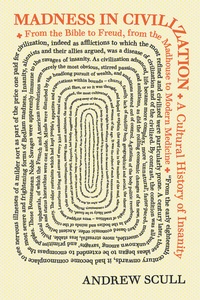
Madness in Civilization
A Cultural History of Insanity, from the Bible to Freud, from the Madhouse to Modern Medicine
1st Edition
Published on 28. July 2015
432 pages
978-1-4008-6571-0 (ISBN)
Description

A beautifully illustrated history of the human encounter with unreason
The loss of reason, a sense of alienation from the commonsense world we all like to imagine we inhabit, the shattering emotional turmoil that seizes hold and won't let go-these are some of the traits we associate with madness. Today, mental disturbance is most commonly viewed through a medical lens, but societies have also sought to make sense of it through religion or the supernatural, or by constructing psychological or social explanations in an effort to tame the demons of unreason. Madness in Civilization traces the long and complex history of this affliction and our attempts to treat it.
Beautifully illustrated throughout, Madness in Civilization takes readers from antiquity to today, painting a vivid and often harrowing portrait of the different ways that cultures around the world have interpreted and responded to the seemingly irrational, psychotic, and insane. From the Bible to Sigmund Freud, from exorcism to mesmerism, from Bedlam to Victorian asylums, from the theory of humors to modern pharmacology, the book explores the manifestations and meanings of madness, its challenges and consequences, and our varied responses to it. It also looks at how insanity has haunted the imaginations of artists and writers and describes the profound influence it has had on the arts, from drama, opera, and the novel to drawing, painting, and sculpture.
Written by one of the world's preeminent historians of psychiatry, Madness in Civilization is a panoramic history of the human encounter with unreason.
The loss of reason, a sense of alienation from the commonsense world we all like to imagine we inhabit, the shattering emotional turmoil that seizes hold and won't let go-these are some of the traits we associate with madness. Today, mental disturbance is most commonly viewed through a medical lens, but societies have also sought to make sense of it through religion or the supernatural, or by constructing psychological or social explanations in an effort to tame the demons of unreason. Madness in Civilization traces the long and complex history of this affliction and our attempts to treat it.
Beautifully illustrated throughout, Madness in Civilization takes readers from antiquity to today, painting a vivid and often harrowing portrait of the different ways that cultures around the world have interpreted and responded to the seemingly irrational, psychotic, and insane. From the Bible to Sigmund Freud, from exorcism to mesmerism, from Bedlam to Victorian asylums, from the theory of humors to modern pharmacology, the book explores the manifestations and meanings of madness, its challenges and consequences, and our varied responses to it. It also looks at how insanity has haunted the imaginations of artists and writers and describes the profound influence it has had on the arts, from drama, opera, and the novel to drawing, painting, and sculpture.
Written by one of the world's preeminent historians of psychiatry, Madness in Civilization is a panoramic history of the human encounter with unreason.
More details
Edition
Pilot project. eBook available to selected US libraries only
Language
English
Place of publication
Princeton, NJ
United States
Publishing group
De Gruyter
Target group
Professional and scholarly
Edition type
Digital original
Illustrations
120 color & b&w illus.
File size
57,76 MB
ISBN-13
978-1-4008-6571-0 (9781400865710)
Schweitzer Classification
Person
Andrew Scull is Distinguished Professor of Sociology and Science Studies at the University of California, San Diego. He is the author of Masters of Bedlam: The Transformation of the Mad-Doctoring Trade (Princeton).
Content
- Cover
- Title
- Copyright
- Dedication
- Contents
- Acknowledgments
- Chapter One: CONFRONTING MADNESS
- Chapter Two: MADNESS IN THE ANCIENT WORLD
- Madness and the Israelites
- The Hellenic World
- Greek and Roman Physick
- Greece and Rome and Imperial China: Worlds Compared
- East and West
- Chapter Three: THE DARKNESS AND THE DAWN
- Successor States
- Islam and Madness
- Early Hospitals
- Demonic Possession and Spiritual Healing
- Christian Europe
- Saints and Miracles
- Literature and Madness
- Medicine and Madness
- Chapter Four: MELANCHOLIE AND MADNESSE
- Fairies, Ghosts, Goblins and Witches
- Melancholie Madnesse
- Drawing Boundaries
- Dramatic Possibilities
- Madness in Its Infinite Variety
- Fictions and Fables
- Madness and Art
- Fools and Folly
- Reformation and Counter-Reformation
- Puzzles and Complexities
- Chapter Five: MADHOUSES AND MAD-DOCTORS
- Changing Responses to Madness
- Representations of Madness
- Shutting People Up
- Novel Predicaments
- Disciplining the Unruly
- Kindness and Humanity?
- Chapter Six: NERVES AND NERVOUSNESS
- Owning a Disease
- Disordered Nerves
- Enthusiasm and Spiritual Agony
- Exorcizing Demons
- Invisible Forces
- Chapter Seven: THE GREAT CONFINEMENT
- Nervous or Mad?
- The Rise of the Empire of Asylumdom
- Imperial Psychiatry
- Moral Treatment
- From Madness to Mental Illness
- Lumps and Bumps, or Mental Cures for Bodily Afflictions
- Madness and the Morgue
- Responsible Guardians
- Chapter Eight: DEGENERATION AND DESPAIR
- The Disorders of Civilized Existence
- Waning Confidence
- Shutting Up the Mad: Pictorial and Literary Protests
- Gothic Tales
- Degenerates
- Artistic Licence
- Dealing with the Depraved
- The Roots of Madness
- Chapter Nine: THE DEMI-FOUS
- Avoiding the Asylum
- The Borderlands of Insanity
- Hysteria on the Stage
- Freud and the Birth of Psychoanalysis
- Repression
- Chapter Ten: DESPERATE REMEDIES
- The Trials of Total War
- Shell Shock
- Fever
- A Crisis of Legitimacy
- The Germ of Madness
- Shock Therapy
- Targeting Brains
- Backlash
- Chapter Eleven: A MEANINGFUL INTERLUDE
- The Search for Meaning
- The Psychoanalytic Movement
- Freud and the Americans
- Into Exile
- Total War and Its Consequences
- Psychoanalysis, American Style
- Pathological Mommies
- Freudian Hegemony
- Madness and the Movies
- Chapter Twelve: A PSYCHIATRIC REVOLUTION?
- The End of Asylumdom
- A Technological Fix?
- Doomed Institutions
- The Fate of Those with Chronic Mental Illness
- The Drugs Revolution
- The Re-Constitution of Psychiatry
- Biology Bites Back
- Epilogue
- Notes
- Bibliography
- Sources of Illustrations
- Index
