

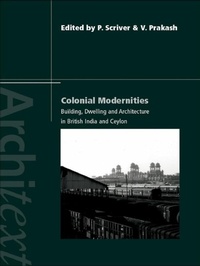
Colonial Modernities
Building, Dwelling and Architecture in British India and Ceylon
Published on 12. March 2007
304 pages
978-1-134-15025-0 (ISBN)
Description

A carefully crafted selection of essays from international experts, this book explores the effect of colonial architecture and space on the societies involved - both the colonizer and the colonized.
Focusing on British India and Ceylon, the essays explore the discursive tensions between the various different scales and dimensions of such 'empire-building' practices and constructions. Providing a thorough exploration of these tensions, Colonial Modernities challenges the traditional literature on the architecture and infrastructure of the former European empires, not least that of the British Indian 'Raj'.
Illustrated with seventy-five halftone images, it is a fascinating and thoroughly grounded exposition of the societal impact of colonial architecture and engineering.
Focusing on British India and Ceylon, the essays explore the discursive tensions between the various different scales and dimensions of such 'empire-building' practices and constructions. Providing a thorough exploration of these tensions, Colonial Modernities challenges the traditional literature on the architecture and infrastructure of the former European empires, not least that of the British Indian 'Raj'.
Illustrated with seventy-five halftone images, it is a fascinating and thoroughly grounded exposition of the societal impact of colonial architecture and engineering.
Reviews / Votes
'From vernacular to monumental architecture, numerous examples of legacies of colonial practices are found throughout South Asia and this book takes the first steps toward introducing their ideological underpinnings, theorizing and narrating them into a particular intellectual space.' - Cities 'From vernacular to monumental architecture, numerous examples of legacies of colonial practices are found throughout South Asia and this book takes the first steps toward introducing their ideological underpinnings, theorizing and narrating them into a particular intellectual space.' - Cities"This book is an enjoyable read, and a solid scholarly contribution by some familiar names, to the modest field of postcolonial architectural studies. The essays highlight many of the complex issues involved in the field, and in an area where records are not always easily accessible, there is much detailed critique." - Martin Beattie, Landscape Research, Vol. 34, No. 4
More details
Series
Language
English
Place of publication
London
United Kingdom
Publishing group
Taylor & Francis Ltd
Target group
College/higher education
Product notice
Reflowable
Illustrations
1 s/w Tabelle, 79 s/w Photographien bzw. Rasterbilder, 25 s/w Zeichnungen
1 Tables, black and white; 25 Line drawings, black and white; 79 Halftones, black and white
File size
7,90 MB
ISBN-13
978-1-134-15025-0 (9781134150250)
Copyright in bibliographic data and cover images is held by Nielsen Book Services Limited or by the publishers or by their respective licensors: all rights reserved.
Schweitzer Classification
Other editions
Additional editions
Peter Scriver | Vikramaditya Prakash
Colonial Modernities
Building, Dwelling and Architecture in British India and Ceylon
Book
03/2007
1st Edition
Routledge
€99.35
Shipment within 15-20 days
Peter Scriver | Vikramaditya Prakash
Colonial Modernities
Building, Dwelling and Architecture in British India and Ceylon
Book
03/2007
1st Edition
Routledge
€267.85
Shipment within 15-20 days
Persons
Peter Scriver is a researcher in the Centre for Asian and Middle-Eastern Architecture (CAMEA) and Senior Lecturer in Architecture, History and Theory at the University of Adelaide, Australia. He is the author, with Vikram Bhatt, of After the Masters: Contemporary Indian Architecture, and a forthcoming monograph, The Scaffolding of Empire, on the architecture and planning history of the Public Works Department of British India.
Vikramaditya ("Vikram") Prakash is currently Chair of the Department of Architecture, University of Washington, having been previously Associate Dean of the College of Architecture and Urban Planning. He is author of Chandigarh's Le Corbusier: The Struggle for Modernity in Postcolonial India and (with Francis Ching and Mark Jarzombek) A Global History of Architecture.
Vikramaditya ("Vikram") Prakash is currently Chair of the Department of Architecture, University of Washington, having been previously Associate Dean of the College of Architecture and Urban Planning. He is author of Chandigarh's Le Corbusier: The Struggle for Modernity in Postcolonial India and (with Francis Ching and Mark Jarzombek) A Global History of Architecture.
Content
Part 1: Frames of Discourse 1. Between Materiality and Representation: Framing an Architectural Critique of Colonial South Asia 2. Stones and Texts: The Architectural Historiography of Colonial India and its Colonial-Modern Contexts 3. The Stone Books of Orientalism Part 2: Institutional Frameworks 4. Empire-Building and Thinking in the Public Works Department of British India 5. 'Strangers within the Gate': Artisanry as Supplement of Labour in the Crafting of Colonial India 6. Between Copying and Creation: The Jeypore Portfolio of Architectural Details 7. Institutional Audiences and Architectural Style: The Napier Museum Part 3: Domestic Frames of Practice 8. A Tomb of One's Own: The Governor's House, Lahore 9. The Other Face of Primitive Accumulation: The Garden House in British Colonial Bengal 10. The Trouser Under the Cloth: Personal Space in De-Colonization, Ceylon 1815-1948 11. Negotiated Modernities: Symbolic Terrains of Housing in Delhi
