

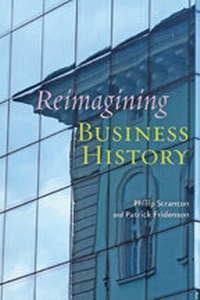
Reimagining Business History
Published on 10. June 2013
254 pages
978-1-4214-0863-7 (ISBN)
Description

A vigorous call for rethinking the field of business history.
Business history needs a shake-up, Philip Scranton and Patrick Fridenson argue, as many businesses go global and cultural contexts become critical. Reimagining Business History prods practitioners to take new approaches to entrepreneurial intentions, company scale, corporate strategies, local infrastructure, employee well-being, use of resources, and long-term environmental consequences.
During the past half century, the history of American business became an unusually active and rewarding field of scholarship, partly because of the primacy of postwar American capital, at home and abroad, and the rise of a consumer culture but also because of the theoretical originality of Alfred D. Chandler. In a field long given over to banal company histories and biographies of tycoons, Chandler took the subject seriously enough to ask about the large patterns and causes of corporate success. Chandler and his students found the richest material for theorizing about the course of business history in large companies and their institutional structures and cultures. Meantime, Scranton and others found smaller firms, those specializing in batch work as opposed to mass-produced goods, far closer to the norm and more telling.
Scranton and Fridenson believe that the time has come for a sweeping rethinking of the field, its materials, and the kinds of questions its practitioners should be asking. How can this field develop in an age of global markets, growing information technology, and diminishing resources? A transnational collaboration between two senior scholars, Reimagining Business History offers direction in forty-four short, pithy essays.
Business history needs a shake-up, Philip Scranton and Patrick Fridenson argue, as many businesses go global and cultural contexts become critical. Reimagining Business History prods practitioners to take new approaches to entrepreneurial intentions, company scale, corporate strategies, local infrastructure, employee well-being, use of resources, and long-term environmental consequences.
During the past half century, the history of American business became an unusually active and rewarding field of scholarship, partly because of the primacy of postwar American capital, at home and abroad, and the rise of a consumer culture but also because of the theoretical originality of Alfred D. Chandler. In a field long given over to banal company histories and biographies of tycoons, Chandler took the subject seriously enough to ask about the large patterns and causes of corporate success. Chandler and his students found the richest material for theorizing about the course of business history in large companies and their institutional structures and cultures. Meantime, Scranton and others found smaller firms, those specializing in batch work as opposed to mass-produced goods, far closer to the norm and more telling.
Scranton and Fridenson believe that the time has come for a sweeping rethinking of the field, its materials, and the kinds of questions its practitioners should be asking. How can this field develop in an age of global markets, growing information technology, and diminishing resources? A transnational collaboration between two senior scholars, Reimagining Business History offers direction in forty-four short, pithy essays.
More details
Language
English
Place of publication
Baltimore
United States
Target group
College/higher education
Illustrations
1 s/w Zeichnung
1 Line drawings, black and white
File size
2,47 MB
ISBN-13
978-1-4214-0863-7 (9781421408637)
DOI
10.1353/book.49239
Copyright in bibliographic data and cover images is held by Nielsen Book Services Limited or by the publishers or by their respective licensors: all rights reserved.
Schweitzer Classification
Other editions
Additional editions
Philip Scranton | Patrick Fridenson
Reimagining Business History
Book
06/2013
Johns Hopkins University Press
€57.00
Article not available at the moment
Philip Scranton | Patrick Fridenson
Reimagining Business History
Book
06/2013
Johns Hopkins University Press
€30.50
Article not available at the moment
Persons
Philip Scranton is University Board of Governors Professor, History of Industry and Technology, at Rutgers University and editor-in-chief of the journal Enterprise and Society. Patrick Fridenson is emeritus professor of international business history at the Ecole des Hautes Etudes en Sciences Sociales in Paris and founding editor of Entreprises et Histoire. Both are former presidents of the Business History Conference.
Content
Preface
Introduction
Part I: Traps: Practices Business Historians Would Do Well to Avoid
1. Misplaced Concreteness
2. Not Recognizing That the State Is Always "In"
3. Periodization as a (Necessary) Constraint
4. Privileging the Firm
5. Retrospective Rationalization
6. Searching for a New Dominant Paradigm
7. Scientism
8. Taking Discourse at Face Value and Numbers for Granted
9. Taking the United States (or the West) as Normal and Normative
10. The Rush to the Recent
Part II: Opportunities: Thematic Domains
1. Artifacts
2. Creation and Creativity
3. Complexity
4. Improvisation
5. Microbusiness
6. The Military and War
7. Nonprofits and Quasi Enterprises
8. Public-Private Boundaries
9. Reflexivity
10. Ritual and Symbolic Practices
11. The Centrality of Failure
12. Varieties of Uncertainty
Part III: Prospects: Promising Themes in Developing Literatures
1. Deconstructing Property
2. Fraud and Fakery
3. From Empires to Emergent Nations
4. Gender
5. Professional Services
6. Projects
7. Reassessing Classic Themes
8. Standards
9. The Subaltern
10. Transnational Exchanges
11. Trust, Cooperation, and Networks
Part IV: Resources: Generative Concepts and Frameworks
1. Assumptions
2. Communities of Practice
3. Flows
4. Follow the Actors
5. Futures Past
6. Memory
7. Modernity
8. Risks
9. Spatiality
10. Time
Afterword
Author Index
Subject Index
Introduction
Part I: Traps: Practices Business Historians Would Do Well to Avoid
1. Misplaced Concreteness
2. Not Recognizing That the State Is Always "In"
3. Periodization as a (Necessary) Constraint
4. Privileging the Firm
5. Retrospective Rationalization
6. Searching for a New Dominant Paradigm
7. Scientism
8. Taking Discourse at Face Value and Numbers for Granted
9. Taking the United States (or the West) as Normal and Normative
10. The Rush to the Recent
Part II: Opportunities: Thematic Domains
1. Artifacts
2. Creation and Creativity
3. Complexity
4. Improvisation
5. Microbusiness
6. The Military and War
7. Nonprofits and Quasi Enterprises
8. Public-Private Boundaries
9. Reflexivity
10. Ritual and Symbolic Practices
11. The Centrality of Failure
12. Varieties of Uncertainty
Part III: Prospects: Promising Themes in Developing Literatures
1. Deconstructing Property
2. Fraud and Fakery
3. From Empires to Emergent Nations
4. Gender
5. Professional Services
6. Projects
7. Reassessing Classic Themes
8. Standards
9. The Subaltern
10. Transnational Exchanges
11. Trust, Cooperation, and Networks
Part IV: Resources: Generative Concepts and Frameworks
1. Assumptions
2. Communities of Practice
3. Flows
4. Follow the Actors
5. Futures Past
6. Memory
7. Modernity
8. Risks
9. Spatiality
10. Time
Afterword
Author Index
Subject Index
