

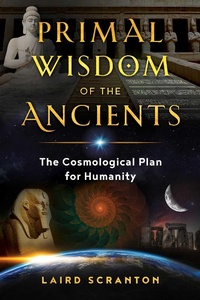
Primal Wisdom of the Ancients
The Cosmological Plan for Humanity
Published on 7. July 2020
208 pages
978-1-64411-029-4 (ISBN)
Description

Examines how the similarities of symbols and wisdom across many cultures point to an ancient civilizing plan and system of ancient instruction
• Reveals the shared cosmological knowledge of Dogon and Maori cultures, ancient Egypt, Gobekli Tepe, Vedic India, the pre-Indian Sakti civilization, Buddhism, the Tibetan Bon religion, and the kabbalistic tradition of the Hebrews
• Explores symbols and techniques used to frame and preserve instructed knowledge as it was transmitted orally from generation to generation
• Explains how this shared ancient knowledge relates to the precessional year and the cycles of time known as the yugas
Exploring the mystery of why so many ancient cultures, separated by time and distance, share remarkably similar cosmological philosophies and religious symbolism, Laird Scranton reveals how this shared creation tradition upholds the idea that ancient instruction gave birth to the great civilizations, each of which preserves fragments of the original knowledge.
Looking at the many manifestations of this shared cosmological knowledge, including in the Dogon and Maori cultures and in ancient Egypt, Gobekli Tepe, Vedic India, Buddhism, the Tibetan Bon religion, and the kabbalistic tradition of the Hebrews, Scranton explores the thought processes that went into formulating the archetype themes and metaphors of the ancient symbolic system. He examines how commonly shared principles of creational science are reflected in key terms of the ancient languages. He discusses how the primal cosmology also transmitted key components of sacred science, such as sacred geometry, knowledge of material creation, and the nature of a nonmaterial universe--evidence for which lies in the orientation of ancient temples, the drama of initiations and rituals, and countless traditional myths. He analyzes how this shared knowledge relates to the precessional year and the cycles of time known as the yugas. He also explores evidence of the concept of a nonmaterial twin universe to our own--the ?above? to our ?below? in the famous alchemical and hermetic maxim.
Through his extensive research into the interconnected wisdom of the ancients, Scranton shows that the forgotten instructional tradition at the source of this knowledge was deliberately encoded to survive for countless generations. By piecing it back together, we can discover the ancient plan for guiding humanity forward toward greater enlightenment.
• Reveals the shared cosmological knowledge of Dogon and Maori cultures, ancient Egypt, Gobekli Tepe, Vedic India, the pre-Indian Sakti civilization, Buddhism, the Tibetan Bon religion, and the kabbalistic tradition of the Hebrews
• Explores symbols and techniques used to frame and preserve instructed knowledge as it was transmitted orally from generation to generation
• Explains how this shared ancient knowledge relates to the precessional year and the cycles of time known as the yugas
Exploring the mystery of why so many ancient cultures, separated by time and distance, share remarkably similar cosmological philosophies and religious symbolism, Laird Scranton reveals how this shared creation tradition upholds the idea that ancient instruction gave birth to the great civilizations, each of which preserves fragments of the original knowledge.
Looking at the many manifestations of this shared cosmological knowledge, including in the Dogon and Maori cultures and in ancient Egypt, Gobekli Tepe, Vedic India, Buddhism, the Tibetan Bon religion, and the kabbalistic tradition of the Hebrews, Scranton explores the thought processes that went into formulating the archetype themes and metaphors of the ancient symbolic system. He examines how commonly shared principles of creational science are reflected in key terms of the ancient languages. He discusses how the primal cosmology also transmitted key components of sacred science, such as sacred geometry, knowledge of material creation, and the nature of a nonmaterial universe--evidence for which lies in the orientation of ancient temples, the drama of initiations and rituals, and countless traditional myths. He analyzes how this shared knowledge relates to the precessional year and the cycles of time known as the yugas. He also explores evidence of the concept of a nonmaterial twin universe to our own--the ?above? to our ?below? in the famous alchemical and hermetic maxim.
Through his extensive research into the interconnected wisdom of the ancients, Scranton shows that the forgotten instructional tradition at the source of this knowledge was deliberately encoded to survive for countless generations. By piecing it back together, we can discover the ancient plan for guiding humanity forward toward greater enlightenment.
More details
Other editions
Additional editions
Book
08/2020
Inner Traditions Bear and Company
€16.50
Shipment within 10-20 days
Person
Laird Scranton is the author of a series of books on ancient cosmology and language, including The Science of the Dogon and Point of Origin. He has presented at conferences throughout the United States and is a frequent guest on radio shows such as Coast to Coast AM, Fade to Black, and Midnight in the Desert. He lives in Albany, New York.
Content
An Introduction to Comparative Studies
1 Motives and Intentions of the Esoteric Tradition
2 What Makes Us Think There Was a Plan?
3 Dynamics and Principles of Symbolism
4 Metaphors of the Cosmology
5 The Aligned Shrine
6 Anthropomorphism
7 The Role of Myth
8 Symbolic Aspects of Angular Momentum
9 Symbolism of Time and Space
10 Mythology of Light
11 Lessons in Sacred Geometry
12 Nonmaterial to Material Translation
13 Self-Confirmation of Meaning
14 Dynamic of the Initiate and Informant
15 The Nature of Water
16 Unity and the Dimensionality of Numbers
17 Extended Symbolism of Language
18 Discriminating Knowledge
CONCLUSION
Final Thoughts on the Cosmological Plan
Notes
Bibliography
Index
1 Motives and Intentions of the Esoteric Tradition
2 What Makes Us Think There Was a Plan?
3 Dynamics and Principles of Symbolism
4 Metaphors of the Cosmology
5 The Aligned Shrine
6 Anthropomorphism
7 The Role of Myth
8 Symbolic Aspects of Angular Momentum
9 Symbolism of Time and Space
10 Mythology of Light
11 Lessons in Sacred Geometry
12 Nonmaterial to Material Translation
13 Self-Confirmation of Meaning
14 Dynamic of the Initiate and Informant
15 The Nature of Water
16 Unity and the Dimensionality of Numbers
17 Extended Symbolism of Language
18 Discriminating Knowledge
CONCLUSION
Final Thoughts on the Cosmological Plan
Notes
Bibliography
Index
